
Who Invented AI The 1956 Dartmouth Conference and the Pioneers Behind It

Introduction
You might have heard someone ask, "Who invented AI?" It sounds like a simple question with a simple answer. But the truth is more interesting than a single name. Artificial intelligence was not created by one person working alone in a lab. It came from the work of many bright minds over many years.
The most important moment for AI happened in 1956. That summer, a small group of scientists gathered at Dartmouth College in New Hampshire. They called it the Dartmouth Summer Research Project on Artificial Intelligence.

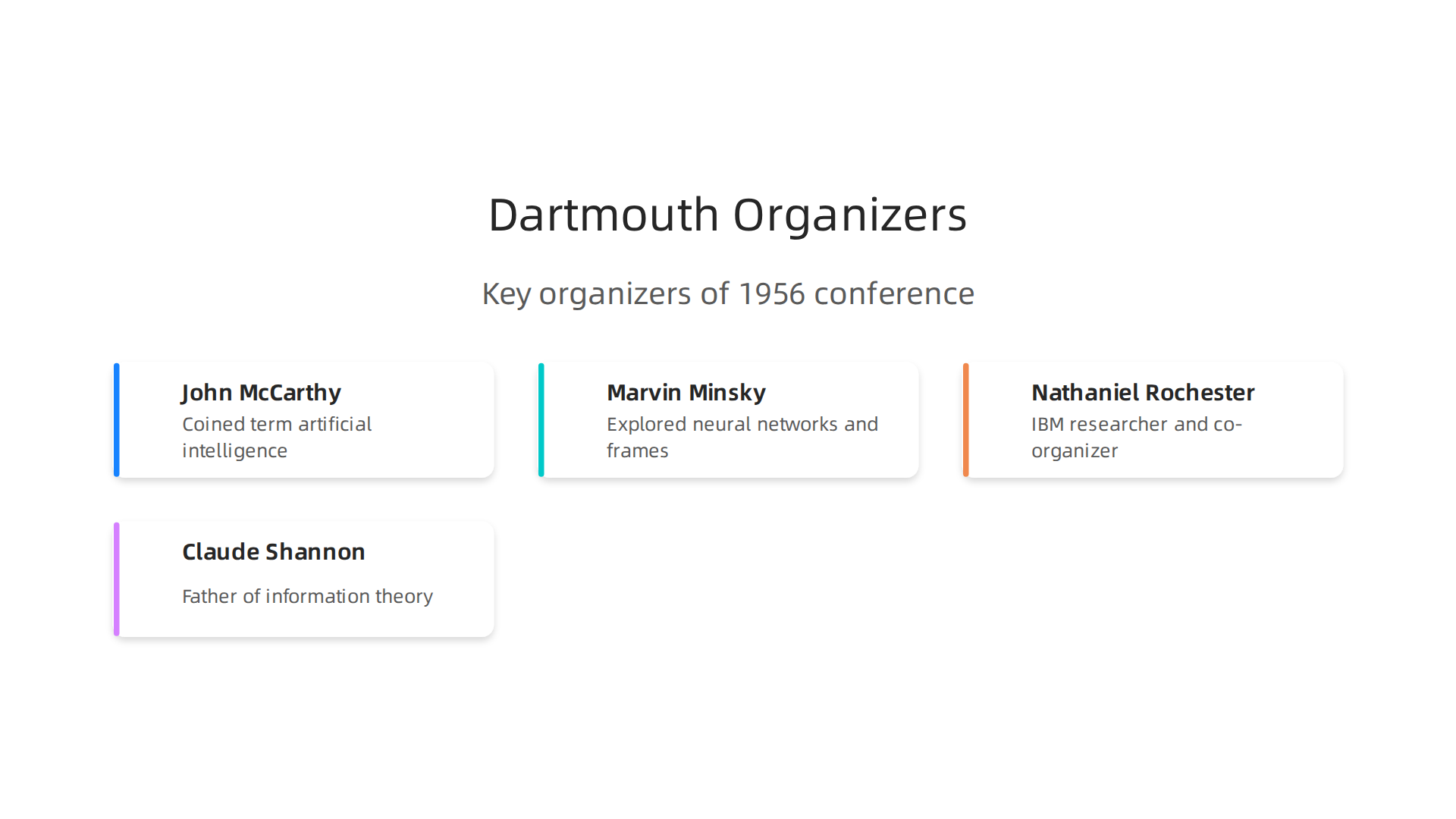
This event is widely seen as the official birth of AI as a field. The four main organizers were John McCarthy, Marvin Minsky, Nathaniel Rochester, and Claude Shannon.
They believed that machines could be made to think, learn, and solve problems just like humans.
At that summer workshop, the term "artificial intelligence" was used for the first time. The group also started important ideas like machine learning and symbolic methods. One attendee, Arthur Samuel, even created the first self-learning program for playing checkers. So when we ask who invented AI, the real answer is a team of pioneers. This event is often called "the Constitutional Convention of AI" because it set the rules for everything that came after.
Why does this history matter for enterprise leaders in 2026? Because knowing where AI comes from helps you judge where it is going. Many modern tools like DeepBrain AI and the Azure OpenAI Service build on ideas from that 1956 summer.

If you understand the foundation, you can make smarter choices about which AI tools to trust and adopt. For a deeper look at how businesses are using AI today, check out this enterprise AI adoption roadmap for 2026.

And if you want to keep up with the fast pace of AI news, consider subscribing to The AI Newsletter Worth Reading. It delivers clear daily updates straight to your inbox.

The Founding Moment: The 1956 Dartmouth Conference
So who really came up with the idea of artificial intelligence? The answer starts with one bold proposal. In 1955, a young math professor named John McCarthy was frustrated. He saw that researchers were publishing dull papers about machines. Nobody was dreaming big about what computers could really do. So he decided to change that.
McCarthy wrote a proposal for an eight week summer workshop. He invited three other brilliant minds to help organize it: Marvin Minsky, Nathaniel Rochester, and Claude Shannon. Together, they asked the Rockefeller Foundation for money to bring ten people to Dartmouth College. The goal was simple but huge. As McCarthy wrote, they wanted to find out "how to make machines use language, form abstractions and concepts, solve kinds of problems now reserved for humans."
That proposal is now famous in computer science circles. It officially introduced the term "artificial intelligence" for the first time. The workshop ran from June to August 1956. About 47 people were invited, though not all stayed the full eight weeks. What happened there changed everything.
The attendees did not agree on one single path forward. Some liked symbolic logic. Others preferred neural networks. But they all shared one belief: thinking was not something only humans could do. Machines could learn, reason, and improve themselves. This shared belief gave birth to the entire field of AI.
One of the most important outcomes was the work of Allen Newell and Herbert Simon. They created the Logic Theorist, often called the first AI program. Another attendee, Arthur Samuel, built a checkers program that taught itself how to play better over time. He even coined the term "machine learning."
The Dartmouth Conference is often called the "Constitutional Convention of AI." It did not solve every problem. But it set the rules and the vision for everything that came after. Without that summer in New Hampshire, we would not have modern tools like DeepBrain AI or the Azure OpenAI Service. Those technologies still rely on the same core idea: machines can learn from data and make decisions.
If you want to see how these early ideas connect to today’s enterprise strategies, check out this enterprise AI adoption roadmap for 2026. It builds directly on the foundation laid back in 1956.
To get a fuller picture of the conference’s legacy, you can read about the Dartmouth Summer Research Project. It is widely considered the single most important event in the history of AI.
The next time someone asks you who invented AI, you can tell them it was not one person. It was a group of bright minds who gathered one summer and dared to imagine machines that could think.
Key Pioneers: The Minds Behind AI’s Birth
The Dartmouth Conference brought many brilliant people together. But the real foundation for AI was laid years earlier by a quiet mathematician in England. If you want to know who invented AI, you have to start with Alan Turing.

Turing did not attend the 1956 workshop. He died two years before it happened. Yet his ideas shaped everything the Dartmouth attendees discussed. In 1936, Turing invented the concept of a universal computing machine. This simple idea proved that a machine could perform any calculation if given the right instructions. It became the theoretical basis for all modern computers.
But Turing went further. In 1950, he published a paper called "Computing Machinery and Intelligence". In it, he asked a radical question: can machines think? He proposed a test, now called the Turing Test, to measure whether a computer could fool a human into thinking it was another person. That question sparked the entire field of AI research.
Turing also predicted that machine learning would be essential for building powerful machines. He said we should give a computer "the blank mind of an infant" and let it learn from experience. Today, every AI system from DeepBrain AI to the Azure OpenAI Service uses exactly that idea.
You can read more about Turing’s pioneering work in this overview of Alan Turing’s lasting contributions to computing and AI. His ideas still influence how we build and evaluate intelligent systems.
Turing was not the only pioneer. John McCarthy gave AI its name. Marvin Minsky pushed neural networks. Herbert Simon and Allen Newell built the first AI programs.
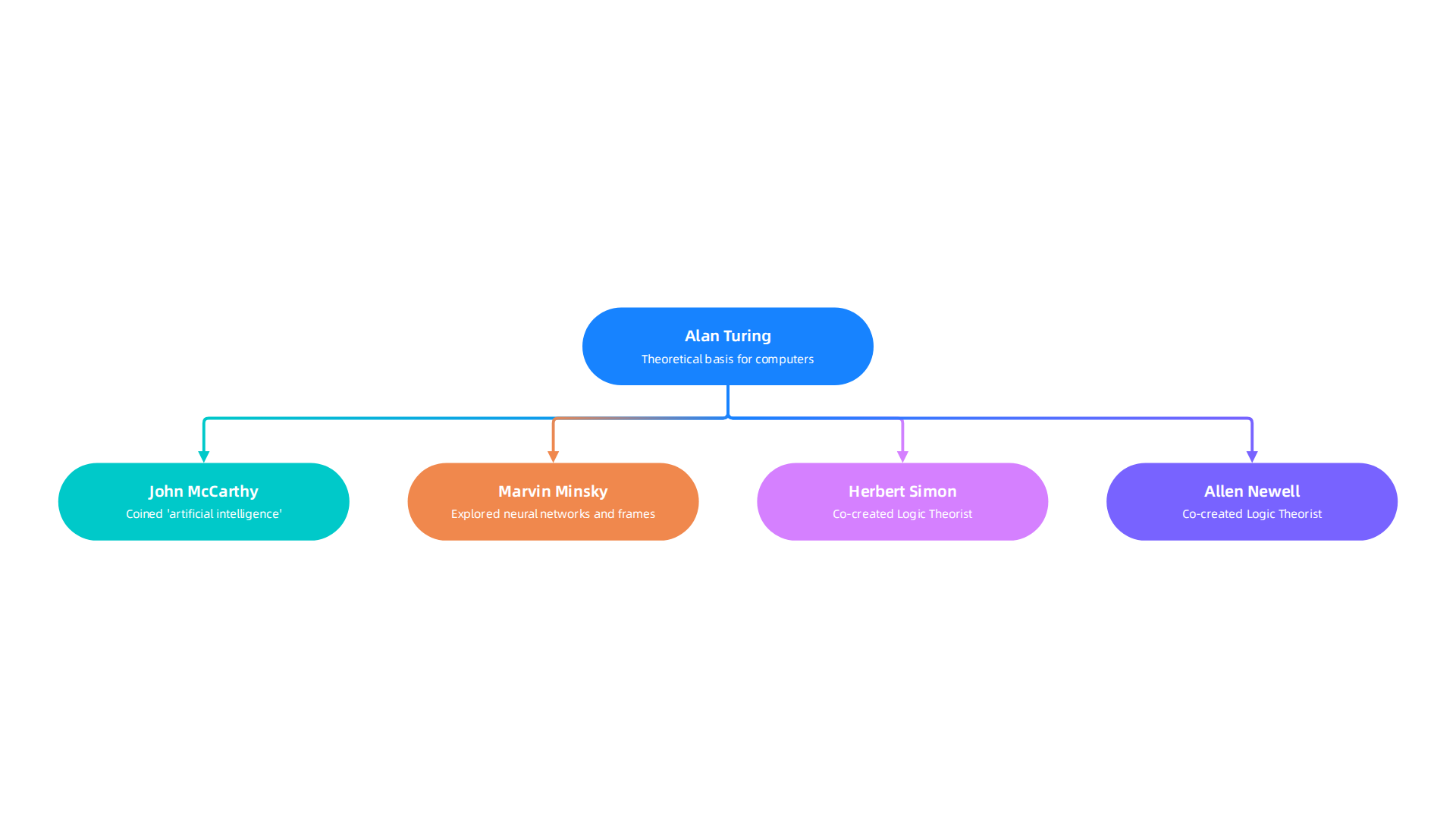
But Turing was the one who first asked the question that started it all.
To stay current on how today’s AI pioneers are building on Turing’s legacy, subscribe to The Deep View Newsletter. It delivers clear daily updates on the latest breakthroughs.
Alan Turing: The Theoretical Foundation
Turing’s work went far beyond the imitation game. In 1936, he introduced the universal Turing machine, a theoretical device that could perform any computation. This single idea proved that a machine could execute any algorithm, as long as it had clear instructions. Without this breakthrough, there would be no modern computers, no DeepBrain AI, and no Azure OpenAI Service. Turing gave the world the blueprint for all programmable machines.
But he did not stop there. In 1948, Turing wrote a report called "Intelligent Machinery" where he argued that a thinking machine should start with a "blank mind" and learn from experience, much like a child. He predicted that machine learning would be key to building powerful AI systems. That insight still drives how we train AI today. As Alan Turing’s everlasting contributions show, his ideas about learning and adaptation were decades ahead of their time.
Turing also recognized that AI development would require patience. He guessed it would take about fifty years of programming effort to bring a learning machine from childhood to adult mental maturity. That prediction, made in 1948, lines up surprisingly well with where we are in 2026. Today’s large language models and AI platforms are the direct result of the foundation Turing laid.
For enterprise leaders looking to apply these principles, understanding Turing’s theoretical framework helps evaluate modern AI tools. To see how today’s companies put his ideas to work, check out this data-backed enterprise AI strategy roadmap for 2026. It connects Turing’s vision directly to current business technology decisions.
John McCarthy: Father of AI and the Lisp Programming Language
If Alan Turing gave AI its theoretical backbone, John McCarthy gave it a name and a practical toolkit. In 1956, McCarthy, then a professor at Dartmouth College, organized a summer workshop that brought together researchers who were curious about thinking machines. He needed a name for what they were studying, so he chose "artificial intelligence." That single decision gave the entire field its identity. The Dartmouth conference is widely seen as the official birth of AI as a research discipline, as detailed in this look back at the birth of AI research.
McCarthy did not stop at naming the field. He invented Lisp, a programming language that became the workhorse of AI research for decades. Lisp was different from other languages at the time. It handled symbolic data naturally, which made it perfect for writing programs that could reason, plan, and learn. Most early AI systems, including expert systems and natural language programs, were written in Lisp. McCarthy also developed time-sharing systems that let multiple people use a single computer at once. That idea seems obvious today, but it was revolutionary in the 1960s.
McCarthy’s work on logic and reasoning also pushed AI forward. He believed that representing knowledge as logical statements was the key to building intelligent machines. That line of thinking influenced everything from early theorem provers to modern knowledge graphs. In computer science circles, McCarthy is remembered as a giant who turned a vague idea into a real, working field.
For enterprise leaders, understanding McCarthy’s contributions helps explain why modern AI platforms like DeepBrain AI and Azure OpenAI Service work the way they do. They all build on the foundation of symbolic reasoning and powerful programming tools that McCarthy started. If you are looking at bringing AI into your organization, it helps to know how we got here. You can read more about evaluating AI companies for enterprise use to make smarter decisions.
The field of AI moves fast, and keeping up with breakthroughs is a full-time job. That is where getting clear daily AI updates from The Deep View Newsletter can help. It cuts through the noise so you focus on what really matters for your business.
Marvin Minsky: Neural Networks, Frames, and Symbolic AI
While McCarthy gave AI its name and its first programming language, his MIT colleague Marvin Minsky took the field in bold new directions. In 1959, Minsky co-founded the MIT Artificial Intelligence Laboratory, which became one of the most influential research hubs in the world. If you’re asking who invented ai, the answer is never a single person. But Minsky’s fingerprints are all over the shape AI took in the 1960s and 1970s.
Minsky was one of the first researchers to seriously explore neural networks. He understood that machines could learn by mimicking the way biological brains work. Interestingly, Alan Turing had already written about the idea of machines learning from experience in a 1948 report that contained an early discussion of neural networks. Minsky built on that foundation.
But Minsky also pointed out the limits of early neural networks. In 1969, he co-wrote the book Perceptrons with Seymour Papert. The book showed that single-layer neural networks could not solve certain problems, like the XOR problem. This criticism temporarily slowed funding and interest in neural network research for nearly a decade. Some historians say this set the field back, but it also pushed researchers to develop more powerful multi‑layer networks that we use today.
Beyond neural networks, Minsky created a concept called "frames." Frames are mental structures that help machines organize knowledge about the world. For example, a "restaurant frame" might include slots for tables, menus, waiters, and food. This idea became the foundation for early expert systems and modern knowledge graphs that power enterprise AI tools like DeepBrain AI and Azure OpenAI Service.
Minsky’s work reminds us that progress in AI is not always a straight line. Sometimes a perceived setback forces the field to grow stronger. For enterprise leaders, his story is a good lesson in evaluating new technologies with clear eyes. If you are building an AI strategy, consider reading the enterprise AI adoption roadmap for 2026 to learn from both the successes and the setbacks of the past.
AI history is full of twists, and staying informed on today’s breakthroughs is just as important as understanding where we came from. Get clear daily AI updates from The Deep View Newsletter so you never miss the key developments that matter for your business.
The Evolution: From Expert Systems to Deep Learning
The history of AI is not a straight success story. It has highs and lows. Researchers call these "AI summers" and "AI winters."
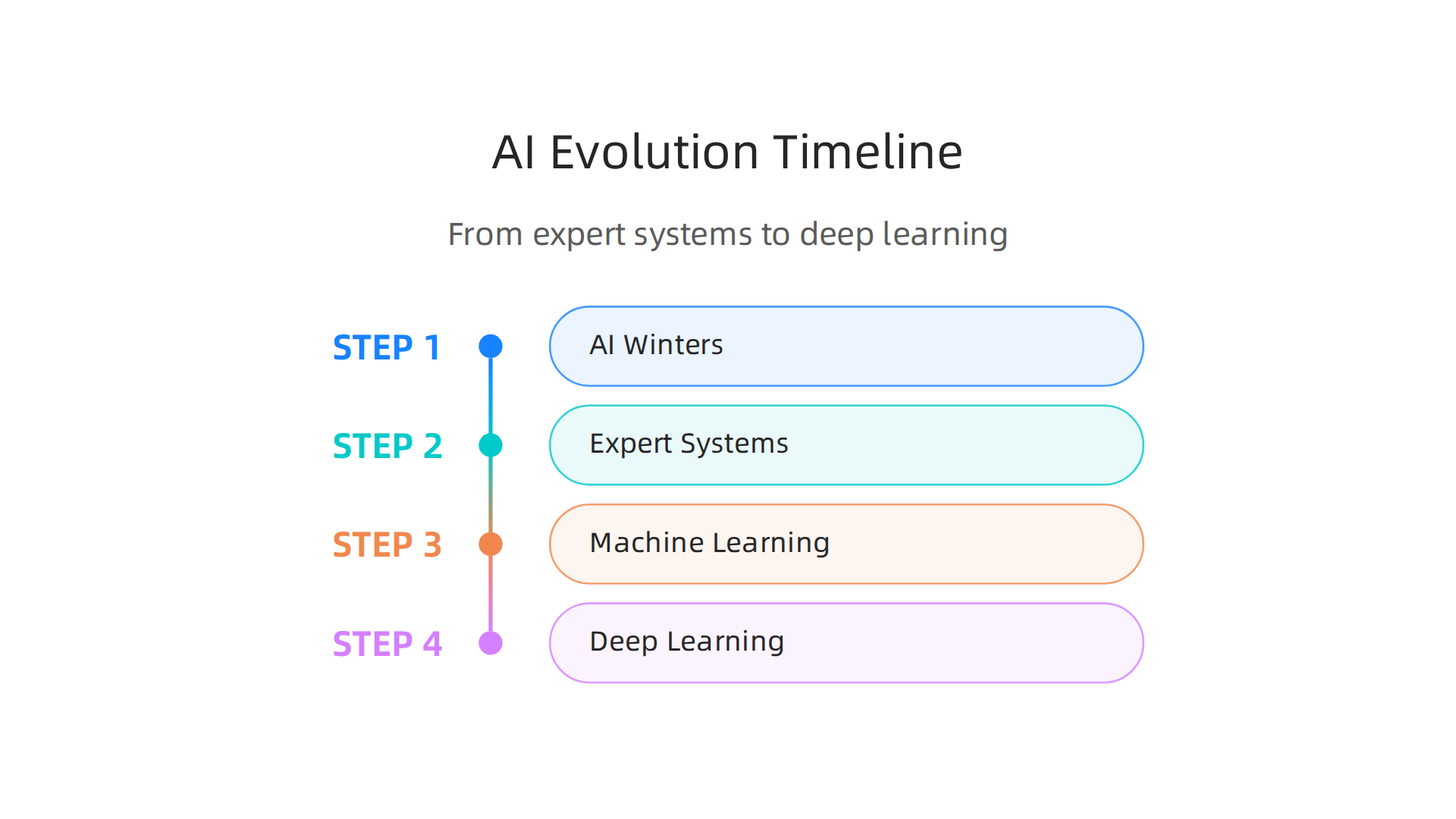
After the early excitement of the 1950s and 1960s, the first major slowdown hit in the mid-1970s.
In 1973, British mathematician James Lighthill wrote a report that slammed AI research. He said the field had over-promised and under-delivered. This led to a steep drop in government funding. According to the AI history timeline from IBM, this report helped start the first AI winter. Many research projects were shut down. Money dried up.
But AI did not die. In the 1980s, a new approach called "expert systems" became popular. These were rule-based programs that could mimic human experts in narrow areas. For example, a system called MYCIN helped doctors diagnose bacterial infections. Companies saw dollar signs and poured money into AI again. This was a short AI summer.
Yet expert systems had big limits. They could not learn on their own. Every rule had to be written by a human programmer. By the late 1980s, interest faded again. This led to a second AI winter. Many computer science circles became skeptical. The term "AI" even became a bad word in some places.
The real shift began in the 1990s. Researchers started focusing on machine learning. Instead of programming every rule, they let algorithms learn from data. The backpropagation algorithm was refined. New techniques like support vector machines emerged. In 1997, IBM’s Deep Blue beat world chess champion Garry Kasparov. This was a huge moment. It showed that data-driven AI could outperform humans at specific tasks.
Then came the 2010s. Deep learning broke through. In 2012, a neural network called AlexNet won a major image recognition contest by a huge margin. This changed everything. Companies like Google, Facebook, and Microsoft invested heavily. The shift from rule-based systems to data-driven approaches transformed what AI could do. Today, we see the results in tools like ChatGPT, self-driving cars, and enterprise platforms such as DeepBrain AI and Azure OpenAI Service.
For enterprise leaders, this history holds a key lesson. The technology that works best is the one that adapts and learns from data. This is why many enterprises are now following a data-backed enterprise AI adoption roadmap for 2026 to guide their investments.
The AI landscape changes fast. To stay ahead, you need reliable daily information. That is why many business leaders rely on The Deep View Newsletter for clear, actionable AI updates every day.
Modern Applications and the Enterprise Impact
Today, the AI landscape looks very different from those early winters. You interact with AI dozens of times a day without even noticing. Your email provider filters spam. Your bank flags unusual transactions. Your phone keyboard predicts what you want to type next. These small conveniences are powered by the same technology that started with simple rule-based systems.
But the scale of modern AI is staggering. According to detailed enterprise AI adoption statistics for 2026, 88% of organizations now use AI in at least one business function. Think about that. Nearly nine out of ten companies are actively running AI workloads. This includes everything from chatbots that handle customer support to predictive analytics that forecast demand.
Generative AI is leading the charge. Tools that create text, images, code, and even music have gone mainstream.
In 2026, nearly two-thirds of companies say they use generative AI regularly. The most popular uses include marketing content, knowledge management, and personalization. These tools save time and let teams focus on higher-value work.
Beyond generative AI, autonomous systems are becoming common. Self-driving cars still have limits, but warehouses already use autonomous robots to move inventory. In healthcare, AI helps radiologists spot tumors faster than the human eye alone. In finance, algorithms trade millions of shares per second. The list goes on.
Understanding this boom helps you appreciate what came before. Knowing who invented AI gives you a clearer view of where the technology is headed. The early pioneers like Alan Turing and John McCarthy laid the groundwork. But today’s breakthroughs come from massive datasets, powerful computers, and deep learning techniques that barely existed twenty years ago.
For enterprise leaders, the lesson is practical. The companies that succeed with AI are the ones that treat it as a long-term investment, not a quick fix.

They focus on data quality, team training, and realistic expectations. Many of them are still figuring out how to scale AI beyond small pilot projects.
If you are evaluating where to invest your AI budget next, it helps to see what other leaders are doing. Our guide on how CIOs and CTOs should evaluate AI companies in 2026 walks through the key factors to consider. That way you can avoid the hype and focus on tools that actually deliver results.
The history of AI shows us one thing clearly: the technology keeps evolving. What seemed impossible ten years ago is routine today. And the pace is only speeding up.
Summary
This article answers the simple‑sounding question