
The Data Backed Enterprise AI Strategy Roadmap for 2026

Introduction: The Urgency of a Coherent AI Strategy
Picture this: your team has tested five different AI tools this year. Everyone loves the speed and the cool results. Yet when it comes to getting real business value from these experiments, you are stuck. You are not alone.
Recent data from the Writer 2026 Enterprise AI Adoption survey reveals that 79% of organizations face challenges in adopting AI. That number jumped sharply from 2025. Even worse, 54% of C-suite executives admit that adopting AI is tearing their company apart. This happens despite 59% of companies investing over $1 million annually in AI technology.
The problem goes deeper. Three-quarters of executives admit their company’s AI strategy is "more for show" than actual internal guidance. They have fancy mission statements but no real plan for putting AI to work. Meanwhile, 67% believe their company has already suffered a data breach because employees used unapproved AI tools. The risks are real.
What is going wrong? The answer is simple: most enterprises jump into AI without a coherent strategy. They chase shiny demos and run pilot projects that never scale. They forget to connect AI to actual business outcomes.
The gap between AI pilots and scaled value creation is the biggest challenge leaders face today.

Only 29% of organizations report significant ROI from generative AI. That means 71% are spending money and effort without seeing real returns. Over 75% of organizations now use AI in at least one business function, yet most lack a structured approach to implementation.
This guide is built to change that. We provide an evidence-based framework for deploying AI in alignment with business outcomes. You will learn practical steps to move from scattered experiments to a coherent strategy that drives real results.
If you want to get started on the right foot, review this data-backed roadmap for enterprise AI adoption. It covers the key steps leaders like you are using to succeed.
Finally, staying informed is part of the strategy. Subscribe to The AI Newsletter Worth Reading for clear, daily AI updates that help you cut through the noise and focus on what matters.

Setting the Stage: The State of Enterprise AI in 2026
So where do things really stand right now? 2026 is the year AI stopped being a cool experiment and started becoming a core part of how companies operate.
Almost every organization you compete with is using AI in some shape or form. According to the 2026 Deloitte report on the state of AI in the enterprise, worker access to AI jumped by 50% in 2025. And companies expect that number to keep climbing fast. The number of organizations with at least 40% of their AI projects in production is set to double in just six months. That is a massive shift from the pilot-heavy days of 2024.
But here is the reality check. Adoption is not the same as value. Deloitte found that only one in five companies has a mature model for governing autonomous AI agents. And the AI skills gap remains the biggest barrier to integration. Companies are spending millions on tools but still struggling to find people who know how to use them safely and strategically.
The most successful organizations share a few common traits.
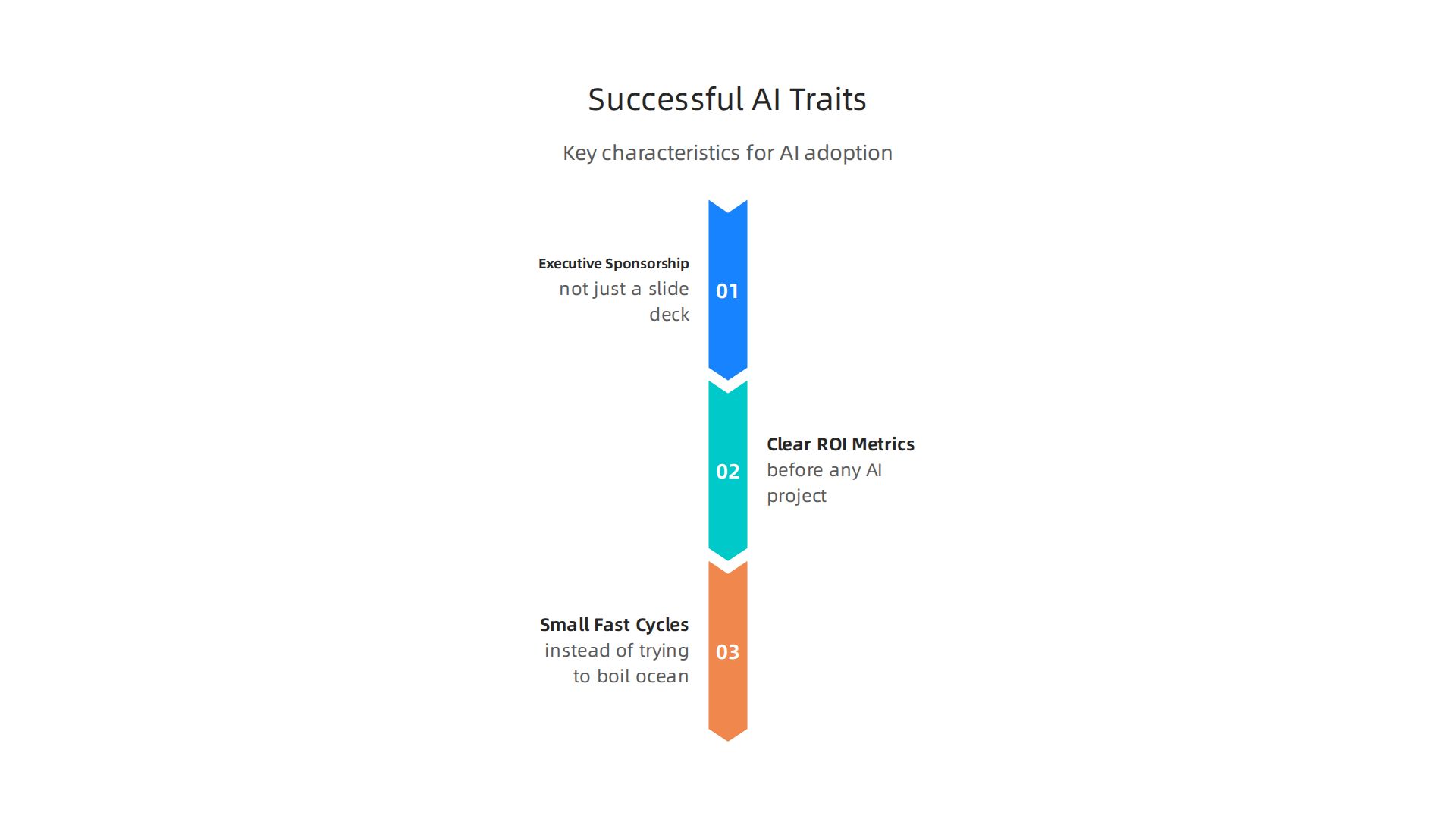
They have real executive sponsorship, not just a slide deck. They define clear ROI metrics before they start any AI project. And they deploy AI in small, fast cycles instead of trying to boil the ocean.
If you want a practical breakdown of what these winning companies do differently, check out this data-backed roadmap for enterprise AI adoption. It walks through the exact steps leaders use to move from scattered pilots to real business results.
The bottom line: 2026 is the year of operational AI. The companies that figure out how to deploy it with discipline, talent, and governance will pull ahead. The rest will keep spending money and wondering why nothing changes.
How to Identify High-Impact AI Use Cases for Your Business
The difference between companies that get real results and those that keep spending without seeing ROI often comes down to one thing: picking the right use case. You can have the best AI tools on the market, but if you apply them to the wrong problem, you are just burning cash.
So how do you figure out where to start? The most successful teams follow a simple rule: focus on problems that are costly, repetitive, and data-rich. If you have lots of clean data and a clear pain point, AI can probably help. If the problem is vague or the data is messy, move on.
A common mistake is chasing the hottest technology instead of solving a real business need. That is why experts recommend starting with business problems when selecting AI use cases. C3 AI uses a structured process that begins with a full value-chain exploration of high-potential problems. They ask business leaders to fill out a template of their top challenges before any technology discussions happen. This keeps the focus on impact, not hype.
Once you have a list of candidate use cases, you need a way to rank them. A prioritization matrix is the simplest tool for this.

You plot each use case on two axes: expected business impact (revenue, cost savings, strategic value) and implementation effort (time, cost, complexity). This gives you four quadrants:
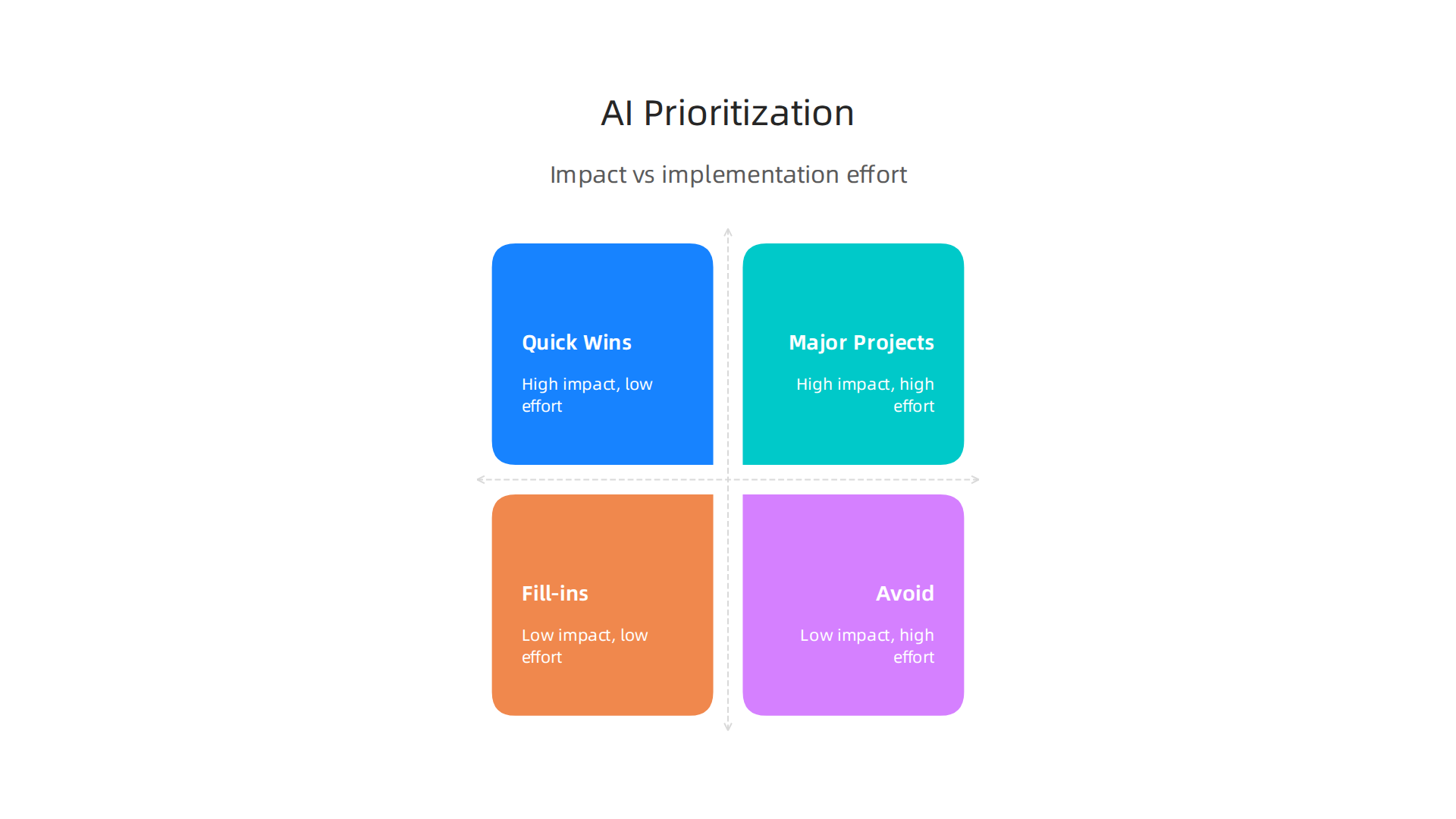
- Quick wins: High impact, low effort. Start here.
- Major projects: High impact, high effort. Plan carefully.
- Fill-ins: Low impact, low effort. Nice to have.
- Avoid: Low impact, high effort. Skip these.
Leading enterprises take this a step further with a portfolio approach. They mix a few quick wins to build momentum with a couple of bigger strategic bets that take longer but offer transformational value. This balanced strategy prevents you from putting all your chips on one risky project.
If you want a deeper look at how top teams evaluate and rank AI opportunities, check out this research-backed roadmap for enterprise AI apps. It covers the full selection and integration process.
The goal is to have a defensible, repeatable process for deciding where to invest. Without one, you will keep chasing shiny objects and wondering why nothing sticks. And as the AI landscape shifts fast, you need to stay informed. Get clear daily AI updates from The Deep View Newsletter to keep your strategy on track.
Building a Governance Framework for Responsible AI
You have picked your AI use cases. You are ready to deploy. But here is the hard truth: deploying AI without a governance framework is like driving a car with no brakes. It might move fast, but the crash is coming.
Governance is what makes AI trustworthy. It defines how decisions are made, who gets to make them, and how those decisions get checked. Without it, you risk regulatory fines, damaged reputation, and angry employees who do not trust the system.
Regulations are catching up fast. The EU AI Act is the most complete example so far. It sets strict rules for high-risk AI systems. These rules cover risk management, data quality, human oversight, and record keeping. For example, businesses must establish a risk management system that runs across the whole life of the AI system. They also need to keep logs and allow human review at key points. You can see the full list of requirements in this summary of the EU AI Act requirements.
Even if you are not in Europe, these rules are becoming a global standard. Other countries are watching and writing similar laws. Building a framework now saves you from scrambling later.
So what does a good governance framework look like in practice? Here are the building blocks:
-
An AI ethics board or oversight committee. This group includes leaders from legal, risk, data science, and the business side. They meet regularly to review new use cases, approve high-risk models, and handle complaints.
-
Model risk management. Every AI system should go through a review before and after launch. This includes testing for bias, checking accuracy, and monitoring performance over time. High-risk systems need ongoing checks.
-
Clear documentation and audit trails. You need to know what data went into each model, how it was trained, and what decisions it made. This is not just for regulators. It helps you debug problems and improve.
-
Human oversight. No AI should make final decisions alone in critical areas like hiring, lending, or healthcare. A human must be able to override the system and ask why.
-
Compliance with emerging regulations. Keep track of laws like the EU AI Act and any local rules. Assign someone to watch for updates.
A good starting point is to form a cross-functional team and run a pilot governance process on one existing AI tool. Learn from that, then expand. For a deeper look at how to build your whole AI strategy including governance, check out this data-backed roadmap for enterprise AI adoption in 2026.
Without governance, your AI journey will hit walls. With it, you earn trust, avoid penalties, and build a system that lasts.
The landscape changes fast. Stay on top of new rules and best practices by getting clear daily AI updates from The Deep View Newsletter.
Managing AI Risk: Security, Compliance, and Ethics
Having a governance framework is your foundation. But even the best committee and documentation can’t stop every problem. AI brings unique risks that traditional software does not. You need to know what they are and how to fight them.
Three big risks stand out:
-
Adversarial attacks. Bad actors can trick your AI by feeding it carefully crafted inputs. For example, a self-driving car might misread a stop sign if someone places small stickers on it. In your business, an attacker could manipulate a fraud detection model to approve fake transactions.
-
Bias amplification. AI learns from data. If your training data has hidden biases, the model will make them worse. A hiring tool might reject qualified women not because of skill but because past hires were mostly men. Bias does not just hurt people. It can land you in legal trouble.
-
Data leakage. AI models sometimes memorize the data they train on. If that data includes customer names, addresses, or health records, those secrets can leak out through model outputs. This breaks privacy laws and destroys trust.
So how do you protect yourself? You need a mix of technical safeguards and strong policies.
On the technical side, run regular red-teaming exercises. That means having experts try to break your AI system on purpose. They look for weak spots so you can fix them before real attackers find them. Continuous auditing is also key. You should check model behavior, accuracy, and fairness at set intervals, not just at launch.
On the policy side, align your risk posture with regulations. The EU AI Act has a detailed system for classifying high-risk AI. You can read the full list in the classification rules for high-risk AI systems to see if your use case is affected. GDPR and CCPA also demand that you explain decisions and protect personal data. Ignoring these laws can cost you millions in fines.
A strong risk management program blends both sides. It includes technical audits, legal reviews, and clear incident response plans. As you build this program, you can learn from how leading enterprises handle security by reading this guide on evaluating AI companies in 2026.
Remember, risk changes over time. A model that works today might drift or get attacked tomorrow. Stay alert, keep testing, and never assume you are done.
Preparing Your Data Infrastructure for AI Success
You have your governance framework and risk management in place. But your AI models are only as good as the data you feed them. If your data is messy, scattered, or hard to reach, your AI will fail. That is where infrastructure matters.
Most enterprises are not ready. Their data sits in silos. Marketing has one system, sales has another, and IT has a third. No single source of truth exists. Before you can put AI to work, you need to build a solid foundation.
The Core Components You Need
First, think about a data lakehouse. This combines the best parts of a data lake (cheap storage for all kinds of data) and a data warehouse (fast queries for structured data). It gives your AI team one place to store and access everything.
Second, set up a feature store. Features are the inputs your AI model uses to make predictions. A feature store lets your team reuse, share, and manage these inputs across different projects. Without it, every team builds their own features from scratch. That wastes time and creates inconsistency.
Third, build automated data pipelines. Manually moving data from source to model does not scale. Automation handles ingestion, cleaning, and transformation so your team can focus on building better models. As one guide on AI ready data infrastructure explains, real-time and batch processing should both be supported to cover operational and analytical use cases.
The New Way: Data Mesh and Data Products
A growing trend in 2026 is the shift toward data mesh. Instead of one central team owning all data, each business unit owns its own data as a "product." They manage quality, access, and governance within their domain. This gives AI teams faster and more reliable data.
For enterprise leaders learning how to use AI effectively, understanding these infrastructure pieces is crucial. You can dive deeper into how to source and structure your data by reading about data collection methods for enterprise AI in 2026.
A Quick Checklist to Get Started
- Assess your current data landscape. What sources do you have? Where are the gaps?
- Choose a scalable storage architecture. A lakehouse is a strong starting point.
- Implement a feature store to avoid rework.
- Automate your data pipelines with tools that support both batch and real-time.
- Enable self-service access so analysts and data scientists can get what they need without waiting on IT.
The path to AI success begins with your data. If you want to stay up to date on the latest trends in data, AI, and enterprise technology, check out The AI Newsletter Worth Reading for clear daily updates straight to your inbox.
Now you have the data infrastructure ready. But who is going to build and run the AI models? That is where the real bottleneck hits. Finding people who actually know how to use AI and can deliver results is harder than ever.
In 2026, the demand for AI talent is far bigger than the supply. A survey from Infragistics found that 91% of organizations now prioritize hiring staff with AI skills. At the same time, 80% say talent shortages are already hurting their operations. AI engineers are the hardest roles to fill, and salaries are climbing fast. Mid-level machine learning roles in the U.S. now pay over $170,000, and total compensation keeps rising.
So how do you bridge this gap without breaking your budget? You need two strategies at once: smart hiring and serious upskilling.
Hire for Potential, Not Just Experience
You cannot wait for the perfect candidate with five years of AI experience. They barely exist. Instead, look for people with strong fundamentals in areas like Python, data analysis, and critical thinking. Then teach them the AI tools your company uses. As the 2026 AI jobs landscape shows, roles are shifting fast and new specialties appear every quarter.
You also need "AI translators." These are people who understand both the business side and the technical side. They do not need to be machine learning engineers. They just need to know enough to spot where AI can help and work with the experts to make it happen.
Invest in Upskilling Your Current Team
Upskilling your existing employees is the number one response to the talent shortage. It works because your people already know your business.

They just need to learn how to use AI in their daily work.
Here is what successful companies do:
- Build AI literacy programs for everyone. Not just engineers. Sales, marketing, HR, and operations teams all need basic AI skills.
- Create a path to become an AI specialist. Offer certificates, online courses, or tuition help for roles like machine learning engineer or data scientist.
- Give people real projects to practice on. Classroom learning alone does not stick. Let employees work on small AI projects with mentorship from experts.
One key fact: 90% of enterprises expect critical AI skill shortages, but only 35% have a mature upskilling program. That gap is your opportunity.
Build a Learning Culture
The best way to retain your AI talent is to keep investing in them. Offer ongoing training, access to conferences, and time to explore new tools. When people feel they are growing, they stay. And when they stay, your AI projects get better results.
You do not need to hire a hundred AI experts overnight. Start with a few strong hires, invest in your current team, and build internal knowledge step by step. That is how you win the talent game in 2026.
Scaling AI: From Pilot to Enterprise-Wide Deployment
You have the talent. You have the data infrastructure. But most companies still get stuck here. They run a few successful AI pilots, but they never spread those wins across the organization. In 2026, this is the number one reason AI investments disappoint.
Why does scaling fail? Three main reasons. First, organizational silos. Marketing runs its own AI project. Supply chain runs another. They do not share data, models, or lessons. Second, lack of MLOps. Teams build models by hand, deploy them once, and never monitor them. When something breaks, nobody knows until the business suffers. Third, misaligned incentives. Teams are rewarded for launching new pilots, not for maintaining and improving existing models at scale.
So what works instead? Companies that successfully take AI enterprise-wide focus on three enablers.
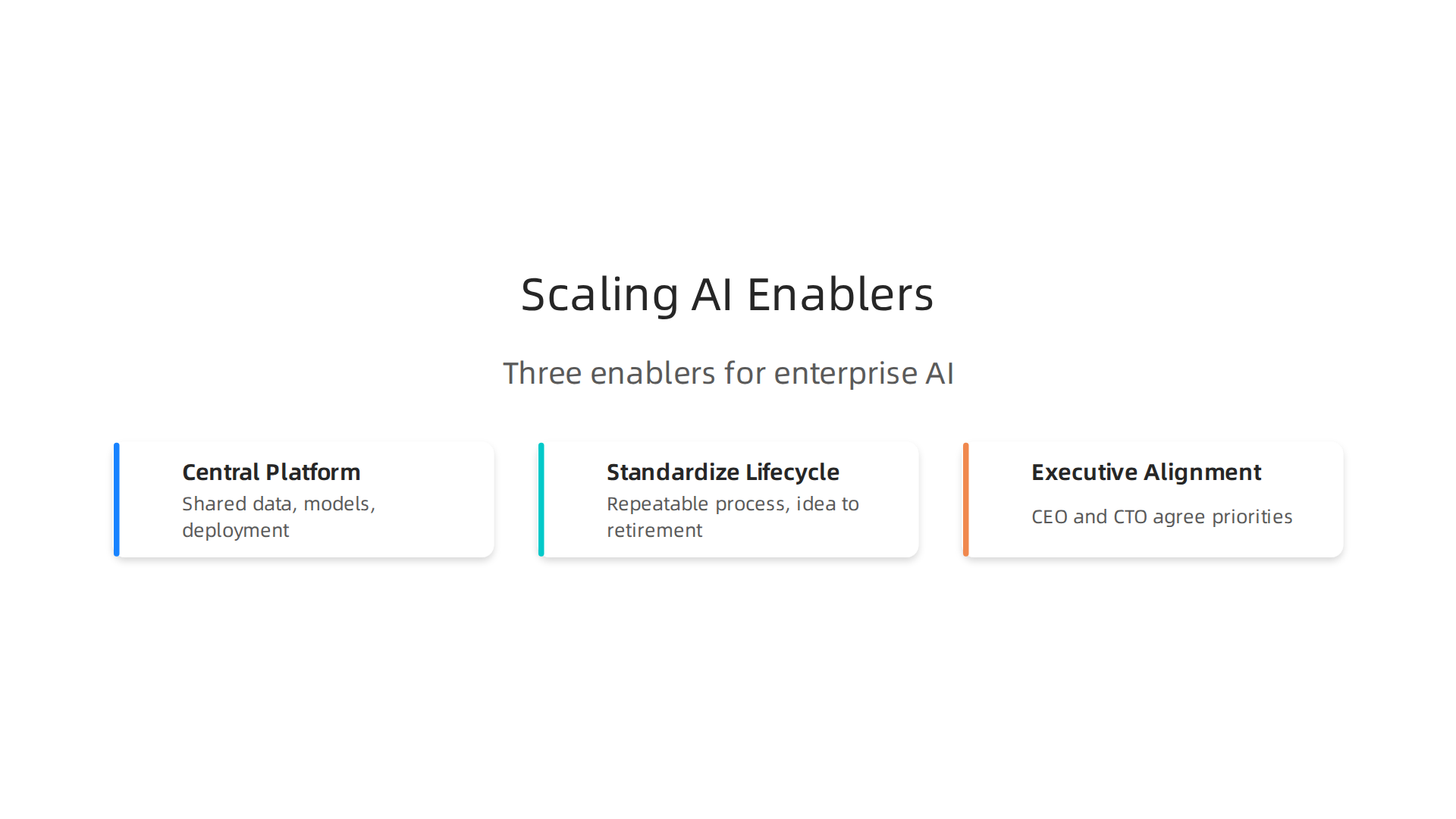
1. Build a central AI/ML platform. Instead of letting each team build its own infrastructure, create a shared platform for data, models, and deployment. This platform handles data pipelines, model training, and monitoring. It removes the busywork so data scientists can focus on solving business problems. As the 2026 best practices for scaling AI data infrastructure show, treating data as a strategic asset and using modular architectures makes scaling much easier.
2. Standardize model lifecycle management. You need a repeatable process for every model from idea to retirement. That includes version control, automated testing, continuous integration and delivery (CI/CD), and real-time monitoring. When a model’s accuracy drops, the system alerts you or rolls back automatically. This is MLOps. Without it, every new model is a risky handoff.
3. Get executive alignment. The CEO and CTO must agree on AI priorities. They need to fund the central platform, set enterprise-wide goals, and break down silos. Leaders who treat AI as a strategic priority rather than a side experiment see the fastest scaling.
And here is the biggest cultural shift: treat AI as a product, not a project. A project ends. A product keeps improving. That means cross-functional teams that include product managers, engineers, data scientists, and business owners. They continuously test, update, and expand AI features based on real user feedback. They also teach teams across the company how to use ai tools like AI-powered coding assistants and business software solutions that make daily work smarter.
Scaling AI is hard, but the payoff is huge. Companies that get it right see faster decisions, lower costs, and new revenue streams. Start with a strong platform, standardize your processes, and align your leaders. Then watch your pilots turn into real business results.
Want to stay ahead of the latest AI trends and enterprise strategies? The AI Newsletter Worth Reading delivers clear daily updates straight to your inbox.
Measuring Success: KPIs and ROI of Enterprise AI
You have built the platform, aligned your leaders, and started scaling. But how do you know your AI is actually working? Many teams track things that look good but do not matter. Things like number of models deployed, data processed, or queries answered. These are vanity metrics. They tell you nothing about real business value.
The best companies in 2026 measure AI success across four real dimensions: cost savings, revenue growth, customer satisfaction, and risk reduction.

Each one connects directly to a business outcome.
Cost savings. Did AI automate manual work? Did it reduce error rates or speed up processes? Calculate the time and money saved.
Revenue growth. Did AI help you sell more, cross-sell smarter, or retain customers longer? Track the lift in sales or customer lifetime value.
Customer satisfaction. Did response times drop? Did net promoter scores improve? Happy customers mean sticky revenue.
Risk reduction. Did fraud detection improve? Did compliance violations decrease? AI that prevents problems saves millions.
A structured approach to AI use case management framework helps you track these dimensions consistently. Leaders use operational dashboards that update in real time. They schedule regular model value reviews every quarter. If a model stopped delivering, they either retrain it or retire it.
Avoid the trap of counting outputs. Number of AI experiments does not equal success. Real success is a measurable shift in your business KPIs. When a marketing team proves that AI cut ad spend by 20 percent while growing leads, that is real ROI.
This is what makes the difference. Teams that know how to use ai for specific business problems see clearer returns. They tie every AI model to a metric that the CFO already cares about. That builds trust. That earns the budget for the next round of innovation.
Start small. Pick one KPI per use case. Measure it before and after. Review results monthly. Then scale what works. That is how you turn AI from a cost center into a profit engine.
Summary
This article explains why most enterprises fail to turn AI pilots into real business value and provides a practical, evidence‑based roadmap to fix that. It surveys the 2026 landscape—rising adoption, widening skills gaps, and new regulation—and shows what winning companies do differently: pick the right use cases, build governance, harden security, prepare data infrastructure, and invest in talent. You’ll learn a simple prioritization framework for selection, the governance building blocks required for trust and compliance, technical and policy controls for risk, and the infrastructure patterns (lakehouse, feature store, automated pipelines) that scale. The guide also covers how to hire and upskill efficiently, convert pilots into repeatable products with MLOps, and measure AI through business KPIs like cost savings, revenue lift, customer satisfaction, and risk reduction. Follow the steps and checklists here to move from experiments to sustained ROI and safer, governed AI at enterprise scale.