
How CIOs and CTOs Should Evaluate AI Companies in 2026

Introduction
If you are a CIO or CTO in 2026, you already know the pressure is real. Enterprise AI adoption is moving faster than ever. The global artificial intelligence market is projected to reach $539.45 billion this year alone, according to recent data from the Artificial Intelligence Market Size & Share Report, 2026-2033. Every week, it feels like a new AI company launches with big promises. But here is the problem.
Strategic clarity is not keeping up with the hype.

Most business leaders are drowning in vendor pitches, confusing product names, and bold claims about what AI can do for their business. The pressure to act is high. The risk of making the wrong choice is even higher. You need a way to cut through the noise and make smart decisions.
That is exactly what this article is for.
We put together a data-driven guide to help you evaluate AI companies with confidence. You will learn how to separate real capability from marketing buzz, how to match AI use cases to your actual business needs, and how to build a resilient AI strategy that delivers results. No fluff. Just practical insight.
If you are looking for a deeper look into specific tools and vendors, our guide on selecting top AI companies in 2026 is a great next step.
The rest of this article walks you through a structured framework. You will understand the current enterprise AI landscape, the key factors to weigh when choosing a partner, and the common traps to avoid. By the end, you will have a clear path forward for your organization.
And if you want to stay ahead of the curve every day, get clear daily AI updates from The AI Newsletter Worth Reading. It is the simplest way to keep your finger on the pulse of enterprise AI.
Market Growth and Adoption Trends
Before you start choosing which AI companies to partner with, you need to see the big picture. Enterprise AI is not slowing down. According to the Enterprise Artificial Intelligence Market Size, Global Report, the market size jumped from $35.33 billion in 2024 to a projected $928.15 billion by 2035. That is a compound annual growth rate of 34.6%. This growth is fueling a wide range of AI companies, from giants like Microsoft and Google to specialized players like ElevenLabs AI for voice and Bright Data for data acquisition.
Cloud-based AI services now lead the deployment models. Most companies are moving their AI workloads to the cloud for flexibility and scale. And adoption is not spread evenly. Financial services and healthcare are the frontrunners, with telecommunications and retail also investing heavily. The 2026 AI report from Deloitte found that worker access to AI jumped by 50% in 2025 alone. This broad access means more teams are experimenting with AI use cases every day.
What does this mean for you? The window to build a strategic advantage is closing. The artificial intelligence implications for business strategy are clear: companies that adopt early gain a lasting edge. If you want a deeper look at how to speed up your own adoption, read our guide on enterprise AI adoption in 2026. It breaks down the steps that leading companies are taking right now.
Key Drivers for Enterprise AI Investment
So why are companies of all sizes pouring money into AI? The answer comes down to three main drivers that keep showing up in the data.
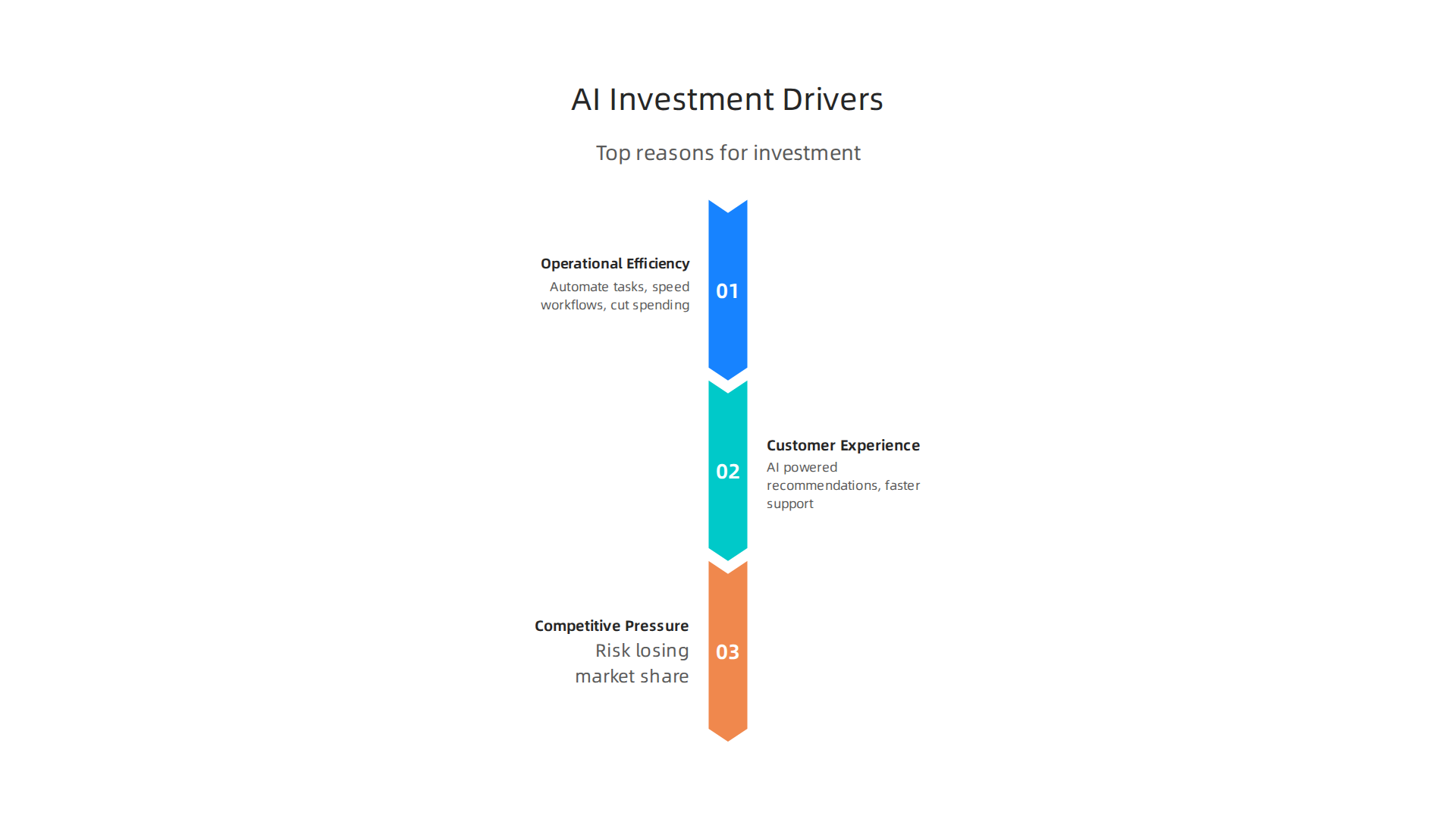
First, operational efficiency and cost reduction remain the top priorities. Companies want to automate repetitive tasks, speed up workflows, and cut unnecessary spending. According to NVIDIA’s State of AI report, the top AI goals for 2026 are creating operational efficiencies and improving employee productivity. This is true across industries, from finance to retail.
Second, customer experience personalization is becoming a must-have. Customers now expect AI powered recommendations, faster support, and tailored interactions. Many AI companies focus specifically on solving this problem. For example, specialized tools like ElevenLabs AI handle voice personalization, while platforms like Bright Data help with the data needed to train those models.
Third, competitive pressure is forcing fast followers to adopt AI or risk losing market share. When your biggest rival cuts costs and improves service using AI, you cannot afford to wait. The artificial intelligence implications for business strategy are urgent: invest now or fall behind.
If you are evaluating which AI companies to bet on, check out our guide to selecting top AI companies for a practical framework.
And to keep up with the fast moving AI landscape every day, The AI Newsletter Worth Reading delivers clear daily updates straight to your inbox.
The Cloud AI Giants: AWS, Microsoft, Google
When you are ready to build AI applications, you will likely choose one of the big three cloud platforms. Amazon Web Services (AWS), Microsoft Azure, and Google Cloud each offer powerful AI services.
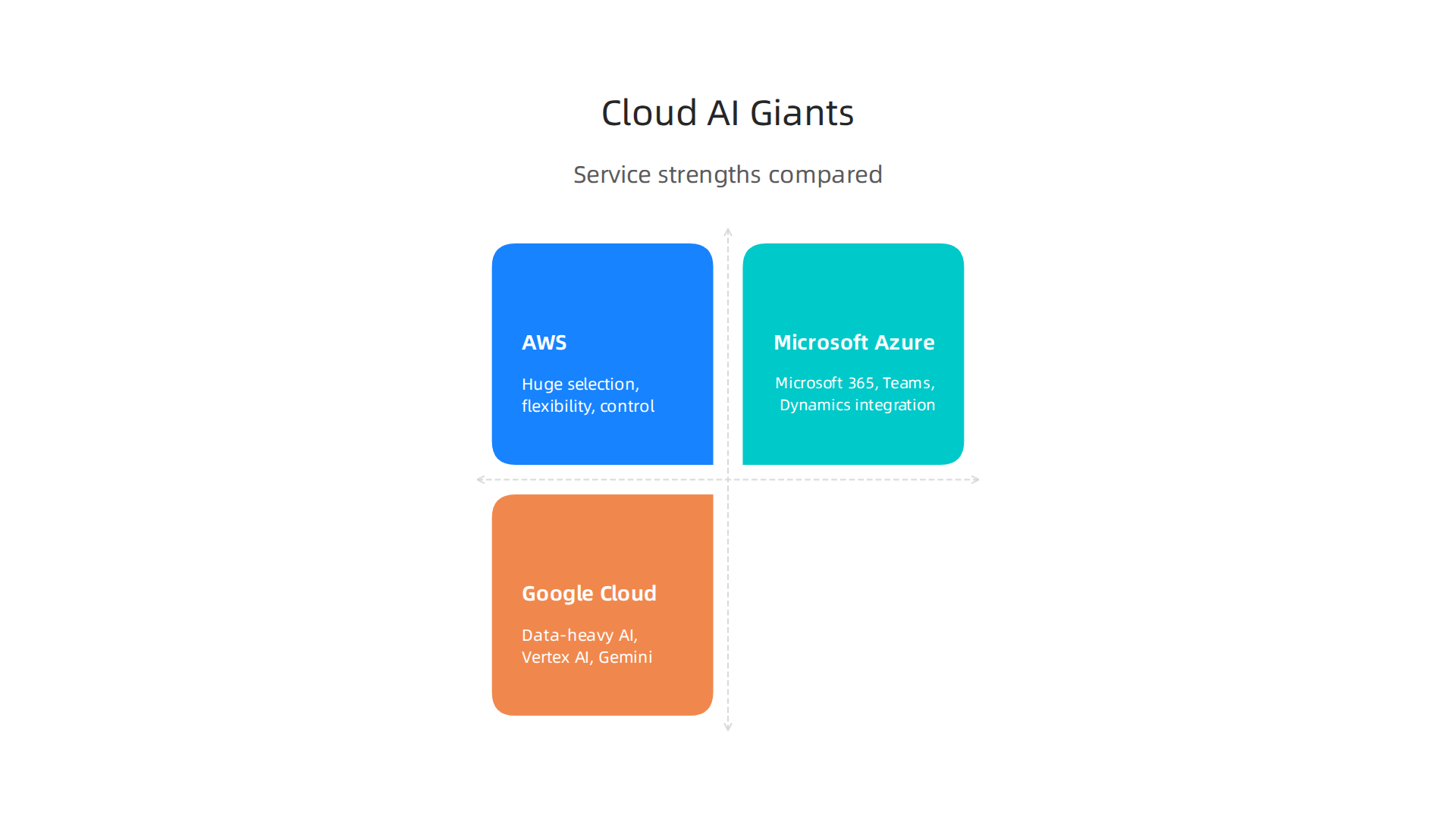
But they shine in different areas.
AWS is known for its huge selection of AI building blocks. It offers Amazon Bedrock for foundation models and SageMaker for machine learning. Over 100,000 organizations already use these tools, according to this generative AI platform comparison. AWS gives you the most flexibility and control.
Microsoft Azure works best if your company already uses Microsoft 365, Teams, and Dynamics. Its Azure OpenAI Service gives direct access to GPT models. This makes Azure a top choice for enterprise AI workflows.
Google Cloud stands out for data heavy AI. Its Vertex AI platform and custom TPUs handle large scale training well. Google also leads in advanced AI research with Gemini models.
So which should you pick? It often comes down to your existing cloud setup. Companies rarely switch clouds just for AI. For a broader look at how to adopt AI across your organization, check out this enterprise AI adoption roadmap.
Specialized AI Platform Providers
The cloud giants are massive, but they cannot cover every industry need. That is where specialized AI platform providers come in. Companies like Dataiku, C3.ai, and H2O.ai build purpose-built tools for specific verticals. They focus on low-code machine learning, clean data pipelines, and ready-to-deploy industry solutions.
Dataiku gives data scientists and business analysts a shared workspace to collaborate on AI projects. C3.ai offers prebuilt applications for sectors like energy, manufacturing, and defense. H2O.ai provides open-source machine learning tools that work across any cloud or on-premises setup.
These platforms fill gaps that the hyperscalers often miss. For highly regulated industries such as healthcare, banking, and government, specialized providers bring stronger compliance guardrails and domain-specific models. They help teams move faster without building everything from scratch. As the AI infrastructure landscape evolves, some analysts note that the cloud choice matters less than it used to, making these focused platforms a smarter option for many business leaders.
This is a crucial factor when you evaluate the wider world of AI companies and their real-world applications. To dig deeper into how to assess these tools for your organization, check out this guide on enterprise AI apps selection and integration.
And to stay ahead of the rapid changes across AI companies and technology, get clear daily AI updates from The AI Newsletter Worth Reading.
Emerging AI Startups with Enterprise Focus
While the big cloud providers and specialized platforms dominate, a new wave of leaner, more agile AI companies is emerging. These startups focus on very specific enterprise problems like document processing, supply chain optimization, and customer service automation. They often build on open-source models, which lets them offer cost-effective alternatives to expensive proprietary systems.
Startups bring flexibility and speed that larger incumbents struggle to match. They can experiment with new architectures and pivot faster based on customer feedback. For enterprises looking to solve a narrow but painful problem, these emerging players are worth a close look. The growing ecosystem of cost-effective cloud options makes it easier for startups to compete, as seen in the cloud comparison for startups in 2026.
To find the best innovators for your needs, check out this guide on how to select top AI companies in 2026 and separate genuine enterprise value from hype.
Aligning AI with Business Objectives
Picking the right AI company is only half the battle. The real success comes when you tie every AI project directly to a clear business goal.

You do not start with the technology. You start with the problem you need to solve.
Ask yourself: Does this use case boost revenue, cut costs, or improve customer satisfaction? If it does not clearly connect to one of those key performance indicators, it might not be worth the investment. According to The State of AI in the Enterprise report, organizations that tie AI directly to revenue outcomes achieve far better results than those that do not.
One proven way to keep things on track is to create an AI Center of Excellence. This team sets the standards, picks the high-impact projects, and makes sure every AI initiative stays aligned with what the business really needs. For a deeper look at structuring your approach, check out this enterprise AI adoption roadmap.
If you want to stay ahead of the curve and get daily insights on AI that can help you make smarter decisions, The AI Newsletter Worth Reading delivers clear, practical updates straight to your inbox.
Data Readiness and Governance
You have the strategy and the right partner. But here is the reality check. Your AI models are only as good as the data they learn from. If your data is messy, scattered, or locked away in silos, even the best AI company in the world will struggle to deliver results.
Many teams underestimate the work it takes to clean and unify their data. They jump straight into building models without checking if the foundation is solid. That is a fast track to failure. You need to start with three critical data questions: Where is your most important data? Is it structured and accessible? And do you have clear rules for who can use it and how?
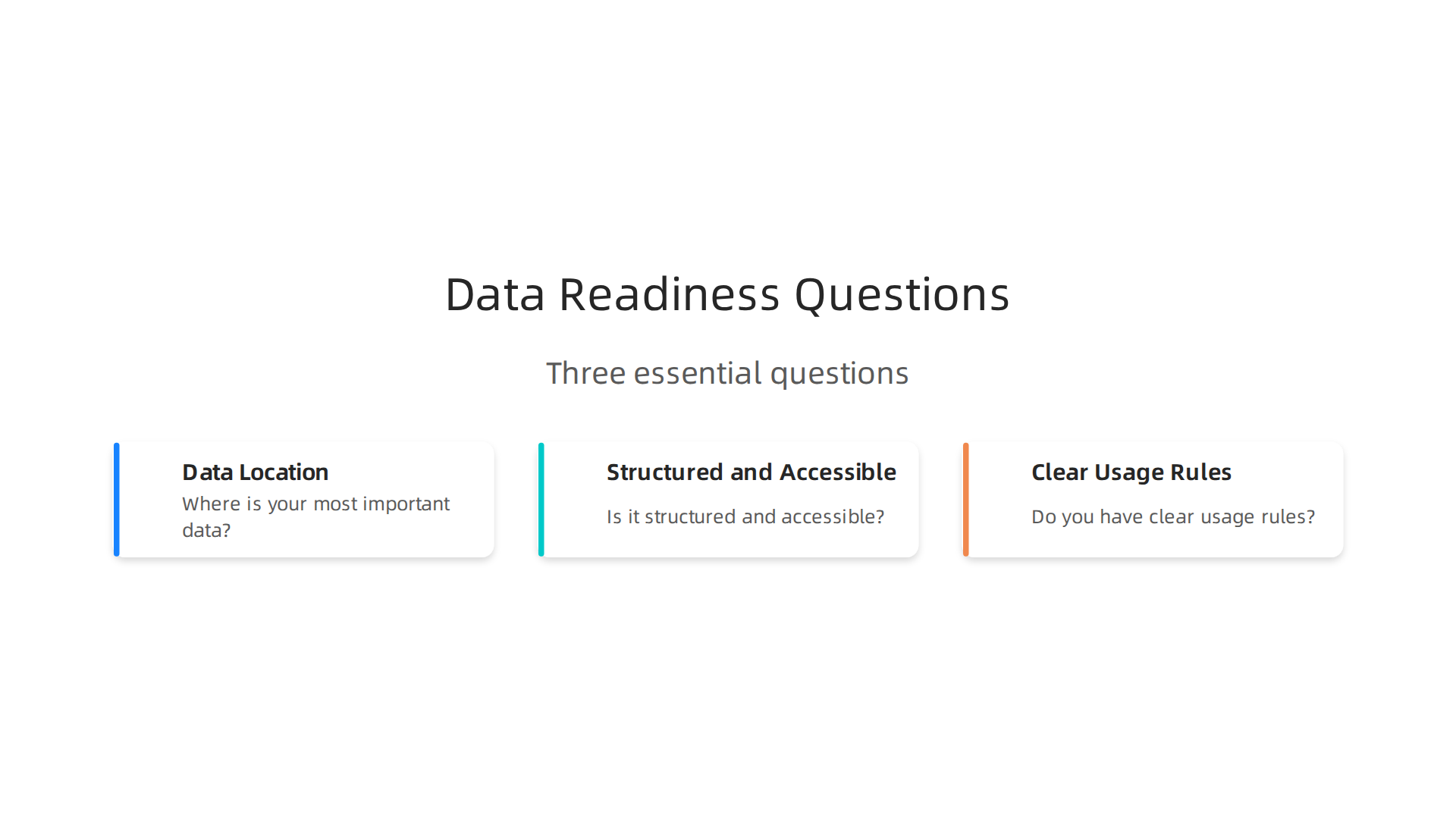
Governance is not just a buzzword. It is the safety rail that lets your AI projects scale without breaking things. A good governance framework covers data quality, privacy, security, and ethical use. It also defines who owns what. According to a practical framework for 2026, you must answer the three data infrastructure questions before you even evaluate any technology.
Set up clear policies before you start running pilots. That way, when your AI projects grow, they grow on a clean, safe foundation. For more on how to gather and prepare your data properly, check out this guide on data collection methods for enterprise AI in 2026.
Build vs. Buy Decisions
Once your data is clean and your governance is in place, the next big question hits you: Should you build your own AI tools or buy them from an existing provider? This is one of the hardest choices enterprise leaders face in 2026.
Building gives you total control and deep customization. You can tailor every model to your exact business workflows and proprietary data. But it demands serious AI expertise, time, and ongoing maintenance. Most teams underestimate the engineering cost.
Buying gets you to market fast. You can deploy proven platforms in weeks instead of months, and the vendor handles updates and security. The trade-off is less flexibility. Off-the-shelf solutions may not fit your unique processes perfectly.
The smartest move for most enterprises is a hybrid approach. Use a phased adoption strategy to identify quick-win use cases you can solve with off-the-shelf tools, then build custom models only for the high-value, proprietary problems that give you a real competitive edge. For a deeper look at selecting the right partners, check out our guide on selecting top AI companies for enterprise growth.
Want to stay ahead of the fast-changing AI landscape? Subscribe to The AI Newsletter Worth Reading from The Deep View for daily, clear updates that help you make smarter build vs. buy decisions.
Technical Capabilities and Integration
Once you decide on a hybrid approach, the real work starts. You need to evaluate each AI company based on technical capabilities and how well its tools fit your existing stack.
Look at model performance first. Does the vendor offer models that match your accuracy and speed needs? Check their APIs and SDKs. The best platforms give you clean, well-documented APIs that your engineering team can start using fast. Pre-built connectors for common data sources and enterprise tools also save weeks of integration time.
Scalability matters just as much. Can the platform handle your workload as it grows? The major cloud providers all offer different strengths here. As one analysis of the AI cloud platform comparison for 2026 shows, AWS provides the broadest model catalog and enterprise governance, while Azure excels at OpenAI integration and Google Cloud leads with research-grade models and TPU hardware.
Finally, check if the vendor supports custom model fine-tuning. Many enterprise AI use cases need models trained on your proprietary data. The ability to fine-tune a model and deploy it where you need it can make or break your ROI.
For a practical look at deploying AI models in the cloud, see our guide on AWS SageMaker for enterprise data science.
Security, Compliance, and Ethical AI
Picking an AI company is not just about performance. You also need a partner that takes security and ethics seriously. Regulations like GDPR and CCPA already apply, and new laws like the EU AI Act are coming fast. The deadline for high-risk AI system obligations is August 2, 2026, which means your chosen vendor must already have compliance built in, not added as an afterthought. Check out this breakdown of the EU AI Act high-risk compliance deadline to see what providers and deployers actually need to do.
Data privacy is another major concern. You need to know how the vendor handles your data during both training and everyday use. Ask about encryption, access controls, and whether they let you fine-tune models without exposing sensitive information. Ethical AI is also becoming a must-have. Look for vendors that can explain how their models make decisions and show clear steps to reduce bias. These features build trust with your customers and protect your business from risk.
For a closer look at how to evaluate vendors beyond the hype, read our guide on selecting top AI companies for enterprise growth. And to keep up with all the fast-moving changes in AI regulation and ethics, stay informed with The AI Newsletter Worth Reading for daily updates you can actually use.
Total Cost of Ownership and ROI
Now that you know what to look for in terms of security and ethics, let’s talk about money. Understanding the total cost of ownership (TCO) for an AI company goes well beyond the sticker price.

You have to factor in licensing fees, compute resources, data preparation, and ongoing maintenance. Cloud AI services often advertise a pay-as-you-go model, but scaling up can surprise you. Inference costs multiply fast as you add users or use cases. A solid enterprise AI strategy guide for 2026 recommends piloting small projects first so you can see real costs before you commit to a big spend.
Measuring return on investment (ROI) is just as important. Look for hard savings like reduced manual work or faster processing. But also track soft benefits like speed to insight. When your team can answer business questions in minutes instead of days, that time savings adds real value. For a deeper look at how to track ROI through the full AI lifecycle, check out our research-backed roadmap for enterprise AI apps selection integration and ROI. Start your TCO analysis before you pick a vendor, and you will avoid costly surprises later.
Upskilling Existing Workforce
Rather than racing to hire brand-new AI specialists, many smart enterprises are choosing to invest in the people they already have. Reskilling your current team is often faster, cheaper, and better for morale.

By 2026, about 40% of enterprise roles will need some level of AI fluency, according to the State of AI in the Enterprise 2026 report. Yet few organizations are truly ready.
AI literacy programs and certification tracks are growing fast. Companies are building role-specific learning paths so that a marketer, an engineer, and a finance manager each learn exactly what they need. This kind of targeted upskilling helps people use AI tools in their daily work without needing a computer science degree.
Partnering with online learning platforms can scale these efforts across the whole company. Instead of a one-time workshop, you get continuous training that adapts as AI evolves. If you want a deeper look at how to build your technical workforce from within, check out our guide on building your engineering workforce from within.
And to stay ahead of the fast-changing AI landscape, consider getting daily, clear updates. The AI Newsletter Worth Reading delivers insights straight to your inbox, so your upskilling efforts stay current.
Leveraging AI Platforms to Augment Teams
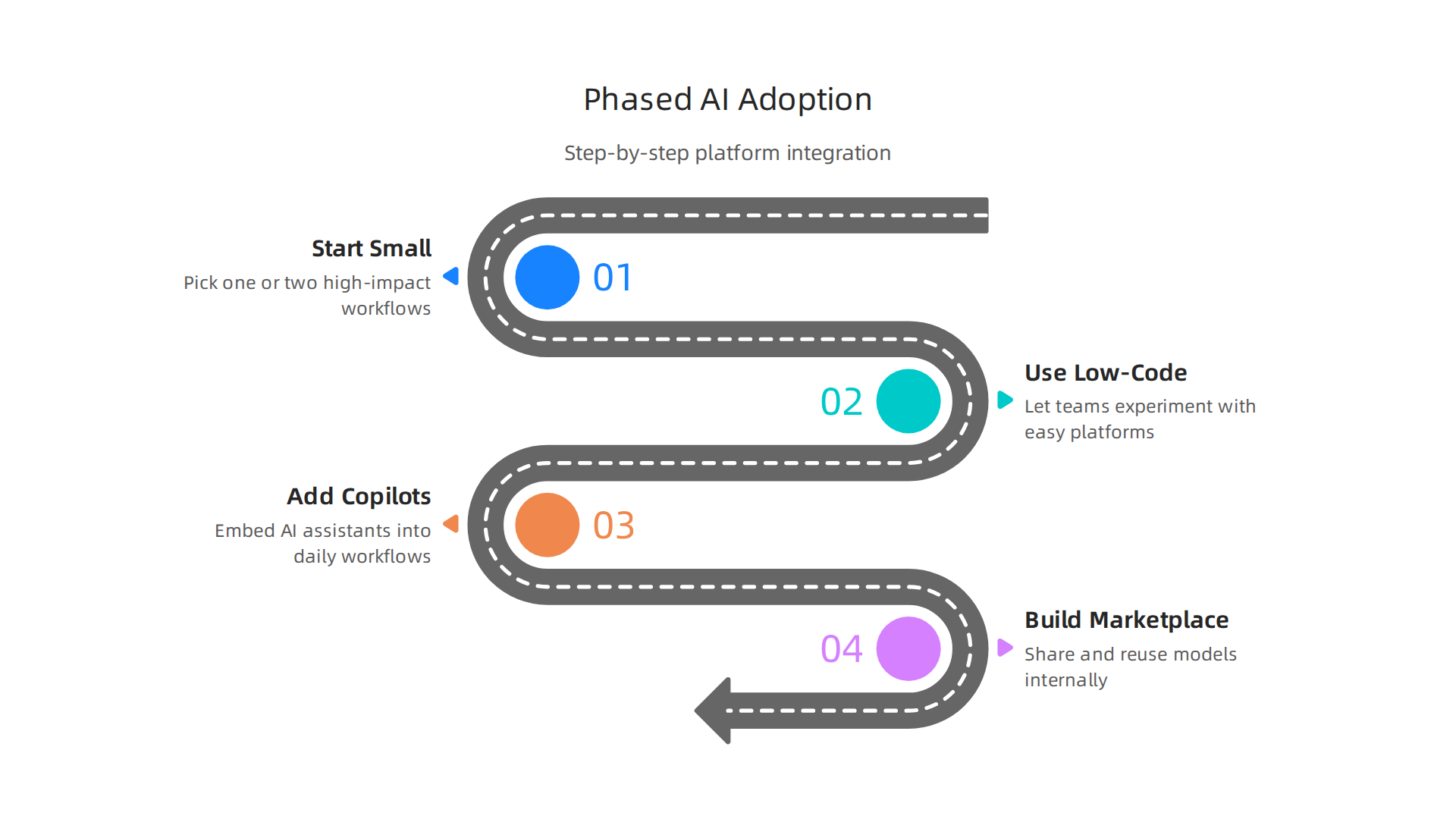
Once your team has the right skills, the next step is giving them the right tools. AI platforms that are easy to use can turn everyday employees into AI builders. Low-code and no-code platforms let people without a computer science degree create models that solve real business problems. Instead of waiting weeks for a data scientist, a marketing manager can build a prediction tool in hours.
AI copilots and assistants are also changing how teams work. Developers get faster code suggestions. Analysts get instant data summaries. These tools don’t replace people. They handle the repetitive work so humans can focus on judgment and creativity. The goal is to embed AI copilots into daily workflows so the whole team gets a productivity boost.
Many smart enterprises also create internal AI marketplaces. Teams can share and reuse models instead of building everything from scratch. This saves time and spreads best practices across the company. When you reuse a well-tested model, you also reduce risk.
To get the most out of these platforms, start small. Pick one or two high-impact workflows and let your team experiment. Use low-code tools first. Add copilots next. Build an internal marketplace as you grow. This step-by-step approach works better than rolling out everything at once.
If you are evaluating which platform fits your needs, check out our guide on selecting the right AI platform for enterprise leaders. It breaks down the options so you can make a confident choice.
Vendor Lock-In and Interoperability
Relying too heavily on a single AI vendor can create big problems down the road. If that vendor changes its pricing, shuts down a service, or pivots its strategy, you might be stuck with models that don’t move easily. This is the risk of vendor lock-in, and it’s a real concern for enterprises scaling AI in 2026.
The best way to protect your organization is to build around open standards and multi-cloud strategies. Using formats like ONNX and deploying models in custom containers means you can switch providers without rebuilding everything. This portability gives you leverage and keeps your options open.
A multi-cloud approach also helps spread risk. Instead of putting all your AI workloads with one cloud provider, you can distribute them across AWS, Azure, and Google Cloud. This way, if one vendor has an outage or changes terms, your operations keep running.
When you evaluate new tools, prioritize those that support AI compliance frameworks and open standards. These frameworks often require transparency and interoperability, which naturally reduce lock-in. For more help choosing partners, read our guide on selecting top AI companies that prioritize portability. And to keep up with fast-moving changes in AI, get free daily updates from The Deep View Newsletter.
Model Risk and Hallucinations
Large language models are powerful, but they can also produce outputs that sound correct yet are completely wrong. That’s a hallucination. For enterprises relying on AI, a hallucination in a customer-facing chatbot or an internal report can cause serious harm.
That is why rigorous testing and continuous monitoring matter so much. You cannot just deploy a model and hope for the best. Human oversight is a must, especially for high-stakes decisions. Regulations like the EU AI Act also require transparency and human review for certain risk categories, so building these checks in early saves you trouble later.
A smart technique called retrieval-augmented generation (RAG) helps reduce hallucination risk. RAG grounds the model’s answers in your own trusted data rather than letting it guess. Many leading ai companies now bake RAG into their offerings. For a deeper look at how enterprises are rolling out these tools safely, check out this guide on enterprise AI adoption in 2026. And to stay on top of model risks and security best practices, familiarize yourself with AI security standards for 2026 from SentinelOne.
Regulatory and Ethical Risks
Regulations are catching up fast with AI. The EU AI Act starts enforcing high-risk system obligations on August 2, 2026, and that date has not been delayed. Any company deploying AI in Europe needs to meet these rules now. Leading ai companies are already building responsible AI frameworks into their strategy. As highlighted in an enterprise compliance guide for the EU AI Act, providers must complete conformity assessments and register systems before placing them on the market.
Beyond regulations, ethical risks like biased outcomes and lack of transparency can damage trust. Boards are making responsible AI a top priority in 2026. To navigate this landscape, leaders need clear, daily updates on what matters. That is where The AI Newsletter Worth Reading comes in. It delivers concise AI news to help you stay compliant and ethical.
For a deeper look at how leading enterprises are structuring their AI governance, check out this guide on selecting top AI companies in 2026.
Agentic AI and Autonomous Operations
Here is where things get really interesting. Agentic AI systems can handle multi-step tasks all on their own without waiting for a human to guide every move. In 2026, early adopters are already using these agents in IT operations to fix network issues, in customer support to resolve tickets end to end, and in supply chain management to reroute shipments automatically. But this power comes with a new challenge. Governance of autonomous agents is still an open question. The 2026 AI report from Deloitte points out that only one in five companies has a mature model for overseeing these agents. That gap needs to close fast as more ai companies push agentic solutions into production. For a broader look at how to adopt enterprise AI responsibly, check out this data-backed roadmap for business leaders.
Industry-Specific AI Solutions
Generic AI tools often fall short in highly regulated fields like healthcare or finance. That is why more ai companies are building vertical AI solutions made just for one industry. These tools understand the specific data, rules, and workflows of sectors such as manufacturing, banking, and energy. For example, an AI trained on medical records can help with diagnosis, while a finance AI handles compliance checks automatically. According to the Enterprise AI Strategy in 2026 guide, these industry-specific solutions are becoming a top trend because they deliver more relevant results than one-size-fits-all software. The catch? Success usually depends on deep partnerships with leaders who know the field inside out. If your organization is exploring which tailored AI tools to invest in, reading this guide on how to select top AI companies in 2026 for enterprise growth can help you cut through the hype.
Want to stay ahead of every AI trend that matters to your business? The AI Newsletter Worth Reading delivers clear, daily updates straight to your inbox so you never miss a shift in the landscape.
The Role of Open Source vs. Proprietary
When choosing which AI models to use, enterprises face a big decision: open source or proprietary? Open-source models like Llama and Mistral have improved fast. They are catching up to closed systems from top vendors. Many organizations now find that open source gives them better control. They can customize the model for their own data, save money on licensing, and see exactly how the model works.
But proprietary AI tools offer strong support, security, and compliance guarantees. For regulated industries, the safety of a vendor solution may be worth the extra cost. According to the 2026 Deloitte AI in the Enterprise report, insufficient worker skills are the biggest barrier to AI integration. This applies to both open and closed models. Teams need training to manage either type.
The best choice depends on your resources and risk tolerance. If your team has strong engineering skills, open source can unlock huge value. If you need hand-holding and strict compliance, a proprietary solution may be safer. For more on evaluating AI options, check out this research-backed roadmap for enterprise AI apps.
Conclusion: Building a Future-Ready Enterprise AI Strategy
Building a strong AI strategy in 2026 starts with a clear focus. It is not just about picking the hottest tool. You need to align technology with your actual business goals. The market is growing fast. According to the Enterprise AI trends in 2026 report, sovereign AI and agentic AI are reshaping how companies operate. Leaders who prioritize real business value will pull ahead.
Start with your data. Clean, well-organized data is the fuel for any AI project. Without it, even the best model will fail. Then, manage risk carefully. Whether you choose open source or a proprietary vendor, you need strong governance and security from day one.
Continuous learning is the secret weapon. The AI world changes every week. The best teams stay curious and test new use cases often. Specialized companies like ElevenLabs and Bright Data show how focused tools can solve specific problems. They are great examples of how to find the right fit for your needs.
To keep up with daily changes, you need a reliable source of insights. Try The AI Newsletter Worth Reading. It delivers clear daily AI updates so you never miss an important shift.
Finally, remember that AI is a journey. Start small, measure what works, and scale from there. For a deeper look at picking the right partners, read our guide on how to select top ai companies in 2026 beyond hype. With the right strategy, your enterprise can thrive in the age of AI.
Summary
This article gives CIOs and CTOs a practical, data‑driven framework to evaluate AI companies and build a resilient enterprise AI strategy in 2026. It surveys the fast‑growing market, compares cloud giants (AWS, Microsoft, Google) with specialized vendors and startups, and explains when to buy, build, or use a hybrid approach. The guide stresses that clean, accessible data and strong governance are non‑negotiable foundations, and it outlines technical checks like API quality, scalability, and fine‑tuning support. You’ll also learn how to assess security, compliance (including the EU AI Act deadline), TCO and ROI, and how to upskill existing teams with low‑code tools and AI copilots. Practical tactics for avoiding vendor lock‑in, reducing hallucination risk, and selecting industry‑specific solutions are included so you can pilot quickly, measure impact, and scale safely. After reading, you’ll have a clear checklist to separate real capability from hype and choose partners that deliver measurable business value.