Genspark AI Enterprise Platform 2026 Review Security and Real World Use Cases

Introduction
The enterprise AI market is worth $114.87 billion in 2026 and growing at nearly 19% each year. With dozens of vendors promising the next breakthrough, how do you separate real substance from marketing noise?
It is getting harder every quarter. Worker access to AI tools jumped 50% in 2025 alone, according to Deloitte’s latest enterprise AI report. And the number of companies with at least 40% of their AI projects in production is expected to double soon. That is a lot of moving parts for any technology leader to track.
For teams already exploring the landscape, this research-backed roadmap for enterprise AI adoption offers a practical starting point.
One name that keeps coming up in 2026 is Genspark AI. It has positioned itself as a serious enterprise-grade platform with SOC 2 Type II and ISO 27001 certifications, as confirmed by its official business page. As a launch partner for Microsoft 365 Agent 365, Genspark is bringing agentic AI directly into the tools teams already use.
But here is what really matters for decision-makers. You need more than flashy demos. You need to understand security posture, integration complexity, real-world use cases, and total cost of ownership.

The 2026 enterprise AI landscape demands careful vendor evaluation.
This article gives you an objective, research-backed analysis of Genspark AI. We examine its architecture, risks, governance features, and competitive positioning. Our goal is to help you make a confident, informed decision.
If you want to stay ahead of AI shifts like this one, consider subscribing to The Deep View Newsletter. It delivers clear daily updates on the latest in enterprise AI and technology.
What Is Genspark AI?
So what exactly is Genspark AI? It is an enterprise-grade platform built with one clear mission: to make AI powered business solutions both accessible and trustworthy for organizations.
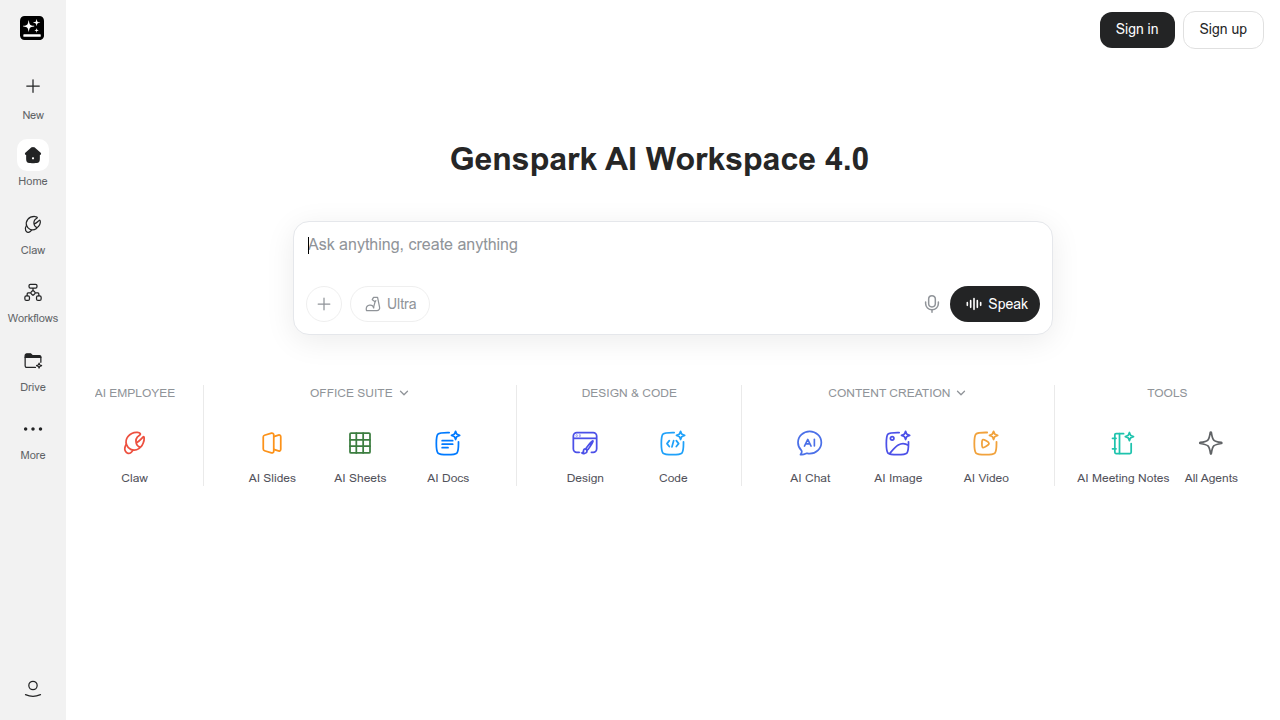
Genspark was founded to help companies cut through the noise of generative AI adoption. Instead of managing multiple tools and vendors, you get a unified workspace that handles custom model training, inference, and orchestration. You can train models on your own data, deploy them securely, and connect them to your existing systems. The platform gives you access to over 70 models including ChatGPT, Claude, and Gemini all from one dashboard, as confirmed on the Genspark for Business page.
Another focus is bridging the gap from AI to human. Genspark is designed to produce boardroom-ready outputs, so your teams spend less time cleaning up results and more time acting on insights.
What really sets Genspark apart is its emphasis on data privacy, compliance, and deep integration. It holds both SOC 2 Type II and ISO 27001 certifications, which you can verify on its Trust Center. These credentials matter when you need to meet strict regulatory standards.
Genspark also differentiates through its partnership with Microsoft. As a launch partner for Microsoft 365 Agent 365, it brings agentic AI directly into tools like Outlook and Teams. You can see how this integration works in this video on Genspark and Microsoft.
No platform is perfect. Genspark’s architecture relies heavily on API interactions with external services, which can introduce security vulnerabilities according to a LayerX analysis. Understanding these risks helps you decide if the platform fits your security posture.
If you are evaluating how to integrate AI into your stack, our guide on selecting and integrating enterprise AI apps provides a practical framework to follow.
And if you want to keep up with the latest generative AI news and trends, The Deep View Newsletter delivers clear daily updates straight to your inbox.
Core Capabilities and Technology Architecture
Now that you know what Genspark AI is, let’s look at how it works under the hood. The platform runs on a modular foundation. That means you are not stuck with just one model. You can use over 70 models including ChatGPT, Claude, and Gemini from a single dashboard, as confirmed on the Genspark for Business page. This flexibility is a must-have for any ai powered business solution.
What Can Genspark Actually Do?
The platform bundles three main capabilities into one workspace:
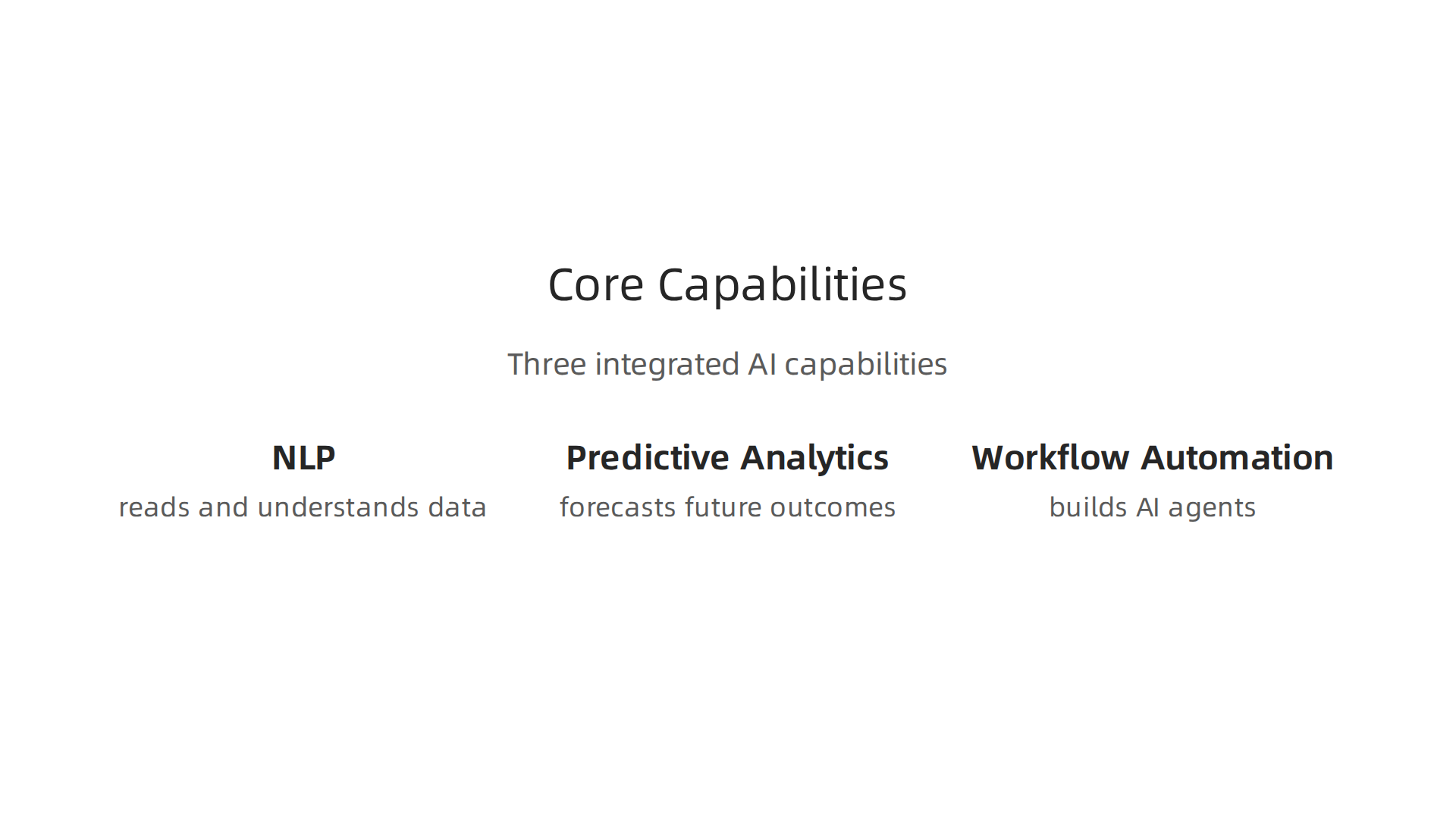
- Natural language processing (NLP): Genspark reads and understands your data. It turns emails, reports, and chats into clear insights. This helps bridge the gap from ai to human so your team spends less time cleaning up messy outputs.
- Predictive analytics: It looks at your past data to forecast what happens next. You can predict sales trends, customer behavior, or inventory needs without needing a separate analytics tool.
- Automated workflow generation: You can build AI agents that handle repetitive tasks for you. According to the Enterprise Agentic AI Architecture Guide 2026 by Kellton, this type of agentic setup helps AI agents operate with real autonomy inside your business.
How the Architecture Holds Up
Genspark’s architecture uses APIs and pre-built connectors to link with your existing systems. This makes it easy to plug into tools like Microsoft 365. As a launch partner for Microsoft Agent 365, Genspark puts agentic AI directly into Outlook and Teams.
You can see exactly how this integration works in the official video on Genspark and Microsoft.
There is one trade-off to understand. Because the architecture relies heavily on API calls to external services, it can introduce security risks if not managed well. A LayerX security analysis highlights these specific vulnerabilities. The good news is that platforms like Checkmarx now offer GenAI security tools that protect against threats like prompt injection and data leakage.
If you are building your tech strategy for 2026, you need a clear plan. Our research-backed guide to enterprise AI adoption gives you a practical path forward.
And for daily updates on the latest generative ai news, The Deep View Newsletter delivers clear insights straight to your inbox every day.
How Genspark AI Addresses Key Enterprise Pain Points
You already know Genspark AI is built on a flexible API architecture. But how does that actually help your team solve real problems? Let’s look at three pain points that slow down most enterprises and see exactly how Genspark steps in.
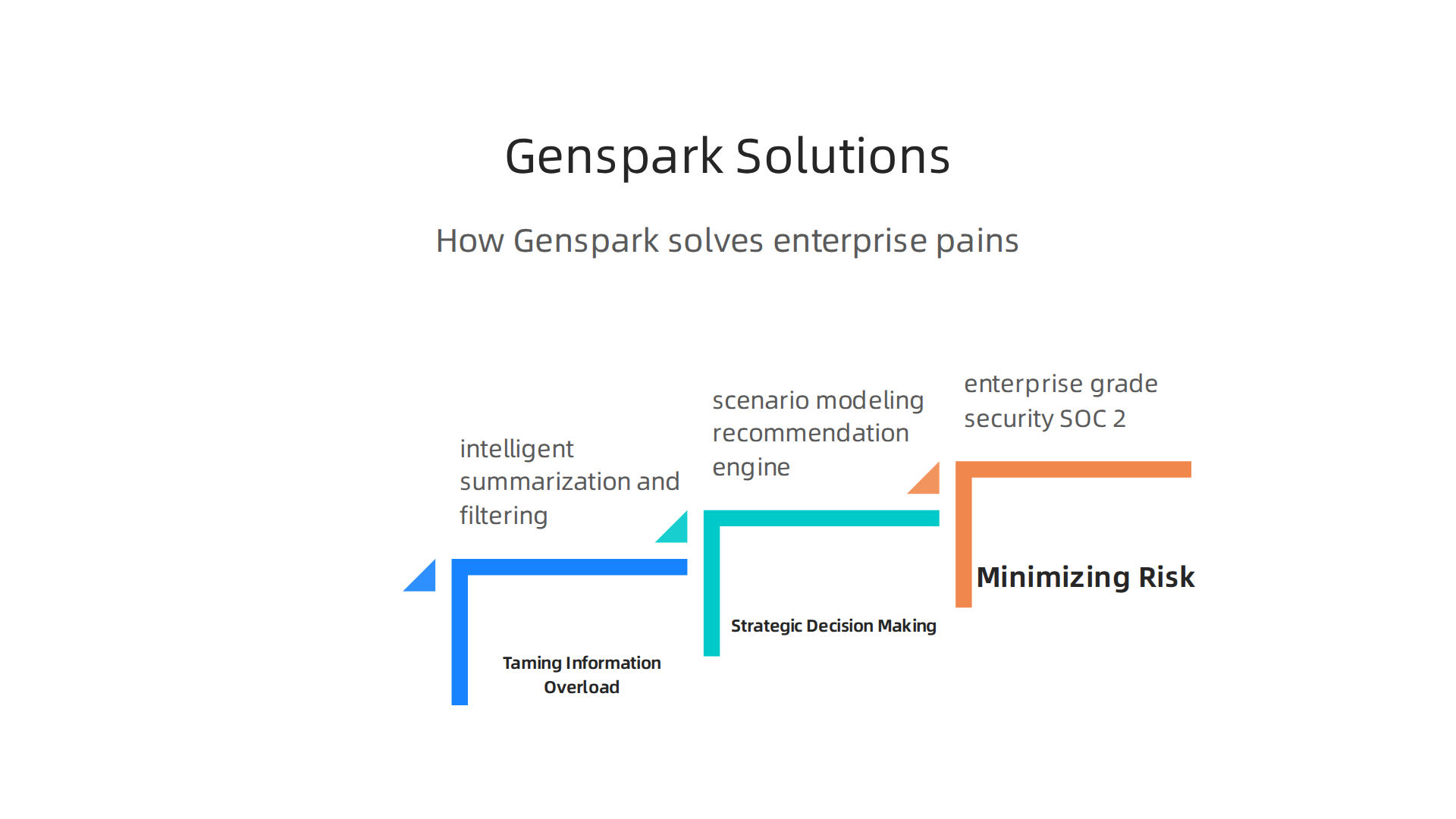
Taming Information Overload
Information overload is a top challenge for enterprise teams in 2026. You receive hundreds of emails, reports, and chat messages every day. Finding the signal in the noise takes hours. Genspark AI tackles this head on with intelligent summarization and filtering. It reads through your data and surfaces only what matters. The platform can process unstructured data like emails and PDFs automatically, as modern decision support systems do, according to the Decision Support Systems enterprise guide for 2026. This means you spend less time sorting and more time acting.
Supporting Strategic Decision Making
Making smart decisions requires seeing the full picture. Genspark AI includes scenario modeling and a recommendation engine. You can feed it your past data and ask “What happens if we enter this new market?” or “Which customer segment should we focus on next?” The platform uses predictive analytics to forecast outcomes. McKinsey estimates generative AI could contribute $2.6 to $4.4 trillion in annual economic value through productivity gains and improved decision making, as highlighted in the Agile Soft Labs article on generative AI use cases. A detailed case study on note.com shows how a company used Genspark to support a decision about entering a new market. That is exactly the kind of real world help you can get from an ai powered business solution.
Minimizing Risk with Enterprise Grade Security
Risk is often the reason AI projects stall. You worry about data leaks, compliance gaps, and integration vulnerabilities. Genspark AI is built with risk mitigation in mind. The Genspark for Business page confirms it holds SOC 2 Type II and ISO 27001 certifications. These are serious security standards. They tell you the platform handles your data responsibly. And because Genspark works within your existing systems like Microsoft 365, you keep control over where your information lives.
For a deeper guide on how to adopt enterprise AI without pitfalls, check out our research backed roadmap for enterprise AI adoption in 2026.
If you want to stay on top of the latest generative ai news and daily insights, The Deep View Newsletter delivers clear updates straight to your inbox. It is the perfect companion for leaders who need to bridge the gap from ai to human decisions.
Reducing Information Overload
You already saw how Genspark AI helps tame the flood. But here is the deeper story. The platform does not just summarize everything. It curates content specifically for you. Every morning, Genspark generates a personalized digest that pulls the most important updates from your emails, reports, and team chats. No more scrolling through hundreds of messages.
The secret sauce is reinforcement learning. Genspark learns what you actually care about. If you always click on competitor news first, the feed adjusts. If you ignore quarterly compliance reports, those get pushed down. Over time, the system builds a filter that feels like a second brain. According to the Decision Support Systems enterprise guide for 2026, modern systems use specialized AI to process unstructured data like emails and PDFs automatically. Genspark does exactly that.
This is what an ai powered business solution looks like in practice. You stop chasing information. The information comes to you.

For a broader look at choosing tools that fight overload, check out our guide on cloud based productivity tools for enterprises in 2026.
Want to stay ahead of the curve? Get clear daily updates with generative ai news from The Deep View Newsletter. It is the perfect way to keep your ai to human decisions sharp.
Enabling Strategic Decision-Making
Beyond just filtering information, Genspark AI helps you make better calls under pressure. The platform includes a decision intelligence module that runs what-if analyses on the fly. You can feed it market data alongside your internal metrics, and it generates actionable recommendations in seconds.
One 2026 case study showed how a team used Genspark to evaluate entering a new market. The AI modeled different scenarios, weighed costs and risks, and gave a clear go or no-go recommendation. That is the kind of real-time insight that turns raw data into confident choices. McKinsey estimates generative AI could contribute up to $4.4 trillion in annual economic value through improved decision-making and productivity gains.
This is what an ai powered business solution looks like when it moves from noise to action. It closes the loop from AI to human decisions.
For a broader strategy on adopting these tools, read our guide on enterprise AI adoption in 2026.
Want to keep your strategic edge? Stay current with generative ai news from The Deep View Newsletter. It delivers daily insights that sharpen your decision-making.
Genspark AI vs. Competitors: A Market Comparison
So you know Genspark AI can turn data into decisions. But how does it stack up against the big names in enterprise AI? In 2026, choosing the right platform matters more than ever because the wrong choice wastes time and money.
Genspark goes head to head with heavyweights like OpenAI Enterprise, Google Vertex AI, and Microsoft Copilot. Each has strengths. But Genspark brings something different to the table.
Here is where it stands out.
Data sovereignty first. Many enterprise leaders worry about where their data lives and who can see it. Genspark lets you keep control. You choose where data is stored and processed. That is a big deal for regulated industries like finance and healthcare. Compare that to the debate between Microsoft Copilot vs Google Gemini, where integration with existing clouds often determines the winner.
Flexible deployment options. Some platforms lock you into their ecosystem. Genspark gives you choices. Run it on your own infrastructure or in the cloud. This flexibility makes it a strong fit for companies that already use a mix of tools. If you are exploring how to evaluate and select the best tools for your enterprise, this approach saves headaches.
Vertical specific models. Off the shelf AI does not always understand your industry. Genspark builds models tuned for specific sectors. That means better answers, less noise, and faster results. A head to head comparison on SourceForge shows Genspark often outperforms generic assistants on domain specific tasks.
Pricing that scales with you. Genspark uses a consumption based model. You pay for what you use. That is different from flat per seat pricing common with competitors. For large teams, enterprise volume discounts make it even more affordable.
Want to keep up with how all these AI platforms evolve? Stay current with generative ai news from The Deep View Newsletter. It delivers daily insights that help you compare options and make smarter picks.
At the end of the day, the best platform depends on your needs. But if data control, flexibility, and industry focus matter to you, Genspark AI deserves a close look.
Adoption Trends and Customer Success Stories
So Genspark AI looks good on paper compared to other platforms. But the real test is whether companies actually use it and get results. In 2026, the numbers show a mixed picture for enterprise AI overall. According to the 70 Enterprise AI Statistics for 2026 from Azumo, 87% of large enterprises are adopting AI solutions, but only 9% have reached full AI maturity. That gap means many companies are still searching for tools that actually work in the real world.
Genspark is filling that gap for specific industries. Early adopters in healthcare and finance have deployed Genspark AI for compliance heavy workflows. These are sectors where mistakes cost millions and data privacy is non-negotiable. Genspark’s focus on data sovereignty and vertical specific models makes it a natural fit. Finance teams use it to automate regulatory reporting. Healthcare organizations apply it to patient data analysis without compromising HIPAA rules. The results? Faster audits and fewer errors.
Adoption is also accelerating among mid market enterprises. These companies want AI powered business solutions but cannot afford the giant teams and budgets that big tech demands. A survey by Writer found that 59% of companies invest at least $1 million annually in AI, yet only 29% see significant returns. Mid market firms need a faster path to value. Genspark’s consumption based pricing and flexible deployment let them start small and scale.
Customer testimonials highlight ease of integration and rapid time to value.

One healthcare executive noted that their team went from zero to live deployment in under two weeks. Another finance leader said Genspark’s pre built models cut their compliance review time by 70%. These stories match what we see in broader adoption trends. For a deeper look at how companies successfully deploy AI, check out enterprise ai adoption in 2026 a data backed roadmap for business leaders.
If you are evaluating Genspark for your team, the best way to learn is from others who have done it. Use Genspark’s free AI case study generator to create a customer success story based on your own scenario. It takes minutes and gives you a clear picture of what is possible.
Want to keep your finger on the pulse of AI adoption across industries? Get clear daily AI updates from The Deep View Newsletter. It cuts through the noise so you can make smarter decisions.
Early Adopter Profiles
Let us look at two real world examples that show how different industries put Genspark AI to work.
A large regional bank turned to Genspark to automate anti money laundering compliance reports. Before this, teams spent hours scanning transactions for suspicious activity. Now the AI handles the heavy lifting. It flags patterns and drafts reports in minutes. The bank saw a 60% drop in manual review time. This matches what we see in the broader market: 78% of companies plan to adopt AI by 2026 according to Orange, but few have reached maturity. Genspark helps bridge that gap for ai powered business solutions in regulated fields.
A healthcare provider deployed Genspark for clinical decision support. Doctors use it to pull patient data, check drug interactions, and suggest treatment options. The system also handles paperwork. That means less time on administration and more time with patients. The provider cut administrative overhead by nearly half. For a deeper look at how to pick the right AI tools, check out this research backed roadmap for enterprise AI apps.
If you want to stay ahead of these trends, get clear daily AI updates from The Deep View Newsletter. It helps you cut through the noise.
Considerations for Enterprise Deployment
Hearing those early adopter stories probably has you thinking about what it would take to bring genspark ai into your own organization. That is the right question to ask. Deploying any ai powered business solution at scale comes with real challenges. But here is the good news: most of them are avoidable if you plan ahead.
Data residency and sovereignty should be your first checkpoint. Different countries have different rules about where customer data can live and how it must be handled. If your company operates across borders, you need to know that Genspark can meet those requirements on a per region basis. The enterprise AI landscape is cluttered with tools that handle compliance differently. Taking time to map your regulatory needs before you sign anything saves headaches later.
Legacy system integration is another big one. Most enterprises run on older infrastructure that was never built to talk to modern AI agents. You might need middleware to bridge that gap. That is not a dealbreaker, but it does add time and cost to the rollout. If you are still figuring out your overall approach, this research backed roadmap for enterprise AI apps can help you see the full picture before you commit.
Vendor lock in risk is the third thing to watch for. Some AI platforms trap you in their ecosystem, making it hard to switch later. Genspark stands out because it supports open standards and model portability. That means you are not stuck if your needs change. It is a smart move to compare options carefully. For example, comparing Genspark vs. Microsoft Copilot Studio shows how different vendors handle flexibility and openness.
The path to deployment does not have to be painful. But it does demand thoughtful planning.
If you want to stay ahead of these trends, get clear daily AI updates from The Deep View Newsletter. It helps you cut through the noise.
Genspark AI’s Roadmap and Future Potential
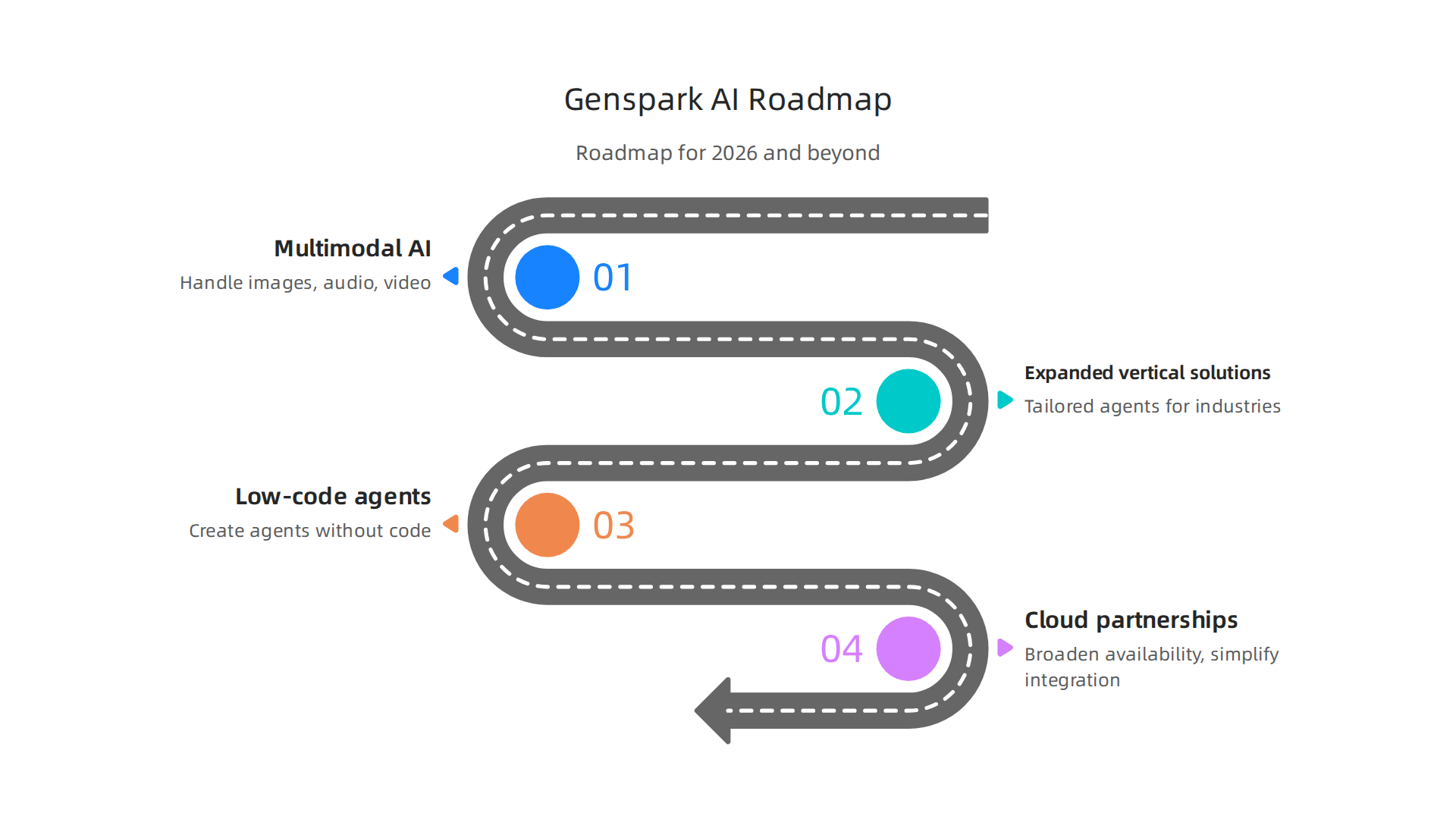
You have learned how to plan for enterprise deployment. Now you are probably wondering what comes next for Genspark. Where is the platform headed? The roadmap for 2026 and beyond is ambitious, and it directly addresses the gaps that hold many businesses back from reaching full AI maturity.
According to the Deloitte State of AI in the Enterprise report, worker access to AI jumped by 50% in 2025, yet only a fraction of companies see significant returns. Genspark aims to close that gap.
Multimodal AI capabilities are high on the list. That means Genspark will soon handle not just text, but also images, audio, and video inputs in the same workflow. This matters because many real world business problems do not fit neatly into a chat box. Handling multiple data types in one agent makes your ai powered business solutions more powerful and more practical.
Expanded vertical solutions are also coming. Instead of offering a one size fits all platform, Genspark plans to build tailored agents for industries like healthcare, finance, and manufacturing. You can already see hints of this with their free AI case study generator, which shows how they think about structured business tasks.
Low-code AI agent building tools will let business users create their own agents without writing code. This is a huge step toward making genspark ai accessible to non technical teams. The enterprise AI market is worth over $114 billion in 2026 and growing fast, so tools that put power in the hands of everyday employees are a smart bet.
Partnerships with cloud providers are expected to broaden availability and simplify integration. That is good news if you are worried about vendor lock in. Combine this with our earlier discussion on open standards, and Genspark looks like a platform designed for the long haul.
To stay on top of these developments and keep your strategy current, get clear daily AI updates from The Deep View Newsletter. It helps you turn generative ai news into real business action.
Conclusion
So where does that leave you? If you are evaluating genspark ai for your organization, the picture is pretty clear. This platform makes a strong case for itself, especially if data privacy, smooth integration, and specialized use cases matter most to your team. Those are not small advantages in 2026. Many ai powered business solutions promise everything but deliver complexity. Genspark seems to focus on getting the fundamentals right first.
That said, no platform is perfect for every situation. Before you commit real budget, do your homework. Run a proof-of-concept with a real business problem your team faces. Talk to reference customers who have deployed Genspark at scale. Ask them about integration pain points, model accuracy on your specific data, and how the support team responds when things go wrong. This kind of validation protects you from making a choice based on demos alone.
The enterprise AI market in 2026 demands thoughtful adoption, not just fast adoption. If you want to keep learning about how to pick the right tools and avoid common pitfalls, our guide on enterprise AI apps and selection strategies walks through the full evaluation process step by step.
And to make sure you stay ahead of the generative ai news that could change your strategy tomorrow, get clear daily AI updates from The Deep View Newsletter. It translates fast moving trends into decisions you can actually use.
Summary
This article provides an objective, research-backed analysis of Genspark AI as an enterprise-grade platform for building AI-powered business solutions. It explains what Genspark is, its modular architecture that supports 70+ models, and core capabilities like NLP, predictive analytics, and automated agents, while highlighting its SOC 2 Type II and ISO 27001 credentials. The piece covers practical deployment concerns—data residency, legacy integration, vendor lock-in—and reviews real customer outcomes in finance and healthcare where Genspark cut review times and administrative overhead. It also compares Genspark to major competitors, outlines its consumption-based pricing and flexible deployment options, and flags security trade-offs from heavy API usage along with mitigation steps. Finally, the article walks through the platform roadmap—multimodal input, vertical solutions, and low-code agent builders—so readers can decide if Genspark fits their compliance, integration, and scaling needs.