
Mastering Future Tools AI for Enterprise Investment in 2026

The world of business technology is changing faster than ever. In 2026, new artificial intelligence (AI) tools pop up almost every day. For leaders of big companies, this means there are many exciting new options. But it also brings a big challenge. While it’s getting easier to try out these future tools ai, it’s much harder to know which ones will truly help your company in the long run.
Think about it: most large companies are already using AI. Reports show that 87% of big businesses use AI in some way in 2026, and 65% are even using generative AI for tasks like ai content creation or helpful chatbots [1]. Global spending on AI systems is expected to go over $300 billion this year, with many companies seeing good returns on their AI investments [2]. This quick growth means business leaders need a clear way to sort through all the options. It’s not just about picking a cool new tool; it’s about finding one that truly fits your company’s big picture plans.
This article is here to help you. We will give you a simple guide to choose the best new AI tools for your business.

We will look at important things like how a tool fits your company’s goals, what risks it might bring, and how it affects your team and their jobs. Understanding how to wisely evaluate future tools ai means you can make choices that help your company grow strong and stay safe.
We will share helpful tips based on what works for other businesses. You will find a checklist for picking the right vendors and learn about the good and bad sides of putting new AI tools into action. By the end, you’ll have a better idea of how to make smart choices in this fast-moving world.
To stay on top of all the exciting changes in AI and technology every day, make sure you get The AI Newsletter Worth Reading.

It gives you clear, helpful updates right to your inbox. You can also learn more about how CIOs and CTOs should evaluate AI companies in 2026 to make informed decisions.

[1] 87% of Enterprises Run AI in 2026 — State of AI Adoption by …
[2] 67 AI Adoption Statistics for 2026 — Enterprise & SMB Data
Now that we know we need to be smart about picking AI tools, let’s look at the kinds of future tools ai that businesses are investing in. These are often called "AI-first" tools because they are built from the ground up with AI at their core.
1) AI-first Product and Platform Tools: Where to Invest
When thinking about future tools ai, companies often look at big "platform" tools. These are like central hubs for all your AI work. In 2026, many different kinds of these platforms are helping companies solve tough problems. For example, some platforms help you manage all your AI models, like a big library for AI brains. Others are special ways to store and find data quickly, which is super important for AI to work well. Some even create a smart ai gateway that lets different AI tools talk to each other safely.
These tools solve real business problems. They can help automate tasks, make customer service smarter, or even help make better products. Big cloud companies like Microsoft Azure AI, Google Cloud Vertex AI, and AWS offer many of these important AI platforms, helping businesses build and use AI on a large scale
[1]. Other types include tools for managing the whole process of building and running AI, often called MLOps platforms, which help keep AI systems working smoothly and reliably [2].
To make good choices, you need to think about a few key things:
- How hard is it to connect? You need to know how much work it will take to make a new AI tool fit with your current computer systems. If it’s too hard, it might not be worth it.
- Where is your data? AI tools work best when they are close to your important company data. This is sometimes called "data gravity." Choosing a platform that already works well with your data storage can save a lot of trouble.
- Could you get stuck? This is about "vendor lock-in." If you pick an AI tool from one company, how easy will it be to switch to another company’s tool later if you need to? You don’t want to get stuck with something that no longer works for you.
- How soon will you see results? This is the "ROI horizon," or how long it takes to see a return on your investment. Some tools might give you quick wins, like a
smartlead aisystem that boosts sales fast. Others might take longer to show big changes, but they could be more important in the long run.
A Simple Checklist for Picking AI Platforms
To help leaders like you, here’s a quick checklist for looking at new AI-first platforms:
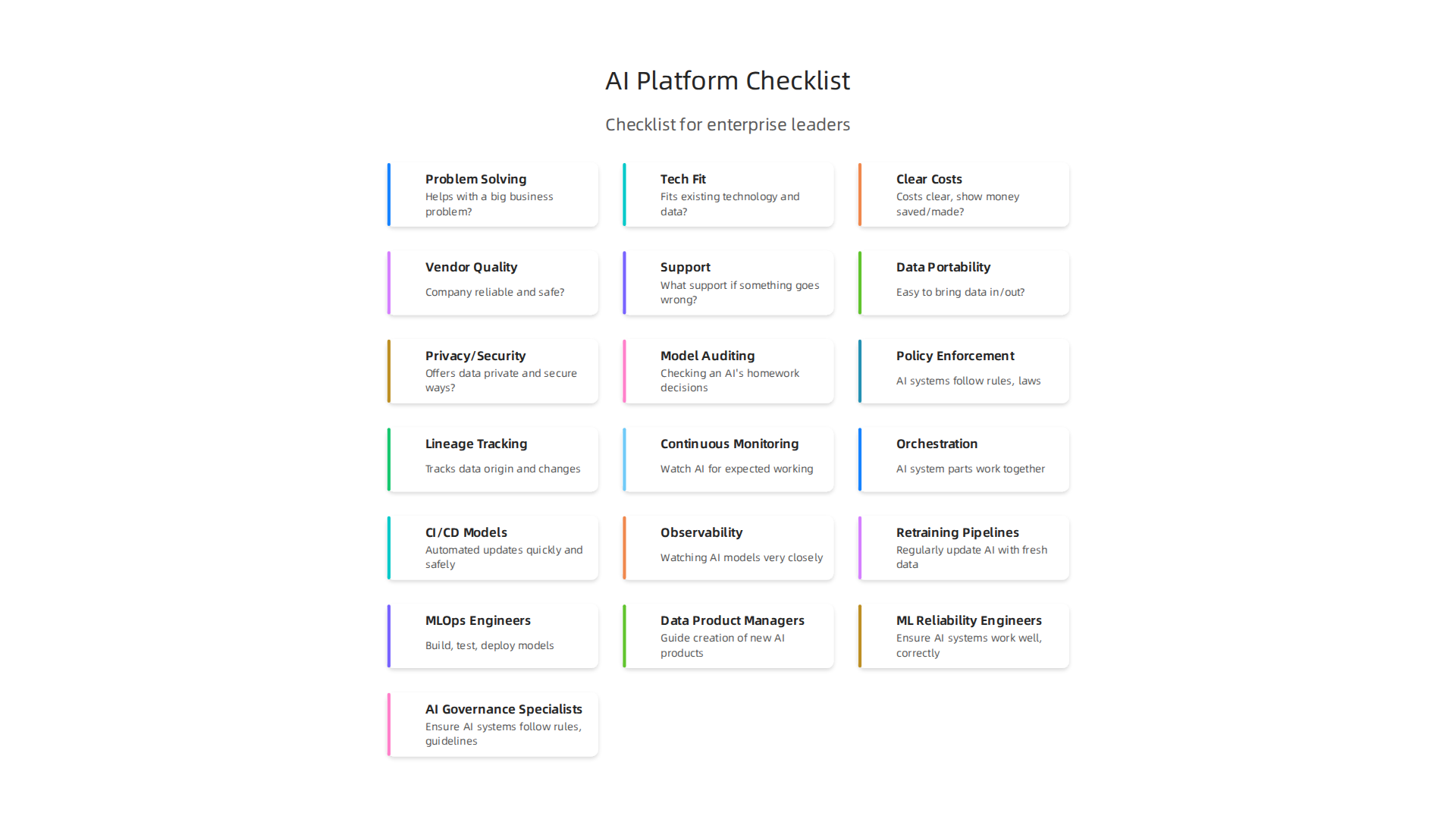
- Does this platform really help with a big problem our business has?
- Does it fit with our existing technology and data?
- Are the costs clear, and can we see how it will save or make us money?
- How good is the company that makes the tool? Are they known for being reliable and safe?
- What kind of support will we get if something goes wrong?
- Can we easily bring our data into the platform and take it out if needed?
- Does it offer ways to keep our data private and secure?
By asking these questions, you can make smarter choices about which AI platforms to bring into your company. For a more detailed look, you can explore an AI Engine Evaluation Framework for Enterprise Leaders in 2026. Also, understanding how to Select Top AI Companies in 2026 Beyond Hype for Enterprise Growth is key to making wise investments.
[1] Top 10 Enterprise AI Platforms in 2026 (Ranked)
[2] Enterprise AI Platform Buyers Guide 2026: From Siloed AI to …
After choosing the right AI platforms, the next big step is making sure they are safe and used correctly. This is where tools for governance, risk, and security come in. These are super important future tools ai because they help businesses trust their AI and follow all the rules.
2) Governance, Risk, and Security: Tools to Trust
Once you have picked your AI platforms, you need to make sure they are used in a smart and safe way. This means having special tools to watch over your AI, almost like a referee. These tools are often called governance and risk tools, and they are key to making sure your AI works well without causing problems.
Here are some important layers of these tools:
- Model Auditing: This is like checking an AI’s homework. These tools look at how an AI makes decisions to make sure it’s fair and accurate. They can spot if an AI is being biased or making mistakes.
- Policy Enforcement: Think of this as the AI’s rulebook. These tools make sure your AI systems follow all the company rules and government laws. For example, some states have new AI laws starting in 2026 that businesses must follow, putting a focus on risk management and oversight for important AI systems [1]. The White House also shared a national AI policy framework in 2026 to guide how AI should be used safely [2].
- Lineage: This tracks where all the data used by your AI comes from and how it changes. It’s like a family tree for data, helping you understand the whole journey of information through your
ai gateway. - Monitoring: These tools constantly watch your AI to make sure it’s working as expected. If the AI starts acting strangely or performs poorly, these tools send an alert so you can fix it quickly. This is crucial for maintaining
ai content creationsystems too, ensuring they don’t produce unwanted outputs.
These risk and governance tools need to work smoothly with your company’s existing security systems. They should fit right in with how you already protect your data and follow other rules. Many companies in 2026 are looking to make their AI governance transparent and secure, often by following frameworks like the one from the National Institute of Standards and Technology (NIST)
[3]. Good data quality is also a big part of AI governance, ensuring that the information AI uses is top-notch [4].
To know if these security tools are working well, companies look at certain numbers, called KPIs (Key Performance Indicators). For AI risk tools, these can include:
- False Positive Rates: How often the tool flags something as a problem when it’s not. You want this number to be low.
- Incident Detection Times: How quickly the tool finds a real problem. Faster is better.
- Audit Readiness: How easy it is to show that your AI systems meet all the necessary rules and regulations.
By carefully choosing and using these governance, risk, and security tools, businesses can use the power of future tools ai with confidence and peace of mind. Keeping up with the latest AI news helps leaders make informed decisions.
If you want to stay updated on all the changes and new tools in the world of AI, there’s a great resource.
The AI Newsletter Worth Reading delivers clear daily AI updates to help you navigate this fast-changing landscape. To learn more about ensuring your AI systems are trustworthy, you might also find this useful: Building Enterprise AI Trust with Human Oversight and Guardrails.
[1] 2026 AI Laws Update: Key Regulations and Practical Guidance
[2] White House Releases National AI Policy Framework | HUB
[3] AI Governance in 2026: A Full Perspective on What It Takes
[4] AI Governance: Data Best Practice and Solutions in 2026
After making sure your AI systems are safe and follow all the rules, the next important step is keeping them running smoothly day after day.

This is where MLOps, observability, and lifecycle tools come into play. These are essential future tools ai that help businesses manage their AI models from start to finish.
3) MLOps, Observability, and Lifecycle Tools: Making Models Operable
Think of MLOps (which stands for Machine Learning Operations) as the process of building, running, and taking care of AI models. It’s like a smart factory for AI, making sure everything works well, from creating the models to keeping them updated and performing their best. In 2026, many companies are focusing on MLOps to make their AI work effectively.
Here are the main parts of a modern MLOps setup:
- Orchestration: This is like a conductor leading an orchestra. It makes sure all the different parts of your AI system work together in the right order. This includes collecting data, training the AI model, and then getting it ready to be used. Tools like Apache Airflow are popular for this, helping manage complex workflows.
- CI/CD for Models: This means Continuous Integration and Continuous Delivery for your AI models. It’s about using automated tools to quickly and safely update your AI models. When a new and better version of an AI model is ready, these tools help roll it out without problems, much like how software updates are managed.
- Observability: This is about watching your AI models very closely. It’s like having a health monitor for your AI. Observability tools check if the AI is still making good predictions and if the data it’s using is still relevant. For example, if an AI was trained on old information, it might start to "drift" and make mistakes as the world changes. Observability helps spot these issues, preventing surprise failures and building trust in your AI systems. Many tools in 2026, like Arize and WhyLabs, focus on helping you detect and fix these drift problems quickly.
- Retraining Pipelines: Because the world changes, AI models need to learn new things. Retraining pipelines are automated systems that regularly update your AI models with fresh data. This ensures your AI stays smart and useful over time.
For businesses, choosing the right MLOps approach means weighing options. You can either build your own MLOps system from scratch, which gives you a lot of control but needs many skilled engineers, or you can use "managed MLOps solutions." These managed solutions are offered by big cloud companies like AWS SageMaker, Google Cloud Vertex AI, or Microsoft Azure ML. They provide ready-to-use tools and services that handle much of the hard work for you. Many businesses, especially large ones, are already using AI in some form, with over two-thirds using generative AI in at least one part of their business in 2026 [1]. Platforms like Databricks Mosaic AI are also widely used for their full lifecycle support, offering a reliable backbone for AI operations today [2].
Deciding between building your own and using a managed service depends on what your company needs and how much time and money you want to spend. Using managed platforms can make it easier to start with MLOps, but building your own might offer more customization for very specific needs. To help understand the skills needed for these areas, you might want to explore the different key software development engineering roles and skills in 2026.
It’s clear that MLOps, observability, and lifecycle tools are critical for any business that wants its AI to be reliable and effective for years to come. They help ensure your AI systems deliver real value and adapt to new challenges.
[1] 87% of Enterprises Run AI in 2026 — State of AI Adoption by …
[2] Best MLOps platforms in 2026
While MLOps helps make sure AI models run well, we also need helpful tools for the people who actually build and work with these models every day. This is where special developer and productivity tools come in. They are part of the exciting future tools ai landscape, speeding up how teams create and manage AI solutions in 2026.
4) Developer & Productivity Tooling: Accelerating Teams
Imagine developers having a super assistant that helps them write code faster and smarter. That’s what many new AI-powered developer tools are doing. They fit right into the programs developers already use, like their Integrated Development Environments (IDEs). These tools use AI to suggest code, fix mistakes, and even write whole sections of code based on simple instructions. This means developers can focus on the big ideas instead of getting stuck on small coding tasks.
Here are some ways these future tools ai are changing how teams work:
- Code-Generation Assistants: These AI helpers are like smart spell-checkers but for code. Tools like GitHub Copilot can suggest lines of code as a developer types, or even create entire functions. This makes the coding process much quicker and helps avoid common errors. It frees up developers to tackle more complex problems.
- AI for Orchestration Frameworks: When building advanced AI, especially with large language models (LLMs), connecting different parts can be tricky. Frameworks like LangChain make it easier to link various AI components, data sources, and tools. They help developers put together complex AI systems more simply. Tools like LangSmith, for example, are purpose-built to help debug and monitor LLM applications, which is a big help for developers [1].
- Better Workflows: These tools change how engineers work. Writing new code becomes faster. Code reviews can focus on the logic and goals of the software, not just small fixes. Testing also gets a boost, as AI can help find potential issues earlier, making the whole process smoother and more reliable.
To make the most of these new tools, businesses should try them out with clear goals. Start with a small team or project to see how much time they save or how they improve the quality of work. For example, measure how much faster a specific task gets done or how many fewer bugs appear. This smart approach helps ensure that new cloud-based productivity tools truly help your team and improve how you build AI.
The goal is to empower developers, allowing them to create AI solutions more quickly and effectively. If you’re looking to understand the skills needed to work with these new technologies, exploring resources like the enterprise AI engineer roadmap for 2026 can be a great next step.
Stay informed on the latest advancements and insights in AI and technology.
The AI Newsletter Worth Reading
[1] 11 MLOps Tools. One Career Shift. What 2026 Demands Now!
AI tools are only as good as the data they use. While smart developer tools help build AI faster, all those future tools ai need a strong base of good data to truly shine. Think of it like building a house. You can have the best tools to put up the walls, but if the foundation is weak, the whole house won’t stand tall. That’s why data infrastructure is so important for AI in 2026.
5) Data Infrastructure & Retrieval: The Foundation for Future Tools
For any new AI tool to work its magic, it needs quick access to the right kind of information. This is where special data systems come in. They are the backbone for things like smart search, recommendations, and even ai content creation. Without them, AI models would be like a chef with no ingredients.
Here are some key parts of this data foundation:
- Vector Databases: Imagine a library where instead of just words, books are stored by what they mean. When you ask a question, the librarian doesn’t look for exact words, but for books that have similar ideas. That’s what vector databases do for AI. They store information in a way that helps AI quickly find things that are alike, which is super important for many
future tools aithat understand meaning, not just keywords. - Real-Time Feature Stores: AI often needs to make decisions right now. To do this, it needs the freshest data possible. Real-time feature stores are like super-fast snack bars for AI models. They make sure the AI gets all the up-to-the-minute details it needs, like a customer’s latest actions or a stock’s current price. This is vital for things like fraud detection or giving instant, personalized advice. You can learn more about building robust data systems with a data pipeline 2026 blueprint for building real-time reliable infrastructure.
- Retrieval Stacks: These are the systems that connect your AI tools to all that data. They make sure that when an AI model needs information, it can pull it quickly and correctly from different places. It’s like having a well-organized system of pipes that brings water (data) to where it’s needed in your house (AI application).
Why Good Data is So Hard to Get Right
Even with all these cool data tools, many businesses face big hurdles. In 2026, about 79% of companies adopting AI still face challenges when getting these tools to work well in their everyday tasks, often because of data issues AI Adoption Statistics by Industry 2026.
- Data Governance: This means having clear rules about how data is collected, stored, and used. It’s about making sure data is safe, correct, and used in the right way. Without good governance, data can be messy, unsafe, or simply not trusted by the AI. This can slow down or even stop new tool adoption.
- Data Integration Challenges: Many companies have data stored in many different places, like old systems, cloud apps, and spreadsheets. Getting all this data to talk to each other is called data integration. It’s often very hard and takes a lot of work. If data isn’t properly connected, AI tools can’t get a full picture, making them less useful. This is a common problem that blocks new AI tools from being fully used. For insights into managing diverse data, explore the advantages and disadvantages of AI in enterprise data management.
Is Your Data Ready for New AI Tools? A Quick Checklist
Before you dive into using the latest future tools ai, ask these questions about your data:
- Is my data clean and accurate? Bad data leads to bad AI results.
- Can my AI tools access data quickly? Slow data means slow AI.
- Do I have rules for data privacy and security? Keeping data safe is a must.
- Is all my important data connected so AI can see it? Isolated data limits AI’s view.
- Can my data systems grow as my AI needs grow? Scalability is key for the long run.
Making sure your data foundation is strong is the first step to unlocking the full power of AI for your business.
Making sure your data foundation is strong is the first step to unlocking the full power of AI for your business. But even with the best data, you still need the right people to build, manage, and use these powerful future tools ai. In 2026, finding these skilled individuals is one of the biggest challenges for companies.
6) Talent, Org Design, and the Skills to Ship AI
The world of AI is growing super fast. This means there’s a huge need for people with special skills to make AI tools work. Think about it: someone needs to build the models, someone needs to make sure they run smoothly, and someone needs to connect them to the business. This creates what many call an "AI skills gap," where there aren’t enough skilled workers to fill all the new quantum jobs (though this term mostly applies to future, highly specialized fields, it shows the direction of highly technical roles).
According to reports, a big problem in 2026 is finding people with the right AI skills. In fact, 62% of Employers Can’t Find Workers With AI Skills needed for new projects.
Here are some of the key roles that matter most for getting AI tools from an idea to something that actually works:
- MLOps Engineers: These folks are like the mechanics of AI. They make sure machine learning models (the brains of AI) are built, tested, and put into action reliably. They’re essential for tools like
smartlead aior anyai content creationsystem to run without a hitch. - Data Product Managers: These people understand both the business side and the technical side of AI. They figure out what problems AI can solve for customers and guide the creation of new AI products.
- ML Reliability Engineers: Their main job is to make sure AI systems are always working well and giving correct results. They fix problems and make sure the AI is fair and safe to use.
- AI Governance Specialists: With new rules and laws about AI, these experts make sure AI systems follow all the guidelines for privacy and ethical use. They also help set up an
ai gatewayfor secure access.
To learn more about what kinds of roles are out there, check out the 2026 AI jobs landscape.
How Teams Can Work Better Together
Getting AI projects done means different types of experts need to work as one team. This is called organizational design. When teams are set up well, they can move fast and make sure AI is used safely. This often means breaking down old walls between departments so everyone can share ideas and tools. Companies are finding that having clear roles and good ways for teams to talk to each other helps them ship AI safely and quickly.
Hiring and Training When Money is Tight
It’s tough to find and keep AI talent, especially for smaller budgets. Here are some smart ways companies are tackling this in 2026:
- Upskilling Current Staff: Many businesses are training their own employees in AI skills. This is often cheaper than hiring new people and helps existing staff grow. You can find out more about building your workforce from within by reading about IT talent 2026 building your engineering workforce from within.
- Clear Career Paths: Showing employees how they can grow within the company and become AI experts encourages them to learn new skills.
- Partnering with Schools: Working with colleges and universities can help create a pipeline of new talent directly from classrooms.
- Focus on Value, Not Just Salary: While pay is important, offering interesting projects, a good work-life balance, and chances to learn can attract and keep talented people.
By thinking carefully about who you hire and how your teams work, you can make sure your business is ready for all the amazing future tools ai coming our way.
Curious about how AI is changing the business world every day?
The AI Newsletter Worth Reading
Summary
This article explains how large companies can choose and deploy the best new AI tools in 2026 by focusing on fit, risk, data, operations, and people. It walks through the main categories of ‘future tools AI’—AI-first platforms, governance and security tools, MLOps and observability, developer productivity tooling, and data infrastructure—showing why each matters and how they connect to business results. The guide offers practical checklists for platform and vendor selection, describes KPIs and controls for trustworthy AI, and outlines trade-offs between building and buying operational tooling. It also covers the talent and org changes needed to deliver AI at scale and gives concrete advice for piloting, monitoring, and retraining models. After reading, leaders will know what questions to ask vendors, how to assess risks and ROI horizons, and what infrastructure and skills to prioritize to make AI investments work long-term.