
Data Pipeline 2026 Blueprint for Building Real Time Reliable Infrastructure

Introduction: The Data Pipeline as a Strategic Asset
Imagine your team spends half of Monday just gathering spreadsheets, API exports, and database dumps before anyone can even think about making a decision. Sound familiar?

In 2026, most enterprises still wrestle with fragmented data sources, slow delivery, and governance headaches. The fix? A modern data pipeline that turns raw, scattered information into a steady, trusted stream of insights.
A strong data pipeline does more than move data from point A to point B. It powers real-time dashboards, fuels machine learning models, and makes business intelligence and data analytics actually useful for decision-makers. Without one, your analytics team spends their time fixing broken feeds instead of answering strategic questions. With one, you get answers in minutes instead of days.
The numbers back this up. The global data pipeline tools market is projected to grow from $12.26 billion in 2025 to $43.61 billion by 2032, according to a recent Data Pipeline Market Study. That explosive growth comes from companies realizing that faster, cleaner data directly translates to better outcomes. Meanwhile, organizations using cloud-based data integration services achieve significant performance gains and even report 3.7x ROI through these modern architectures.
Still, building a pipeline isn’t as simple as plugging in a tool. Most teams ask the same hard questions: Should we build it ourselves or buy a platform? How do we handle real-time streaming? What about data quality and security? And with AI workloads demanding ever-fresher data, the pressure only increases. In fact, over 60 percent of new pipelines now include real-time or near-real-time requirements to support personalization, fraud detection, and AI-driven applications.
This guide cuts through the hype and gives you a practical view of modern data pipelines. We’ll cover the key trends shaping 2026, the architecture decisions that matter, the build-vs-buy tradeoffs, and how to structure your team for success. If you’re leading a data engineering or analytics initiative, consider this your strategic playbook.
One more thing: the enterprise technology landscape shifts fast. To stay ahead, you need daily, digestible signals without the noise. That’s exactly what The AI Newsletter Worth Reading delivers clear, daily AI updates to help leaders like you make smarter moves. It’s free and it takes only a few minutes to read each day.
Before diving into build-versus-buy, let’s first look at the biggest trends reshaping data pipelines right now.
The Data Pipeline Imperative in 2026
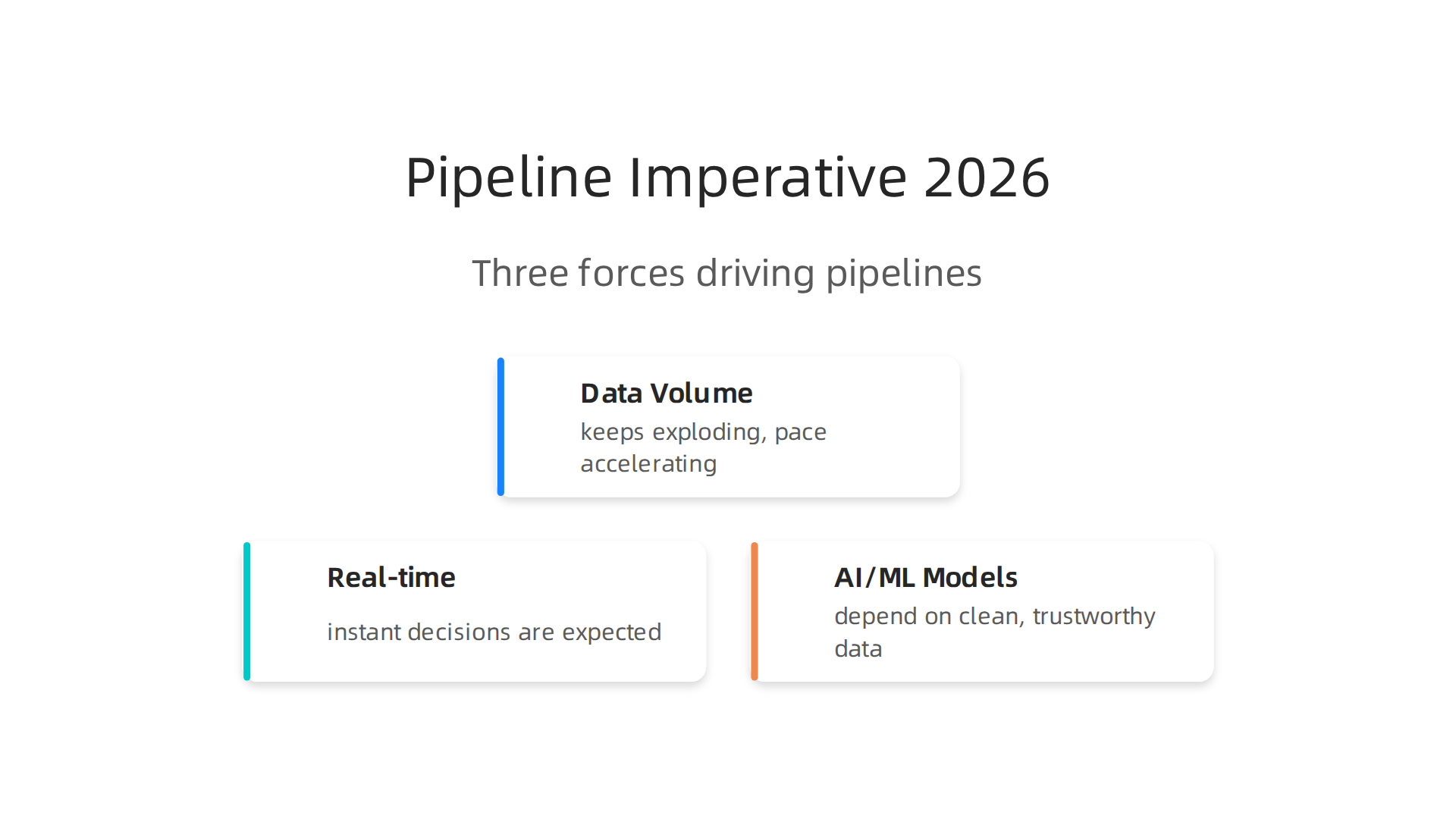
The numbers tell the story. Data volume keeps exploding, and the pace is only getting faster. In 2026, companies generate more data in a single day than they did in entire months just a few years ago. Add in the variety of sources, from IoT sensors to social media feeds, and you have a massive challenge. Without a solid data pipeline, this raw material becomes a mess instead of an asset.
Real-time decision making is no longer a nice to have. It is table stakes. Customers expect instant responses.

Fraud detection needs millisecond reactions. Your competitors already use streaming data to adjust pricing and personalize offers on the fly. According to the latest 2026 Data Engineering Stats report, over 60 percent of new data pipelines now include real-time or near-real-time requirements for operational analytics, personalization, and fraud detection. Batch processing alone just does not cut it anymore.
AI and machine learning models depend on clean, reliable data. Garbage in, garbage out is not just a saying. It is a costly reality. Models trained on messy data produce bad predictions and waste resources. Building a strong data pipeline means you feed your AI systems with consistent, high-quality information. That directly leads to better outcomes. To learn more about how enterprises are approaching AI in 2026, check out this guide on enterprise AI adoption in 2026.
The bottom line: data volume, speed, and variety demand a modern pipeline approach. Real time is the new normal. And AI only works when the data behind it is trustworthy. These three forces make the data pipeline a strategic imperative for every enterprise leader in 2026.
Key Trends Driving Pipeline Modernization
Let’s look at the key trends pushing pipeline modernization forward in 2026. First, real-time streaming and event-driven architectures have become the norm. Batch processing alone can’t keep up with instant customer demands or fraud detection needs. To succeed, you need to evaluate your infrastructure for real-time data and consider a cloud based data integration service that scales automatically.
Second, the lines between data engineering and data science roles are blurring. Engineers now build features for models, while data scientists handle production pipelines. This convergence demands new skills and tools. For a deeper look at how these roles are evolving, check out the AI jobs landscape in 2026.
Third, data observability and automated remediation are top priorities. Modern pipelines include continuous monitoring to catch drifts or errors before they cause downstream failures. This goes beyond simple alerts, using AI to automatically fix issues. To stay on top of these modernization trends, subscribe to The Deep View Newsletter for daily AI updates.
The Cost of Outdated Pipelines
Holding onto old school batch pipelines comes with a steep price tag. When your data only refreshes once a night, your business intelligence and data analytics reports are already out of date by morning. Decisions based on stale data lead to missed opportunities, bad forecasts, and slow responses to market changes.
Worse, poor data quality from a shaky pipeline wrecks your AI performance. Models trained on dirty or delayed data produce unreliable outputs. That is why leaders increasingly follow a data-backed enterprise AI strategy roadmap that prioritizes pipeline reliability.
The maintenance burden is another hidden cost. Your team spends precious hours patching broken connectors and fixing schema changes instead of building new features. Technical debt piles up fast. When deciding whether to build or buy, experts recommend starting with the cost of failure in data pipelines. Ignoring that cost means your budget gets eaten alive by keeping old systems alive, while your competitors race ahead with modern, scalable pipelines.
Core Components and Best Practices
So what does a modern data pipeline actually look like? Think of it as a few distinct layers working together. First, you have ingestion — that is how you pull raw data from sources like databases, APIs, or streams. Next comes transformation, where you clean, model, and get that data ready for use. Then orchestration schedules and manages the whole process so everything runs in the right order. Finally, delivery sends the polished data to tools for business intelligence and data analytics.
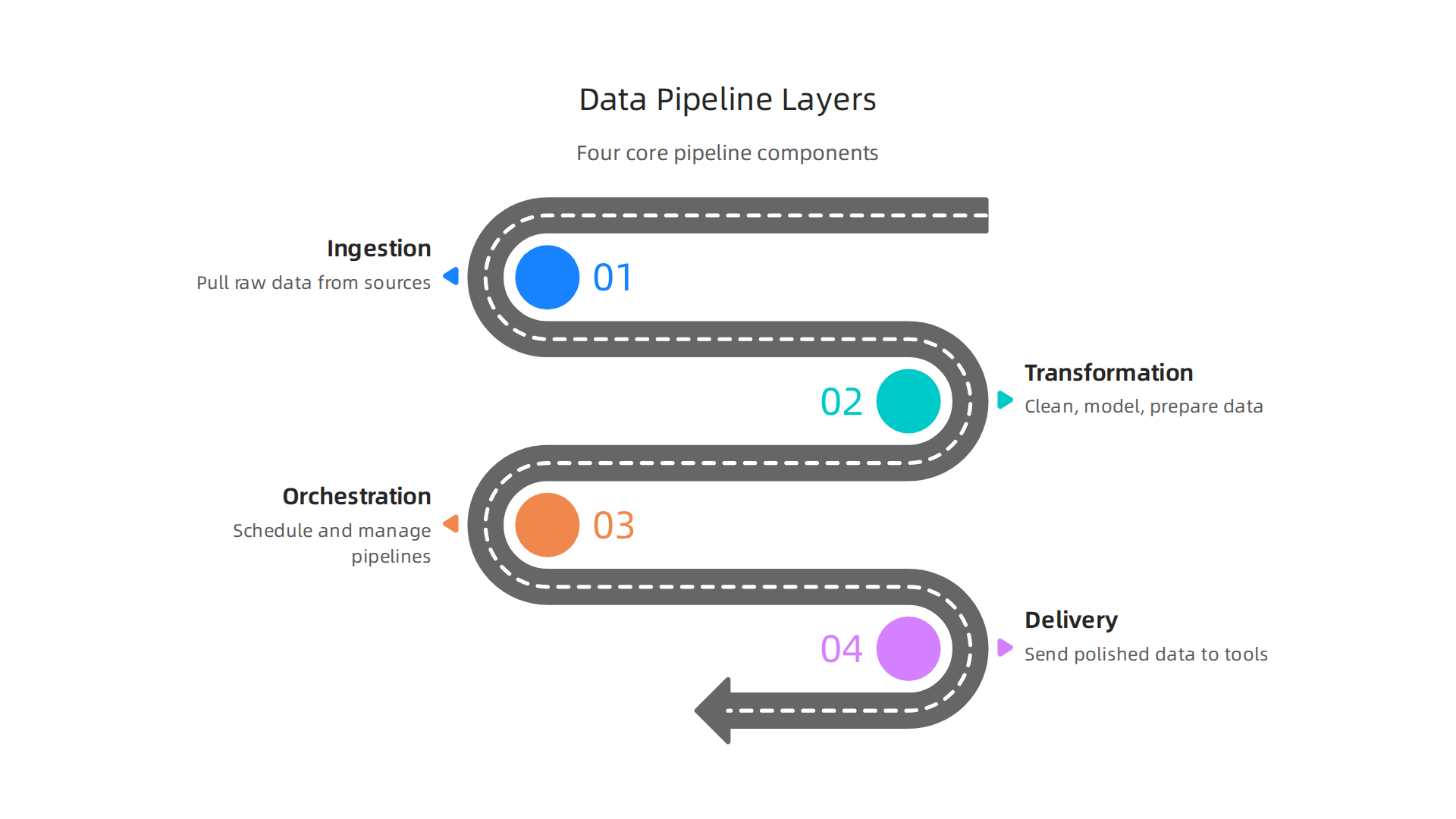
Getting these layers right matters. The best pipelines follow a few proven practices. One is idempotency — meaning you can run the same pipeline again and get the same result, no surprises. Another is decoupled architecture — each layer works independently, so a failure in one doesn’t take down the whole system. And you cannot skip monitoring. You need visibility into data flow, errors, and freshness to catch problems early. For a deeper look at these principles, check out this guide on how to build a modern data pipeline.
Building your pipeline also means choosing the right tools for each layer. Start with solid planning. If you are still gathering data from different places, you might want to read about data collection methods for enterprise AI to make sure you are capturing what matters.
Want to stay on top of all the latest in AI and data engineering? Sign up for The AI Newsletter Worth Reading — clear daily updates that help leaders like you make smarter tech decisions.
Ingestion, Transformation, and Orchestration
Now let’s break down the three engine rooms of your data pipeline. Each one plays a different role in turning raw data into something useful.
Ingestion is how raw data enters your system. It can come from databases, APIs, or real-time event streams. You have two main choices: batch processing, where you collect data in large chunks on a schedule, or streaming, where data flows in continuously. The right pick depends on how fresh your data needs to be. For a deeper look at these options, read this overview of modern data pipeline architecture.
Transformation is where the real magic happens. You clean, model, and get the data ready for analysis. Most teams use either ETL (extract, transform, load) or ELT (extract, load, transform). Careful schema management is key here. If you change how data is structured, it can break your dashboards downstream. Learning how to manage these changes is part of mastering data pipeline components and best practices.
Orchestration acts like a conductor for the whole process. It schedules when each task runs, manages dependencies, and retries jobs that fail. Popular tools like Apache Airflow or Prefect automate this workflow. Without orchestration, you would be stuck starting jobs by hand and hoping nothing breaks.
These three layers work together to keep your pipeline running smoothly. Once you have them wired up, you can focus on delivering quality data for business decisions. And if you want to understand how that data feeds into your analytics strategy, check out this guide on analytics definition for enterprise leaders.
Ensuring Data Quality and Governance
You have ingestion, transformation, and orchestration running. But if your data is full of errors, the whole pipeline loses value. That is why data quality and governance must be baked in at every stage, not just fixed at the end.

Quality checks should start at ingestion. Validate that incoming data is complete and accurate. Keep checking during transformation and before your dashboards consume it. For a step-by-step approach to setting these checks across pipeline stages, read this guide on implementing data governance in your data pipelines.
Governance policies like data lineage and cataloging build trust. Lineage shows the full journey of each data point from source to dashboard. A data catalog makes it easy for teams to find and understand what they are working with. Assigning clear data owners keeps someone accountable for quality.
Automated monitoring prevents quality drift. Manual spot checks are not enough. Set up alerts that notify your team when data gets stale, missing values appear, or schema changes break your transformations. The earlier you catch problems, the less damage they cause.
Your data collection practices also affect quality. Learn how to build strong foundations in the guide on data collection methods for enterprise AI.
Staying current with technology trends helps you refine your governance strategy over time. For clear daily updates on AI and enterprise tech, check out The AI Newsletter Worth Reading. It delivers insights you can apply to keep your pipeline trustworthy.
Architecting for Real-Time and Advanced Analytics
Not every data task needs instant answers. But many business decisions cannot wait for overnight batch jobs. That is why more teams are shifting toward real-time data pipeline designs.
Real-time architectures cut down on delay. Instead of processing data in large chunks every few hours, they move data as it arrives. Two common patterns are Lambda and Kappa. Lambda runs batch and streaming side by side. Kappa skips batch and uses streaming only. Both help you reduce latency. For a deeper look at these approaches, check out the guide on Lambda or hybrid architecture patterns.
Event-driven pipelines take real-time a step further. They react to events as they happen. When a customer places an order, the pipeline triggers updates to inventory, billing, and shipping right away. This helps businesses respond faster to customer needs.
Advanced analytics and AI depend on low-latency data feeds. Machine learning models need fresh data to make accurate predictions. If your data pipeline only refreshes once a day, your AI models are working with stale information. That hurts performance. To learn how to build an AI-ready infrastructure, read this enterprise AI adoption roadmap.
The key is to match your architecture to your use case. Real-time intelligence can unlock new opportunities, but it takes careful planning. Start with the business need, then pick the pattern that fits.
Streaming Architectures and Event-Driven Pipelines
Once you choose a pattern, you need the right tools to make it work. Apache Kafka and cloud-native streaming services like Google Dataflow or AWS Kinesis lead the way in 2026. These platforms can handle huge streams of incoming data without breaking a sweat. According to the guide on best data pipeline tools in 2026, Kafka remains a top choice for distributed event streaming.
Event-driven pipelines take this a step further by decoupling producers and consumers. When one system sends an event, the pipeline routes it to any service that needs it. This makes your data pipeline more flexible and easier to scale. For more on how this works in enterprise settings, read about platform engineering in 2026.
Stream processing engines like Apache Flink and Kafka Streams then transform data in real time. They run continuous transformations on the fly. Instead of waiting for a batch job to finish, you get clean, enriched data instantly. This powers things like live dashboards and real-time fraud detection. To stay on top of these fast-moving tools, subscribe to The AI Newsletter Worth Reading for daily updates on AI and data pipeline trends.
Integrating AI/ML into the Pipeline
Now let’s look at how AI and machine learning fit into your data pipeline. You can add trained models directly as pipeline steps to run predictions on live data. This turns your pipeline into an engine for instant insights. For a full breakdown of each stage, check out the 2026 guide to building and scaling an AI data pipeline.
A key piece is the feature store. It centralizes feature engineering so every team uses the same clean, reusable features. Instead of rebuilding features for every project, you pull them from one place. This saves time and keeps your models accurate. If you want to see how tools like SageMaker handle this, read our article on how AWS SageMaker streamlines feature engineering for enterprise data science.
Finally, automated retraining loops depend on feedback data from the pipeline. As your model makes predictions, the pipeline collects results and flags when performance drops. That signals the system to retrain automatically. Without this feedback loop, your model gets stale and your business intelligence and data analytics suffer. A well-built pipeline keeps your AI sharp and your decisions sound.
Evaluating Solutions: Build, Buy, or Hybrid
After seeing how AI fits into your pipeline, you face a big question. Should you build everything yourself, buy a ready-made tool, or do a mix of both? The right answer depends on your team, timeline, and goals.
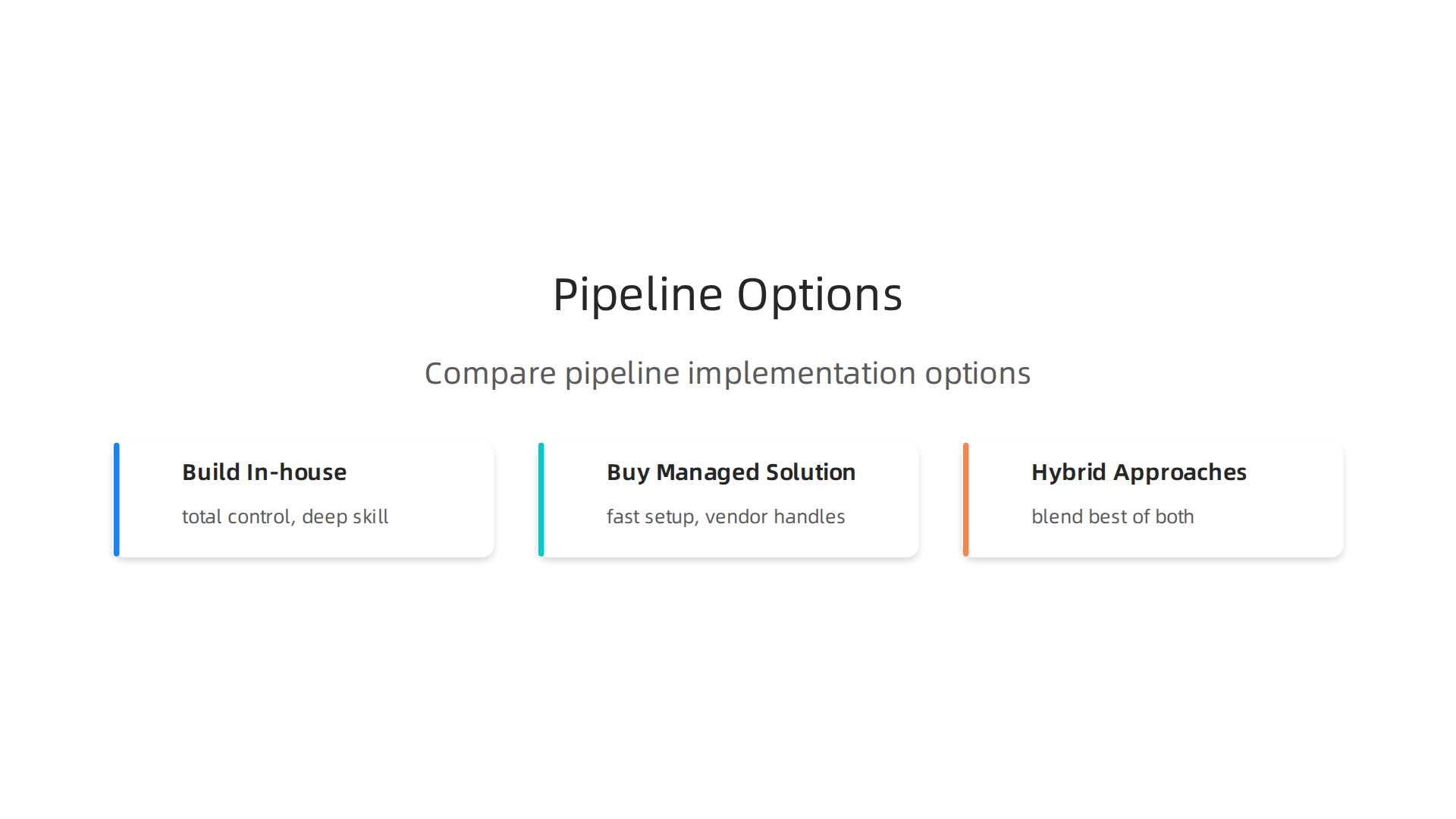
Building in-house gives you total control. You can customize every part of your data pipeline to match your exact needs. But this path requires deep technical skill. Your team must handle development, maintenance, and upgrades. That takes time and money.
Buying a managed solution gets you up and running fast. You skip the hard work of building from scratch. The vendor handles updates and support. If your team is small or you need speed, buying is often smarter. For a clear breakdown of the trade-offs, check out the build vs buy data pipeline guide from RudderStack.
Hybrid approaches blend the best of both. You use a cloud based data integration service for common tasks and build custom pieces only where you need unique control. This saves effort while keeping your special features.
Most enterprise teams end up somewhere in the middle. They buy standard capabilities and build only the parts that give them an edge. To learn more about making this choice for your organization, read our enterprise AI adoption roadmap for 2026.
And to stay sharp on the latest data and AI trends, get clear daily updates from The AI Newsletter Worth Reading.
Building the Team and Culture for Pipeline Success
Choosing your data pipeline approach is only half the work. The other half is building a team and culture that can make it run smoothly. Without the right people, even the best pipeline will break down.

Start with a cross-functional data platform team. Your pipeline needs skills from data engineering, DevOps, and business intelligence and data analytics working together. Data engineers build and maintain the flow. DevOps keeps everything running reliably. Analytics experts turn the data into decisions. When these groups collaborate, your pipeline stays healthy.
DevOps and DataOps practices are your friend. They bring automation, monitoring, and fast feedback to your data pipeline. Instead of fixing broken pipelines manually, you set up alerts and automated recovery. This cuts downtime and builds trust in your data. Investing in these practices early saves headaches later.
Don’t forget data literacy across your organization. A pipeline is only valuable if people actually use the data it delivers. Teach your teams how to read, question, and apply data in their daily work. When everyone understands what is data annotation or how to spot quality issues, your pipeline delivers real value. According to the Enterprise Data Governance 2026: A Strategic Priorities Guide, upskilling teams and promoting cross-department collaboration turns governance from a set of rules into a shared culture.
Building a strong team also means planning your hiring and growth strategy. For practical advice on that, see our guide on IT talent 2026: building your engineering workforce from within. The right mix of skills and a culture that values data will make your pipeline investment pay off.
Summary
This article explains why a modern data pipeline is a strategic asset for enterprises in 2026 and outlines how to build, run, and scale one. It covers the accelerating demands of data volume, speed, and variety—especially the shift to real-time and event-driven architectures—and why clean, fresh data is essential for reliable AI and analytics. The guide breaks pipelines into ingestion, transformation, orchestration, and delivery layers, details best practices like idempotency and decoupling, and shows how to bake data quality and governance into each step. It also examines streaming tools and patterns, how to embed ML (feature stores and automated retraining), and the practical tradeoffs of building, buying, or combining solutions. Finally, it recommends team structures, DevOps/DataOps practices, and skills that make pipelines sustainable so leaders can move from firefighting broken feeds to delivering timely business insights.