Elevate Enterprise Productivity with AI-Powered Study Tools

Introduction: Why AI-Powered Study Tools Matter for Enterprise Productivity and Learning
In 2026, businesses of all sizes are looking for smart ways to help their teams learn and work better. This is where AI-powered study tools come in. Think of these tools as super-smart helpers that use artificial intelligence to make learning easier and faster. They can turn boring study materials into fun quizzes, flashcards, and quick summaries. This helps people understand and remember important information much more effectively Free AI Study Tools – Summarize, Quiz & Learn Faster.
For medium-to-large companies, these ai-powered study tools are a game-changer.

They help with important things like bringing new employees on board quickly, making sure everyone remembers what they learn, and keeping skills fresh with continuous training. Imagine new hires getting up to speed in half the time because an AI tool guides them through company knowledge. Or current employees easily finding and understanding complex information they need for their jobs, boosting their overall output. These top AI tools help companies keep up in a fast-changing world.
The main problems AI-powered study tools solve for businesses are big ones:
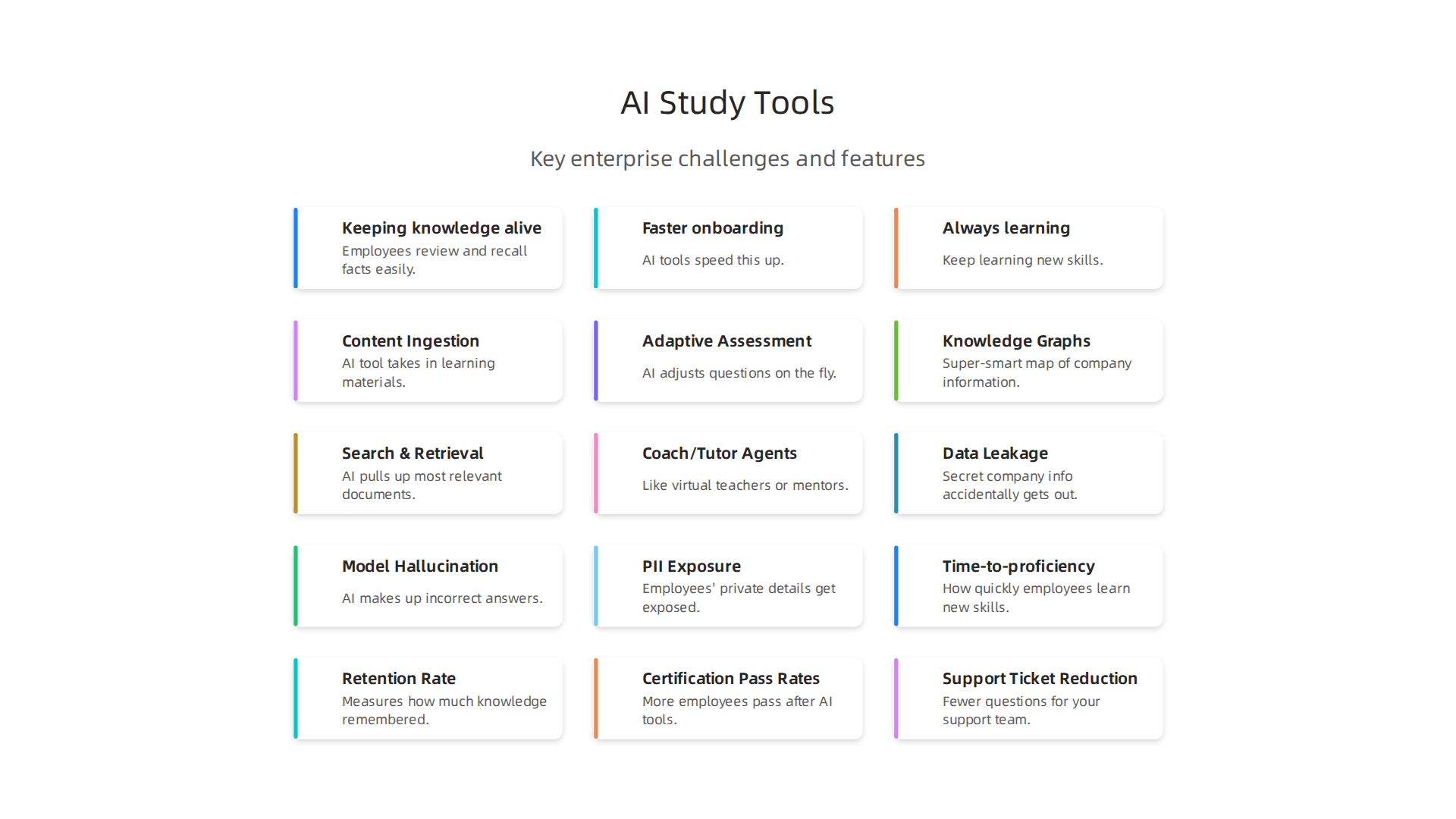
- Keeping knowledge alive: Employees learn a lot, but sometimes they forget things. These tools help them review and recall facts easily.
- Faster onboarding: Getting new team members ready for their roles can take a long time. AI tools speed this up by giving personalized learning paths.
- Always learning: The world of business changes fast. These tools help employees keep learning new skills all the time, which is key for staying competitive.
This guide will walk you through everything you need to know about these helpful tools. We will cover how to pick the right ones, how to put them into action, and how to measure if they are truly helping your company. By the end, you will understand how to use ai-powered study tools to improve how your teams learn and work. To stay on top of all the latest changes in AI and technology for your business, consider subscribing to The AI Newsletter Worth Reading. It helps business leaders like you navigate new tech advancements. For more on how AI can benefit your company, explore our insights on how to master generative AI tools for enterprise productivity.
How ai-powered study tools boost knowledge retention and on-the-job performance
AI-powered study tools do more than just make learning fun; they actually help people remember information much better and for a longer time. This is super important for businesses because when employees remember more, they can do their jobs better.
These tools use smart ways to help people learn and remember. Here are a few:
- Adaptive Review: Imagine a tutor who knows exactly what you’ve learned and what you still struggle with. AI tools do this. They track your progress and present information you need to review more often. If you get something right many times, they show it less. If you often forget something, they bring it up again until it sticks. This personalized approach makes learning much more efficient.
- Spaced Repetition: This method means reviewing information at just the right time, right before you might forget it. AI tools are great at figuring out this perfect timing. Studies show that using AI to help with active review and spaced repetition can really boost how much people remember over time Harnessing Generative AI to Boost Active Retrieval and Retention in MOOCs. This way, what you learn today is still clear in your mind weeks or months later.
- Personalized Microlearning: Instead of long, tiring training sessions, AI breaks down learning into small, easy-to-digest parts. These "micro-lessons" can be quick videos, quizzes, or flashcards that you can do anytime, anywhere. Because they are short and focused, they are easier to fit into a busy workday and less likely to cause overload. The AI makes sure these small parts build on each other, giving each person a unique learning path that fits their needs.
When employees remember what they learn, it leads to big wins for the company.

They make fewer mistakes, complete tasks faster, and are more confident in their work. This directly improves how well the business runs.
Think about these real-world examples in 2026:
- Onboarding New Hires: Instead of taking months to fully train new employees, AI-powered study tools can cut that time down. New team members learn company policies, software, and job tasks faster, getting them productive sooner. This also ensures they meet required training standards quickly.
- Certifications and Compliance: Many jobs need special certifications or regular training to follow rules. AI tools help employees prepare for these tests more effectively, leading to higher pass rates. This keeps the company in good standing and avoids problems.
- Skill Updates: As technology changes, employees need to learn new skills. AI tools make it easy for them to keep their knowledge fresh, so your team always has the latest skills needed to stay competitive.
Choosing the right platform for managing learning in your company is a crucial first step to taking advantage of these benefits. Explore how to make smart enterprise cloud LMS decisions for your business.
Choosing the right learning platform is just the start. To truly get the most out of AI-powered study tools for your company, you need to know what features they offer. Not all tools are built the same, and understanding their different parts helps you pick the best one for your team.
Here are the main features you’ll find in AI-powered study tools for businesses:
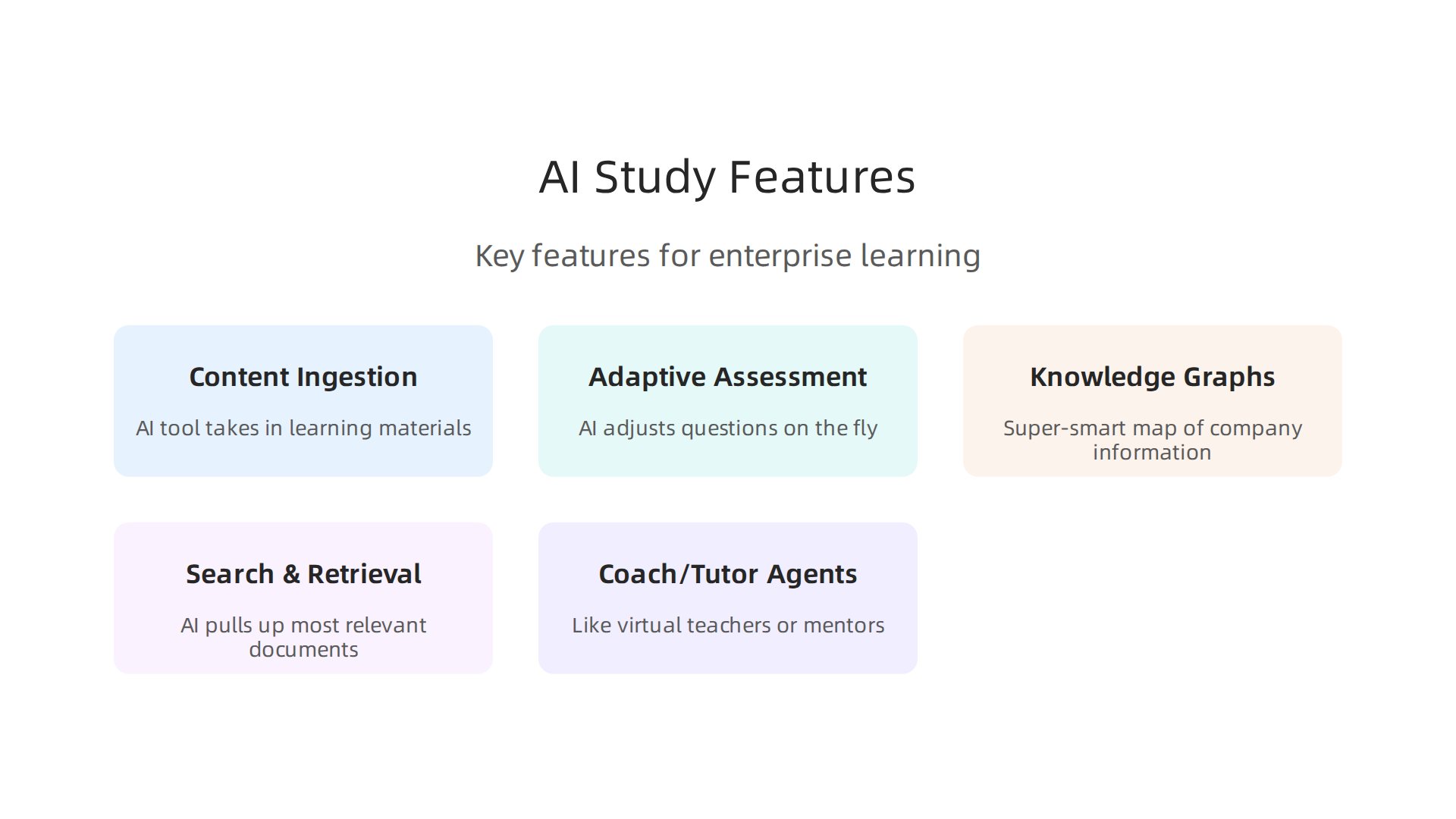
Content Ingestion
This simply means how the AI tool takes in all your company’s learning materials. It can take many forms:
- Text and Documents: The AI reads through your existing manuals, reports, and policies.
- Videos and Audio: It can even understand information from training videos or recorded meetings.
- Presentations: Slides from workshops and talks can also be "ingested."
The better the tool is at understanding all these different kinds of information, the more helpful it will be.
Adaptive Assessment
This is where the AI truly shines. Instead of one-size-fits-all tests, adaptive assessment means the AI checks what each person knows and then adjusts questions on the fly. If you answer correctly, it moves on. If you struggle, it provides more help or similar questions until you grasp the idea. This makes learning much more personal and effective.
Knowledge Graphs
Think of a knowledge graph as a super-smart map of all your company’s information. It connects different ideas, facts, and training topics together. This helps the AI understand how everything relates. When a learner asks a question, the AI can use this graph to give a more complete and helpful answer, even drawing connections you might not expect. Artificial intelligence can even help create these information maps in the first place, making it easier to organize complex data AI & Taxonomy: the Good and the Bad.
Search & Retrieval
When employees need to find specific information quickly, these tools come in handy. The AI can understand what someone is looking for, even if they don’t use the exact keywords. It then pulls up the most relevant documents, videos, or lessons from your content, acting like a super-smart search engine for your company’s knowledge.
Coach/Tutor Agents
These are like virtual teachers or mentors. They can answer questions, explain difficult topics, and even offer practice problems. They provide immediate feedback and guidance, helping employees learn and solve problems as they come up, just like a real coach would.
What Enterprises Need to Look For
For businesses, some extra features are really important:
- Admin Controls: Easy ways for managers to set up learning paths, add users, and oversee progress.
- Analytics: Clear reports that show how employees are learning, what they’re struggling with, and how the training is helping the business.
- Single Sign-On (SSO): This makes it easy for employees to log in using their existing company accounts, saving time and hassle.
- Data Export and APIs: The ability to easily move data out of the system or connect it with other company software. This ensures your learning data can be used with other business tools.
When choosing ai-powered study tools, companies often face a choice:
- Configurable Platforms: These allow you to customize almost everything, fitting the tool perfectly to your company’s needs. This takes more effort to set up but gives you full control.
- Turnkey Solutions: These are ready-to-use right out of the box, with less setup needed. They might not be as flexible, but they are faster to get started with.
The best choice depends on how much customization you need and how quickly you want to launch. Making the right technology choices is a big part of creating an effective best AI for business enterprise strategy guide in 2026.
If you want to keep up with the latest advancements in AI and technology for your enterprise, there’s a valuable resource available. The AI Newsletter Worth Reading delivers clear, daily updates to help business leaders stay informed.
Choosing the right features and thinking about how to set up your new AI tools is important. But for any business using ai-powered study tools, keeping your company’s information safe and private is even more critical. In 2026, using AI means you must pay close attention to security rules and privacy laws.
Common Risks with AI Study Tools
When your company uses AI study tools, there are a few big dangers to watch out for:
- Data Leakage: This happens when secret company information or private employee details accidentally get out. For example, if training materials contain sensitive business plans, you wouldn’t want those to become public.
- Model Hallucination: Sometimes, AI can "make up" answers that sound right but are actually wrong. For learning tools, this means employees could be taught incorrect information, which is bad for business.
- Personal Information (PII) Exposure: Your employees’ names, addresses, or learning progress are private. If these details get exposed, it can cause big problems and break trust. Protecting this kind of data is a key part of enterprise AI security, as highlighted in guides for 2026 Enterprise AI Security: Complete 2026 Guide.
Checking for Rules and Policies
To make sure your ai-powered study tools are safe, you need to check that they follow important rules:
- Data Residency: Find out where the tool stores your data. Some laws require company data to stay in certain countries.
- Security Standards: Look for tools that meet common security rules like SOC or ISO. These show that the tool has been checked and found to be secure. For example, a 2026 security checklist emphasizes a legally binding guarantee that your data will not be used to train vendor models The 2026 Enterprise AI Security Checklist: 15 Non ….
- Contract Promises: Make sure your contract with the tool provider clearly states how they will protect your data. These promises are super important for keeping your business safe.
How to Keep Things Safe
Beyond choosing the right tool, how you use and manage it also matters a lot. These are called operational controls:
- Access Management: This means controlling who can see what information. Only people who need to see certain data should have access to it. This idea is called "least privilege" access and is a best practice for AI security in 2026 AI Agent Security in 2026: What Enterprises Are Getting ….
- Logging: The system should keep a record of everything that happens, like who logged in and what they did. This helps you check for any strange activity.
- Vendor Checks: Before you pick an AI study tool, do a careful check of the company that makes it. Ask them about their security practices and how they handle data.
- Service Agreements (SLAs): These are agreements that clearly spell out the service level and security promises the vendor makes.
By paying attention to these security, privacy, and compliance details, your company can use ai powered study tools with more confidence. Building trust in AI systems through careful planning is essential for any enterprise. You can learn more about how to do this by reading about Building Enterprise AI Trust with Human Oversight and Guardrails.
Measuring Impact: KPIs, Evaluation Frameworks, and ROI for Learning Initiatives
After making sure your AI powered study tools are safe and trustworthy, the next big step is to see if they actually help your business grow. You need to know if the money and time you put into these tools are giving you good results. This means looking at how well people learn and how that helps your company.
Practical Ways to Measure Success
To truly understand the impact of your learning programs, you can track key performance indicators (KPIs).
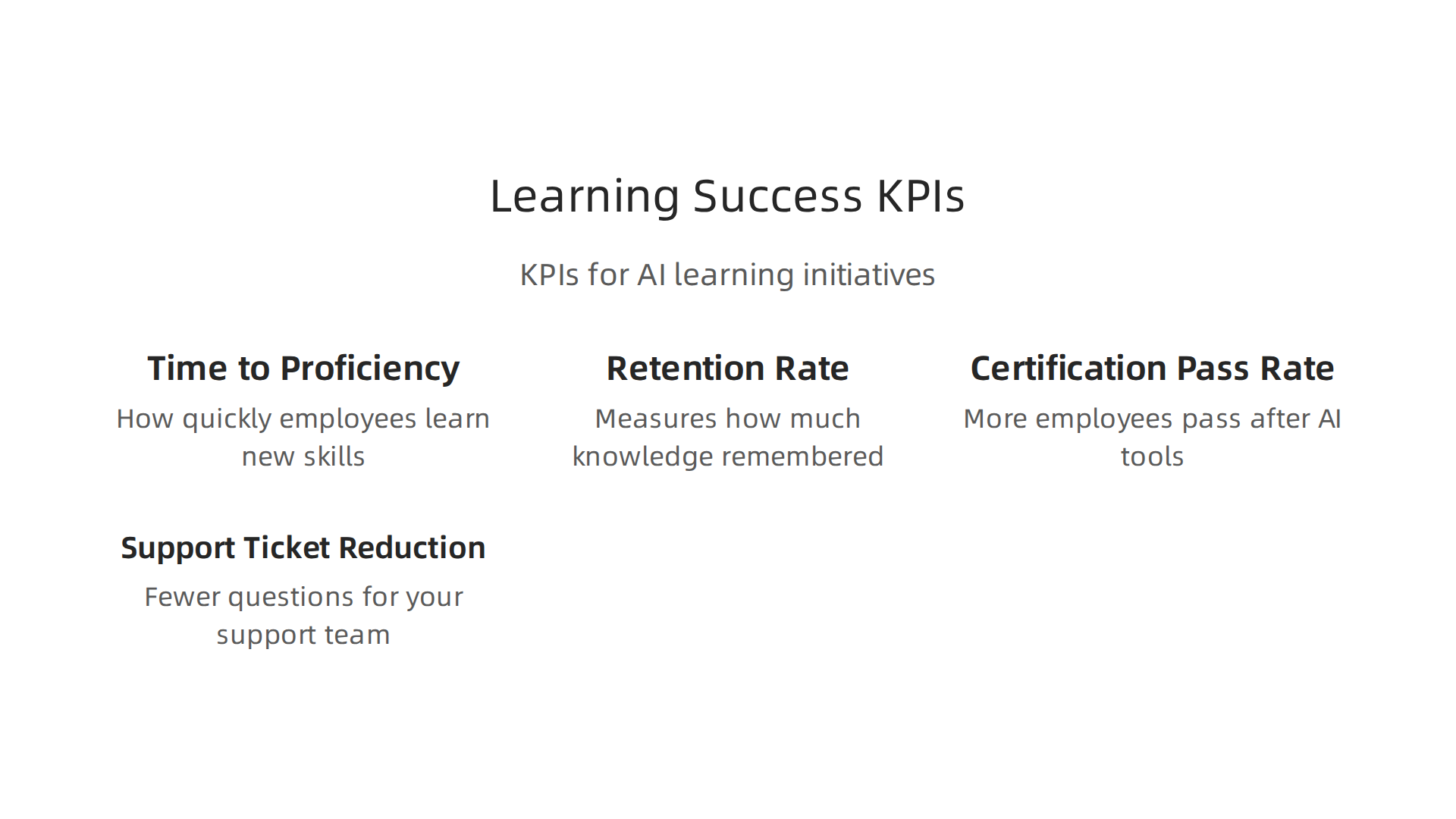
These are simply numbers that help you see if things are getting better.
- Time-to-proficiency: How quickly do employees learn new skills with the help of AI study tools? If they learn faster, they can start new tasks sooner.
- Retention Rate: This measures how much knowledge people remember over time. Studies show that AI-driven learning can make employees remember information better and learn more efficiently International Journal of Instruction.
- Certification Pass Rates: If your employees need to pass certain exams, track if more of them pass after using the AI tools.
- Support Ticket Reduction: When training is really good, employees need less help later on. This can mean fewer questions for your support team.
Testing AI Study Tools
To really know if new ai-powered study tools are helping, you can run small tests. Think of it like a science experiment. You can have one group of employees use the new AI tools, and another group learn the usual way. Then you compare their progress and results.
This kind of testing, like a pilot program or an A/B test, helps you clearly see the benefits. It gives you strong proof that the AI tools are making a difference, as experts say that good "causal evidence" is important when looking at AI’s impact on learning The Evidence Base on AI in K-12: A 2026 Review. For more tips, you can read about How to Evaluate AI Education Tools.
Turning Learning into Business Value (ROI)
The final step is to connect all these learning improvements back to your business goals. For example, if employees learn faster, they might be able to work on new projects more quickly. If they remember more, they could make fewer mistakes or serve customers better.
This helps you figure out the Return on Investment (ROI) for your ai-powered study tools. Showing how better learning leads to more money made or costs saved is very important for business leaders. Understanding how to measure this effectively is part of a strong enterprise AI adoption in 2026 strategy.
To keep up with the latest in AI and enterprise technology, get daily updates from The AI Newsletter Worth Reading.
Integration and implementation: embedding study tools into enterprise workflows
Once you know your AI-powered study tools are working well and making a difference, the next big step is to fit them smoothly into your company’s daily work.

This means connecting them with your existing systems and making sure everyone understands how to use them.
How AI Study Tools Can Connect
Bringing new ai-powered study tools into your company usually happens in a few ways:
- LMS Connectors: Many companies use a Learning Management System (LMS) to handle all their training. AI tools can connect right into these systems. This lets your employees find all their learning in one familiar place. To make good choices for your training platforms, you can look at an Enterprise Cloud LMS Decisions A Leaders 2026 Blueprint.
- API-Driven Knowledge Syncs: This is like building a custom bridge between your AI tools and other company software. It helps share information so learning content stays fresh and smart across different platforms. This is part of a larger strategy for Mastering Massive AI Enterprise Strategy and Implementation in 2026.
- Browser Extensions: Some AI tools work as small add-ons to your web browser. They can help employees learn while they are doing their regular online tasks.
- In-App Assistants: Imagine an AI helper built right into the software your team already uses every day. It can offer learning tips or quick answers without ever leaving the app. Using generative AI tools can greatly improve enterprise productivity.
When thinking about using the best AI tools, it’s key to make sure they can talk to your existing systems. Experts suggest that defining clear business goals is the first step for successful AI Integration in 2026: Skills, Strategy & Future Trends.
Managing Change and Setting Rules
Adding new ai-powered study tools means more than just plugging them in. You need to think about how people will use them and who is in charge of what.
- Content Ownership: Who will create the learning materials that the AI tools use? Who checks them to make sure they are correct and helpful?
- SME Workflows: Subject Matter Experts (SMEs) are the people who know a lot about a specific topic. You need a clear way for them to work with AI, whether it is reviewing AI-generated content or adding their own wisdom.
- Governance for Learning Paths: This means setting up clear rules for how learning programs are built and shared. It helps ensure everyone learns the right things in the right way. Building trust in AI also involves human oversight and guardrails.
Getting Ready for Implementation
Bringing AI study tools into a big company takes time and resources. It’s important to plan for this.
- Timelines: How long will it take to set up these tools and get everyone trained? This often depends on how complex the tools are and how many systems they need to connect with.
- Common Roadblocks: You might run into problems like older computer systems that don’t easily connect, or people being unsure about using new technology. It is important to have a plan for how to handle these issues.
- Resource Requirements: Your IT team will need to help set up and maintain the tools. Your learning and development (L&D) team will help create and manage the content. Thinking about The Enterprise AI Engineer Roadmap for 2026 can help you see what skills your team needs.
After planning how to put AI study tools into your company’s daily work, the next big step is picking the right company to get these tools from. This part is about looking closely at different providers to make sure you choose the best fit.
How to Pick the Right Vendor
When you are looking for new ai-powered study tools, you need to check a few main things. Think of these as important filters:
- Security: How safe is your company’s information with this vendor? Make sure their tools protect your data very well. In 2026, checking things like data encryption and access controls is a must for enterprise AI security, as outlined in The 2026 Enterprise AI Security Checklist.
- What’s Next for the Tool: Does the vendor have a clear plan for making their tool better in the future? You want a tool that will grow with your company.
- Easy Connections: Can the ai powered study tools easily connect with other computer systems you already use? This makes things smoother for everyone.
- Getting Your Data Out: If you ever need to stop using the tool, can you easily get all your company’s learning data back? This is important.
- Clear Prices: Do you understand exactly how much the tool will cost? There should be no hidden fees.
How to Really Check Out Vendors
It’s smart to create a special scorecard to compare different vendors. This helps you look past what they say in ads and see how well their ai-powered study tools will actually work for your business.
When vendors show you their tools, ask them to show real examples of how companies like yours use them. Don’t just look at fancy presentations. Make sure the tools can do what you need them to do every day. This helps you select top AI companies in 2026 beyond hype for enterprise growth.
Planning for the Future: Vendor Risk
You also need to think about what might happen later on. This is called vendor risk management.
- Leaving the Tool: What if the tool no longer meets your needs? You need a plan for how you would stop using it and move to something else without big problems.
- Data Safety: Make sure your data can be moved easily if you switch.
- Understanding the AI: Can the vendor explain how their AI makes its decisions? This is called model transparency and it helps you trust the tool more.
It’s a good idea to use a thorough AI Vendor Due Diligence Checklist (2026) to cover all these points. Choosing a partner for your AI strategy needs careful thought.
Want to stay on top of all the new AI tools and strategies?
The AI Newsletter Worth Reading delivers clear daily AI updates to your inbox.
The world of ai-powered study tools is changing very fast. For business leaders like CIOs, it’s important to know what’s coming next.

Staying updated helps you make smart choices for your company’s learning and growth.
Future trends: where ai-powered study tools are headed and what CIOs should watch
In 2026, ai-powered study tools are getting smarter in many ways. They are not just for students anymore. These tools are now very helpful for training employees and making sure everyone in a company keeps learning new things.
New Ways AI Tools Are Getting Better
Think about how these tools will grow:
- Understanding Everything: Future ai-powered study tools will be able to take in and understand many types of information. This means they can learn from not just text, but also from pictures, videos, and even audio. This is called "multimodal content ingestion" and it means a training program can use all kinds of materials to teach.
- Always Learning: These tools will also have "continual learning loops." This means the more people use them, the smarter they get. They will learn from every question asked and every answer given, making them better over time.
- Showing Their Work: A big step forward is "deeper LLM explainability for assessments." This means the AI won’t just give you an answer or grade. It will show you how it got that answer. For important company training, this helps build trust and makes sure the AI’s judgments are fair and clear.
What Companies Will Look For
As AI changes, so do the things that companies want from their ai powered study tools. Over the next few years, leaders will expect more from vendors:
- Easier to Use: Companies will want tools that are simple for everyone to use, from new hires to top leaders.
- Long-Term Help: Buyers will look for vendors who promise to keep making their tools better and give good support for a long time.
- Smooth Connections: A top priority is how well these AI tools can connect with other systems a company already uses, like learning management systems. This makes sure everything works together without problems. Knowing how to integrate AI is a key strategy for 2026, as discussed in AI Integration in 2026: Skills, Strategy & Future Trends.
- Clear Value: Leaders want to see real results. They need to know that their investment in ai-powered study tools is worth it and helps the company grow.
Making a Plan for the Future
For CIOs, it’s smart to have a plan for how your company will use AI tools now and in the future. This "forward-looking roadmap" helps your company stay strong even when technology changes.
- Be Flexible: Plan to use different kinds of tools, not just one. This way, if one tool changes or stops working well, your learning programs won’t be stopped.
- Stay Ready for Change: Always think about how new AI models or vendors might affect your company. This helps you adapt quickly.
- Focus on the Goal: Remember that the main goal is to help your employees learn and improve. The tools are just there to help you do that.
To build a strong plan, it’s helpful to look at bigger picture strategies. You can find more details on how to map out these plans in The data-backed enterprise AI strategy roadmap for 2026.
Want to stay on top of all the new AI tools and strategies? The AI Newsletter Worth Reading delivers clear daily AI updates to your inbox.
Summary
This article explains how AI-powered study tools can transform enterprise learning by improving knowledge retention, speeding onboarding, and keeping employee skills current. It walks through the core capabilities of modern tools—content ingestion, adaptive assessment, knowledge graphs, search, and coach agents—and highlights the enterprise features leaders must require, such as admin controls, analytics, SSO, and APIs. The guide also covers security and compliance risks like data leakage, model hallucination, and PII exposure, and offers operational controls for access, logging, vendor checks, and SLAs. You’ll learn practical ways to measure impact using KPIs (time-to-proficiency, retention, pass rates, support ticket reduction), how to run pilots and A/B tests, and methods to calculate ROI. The article advises on integration patterns (LMS connectors, APIs, browser extensions, in-app assistants), governance for SME workflows and content ownership, and change-management considerations. Finally, it details vendor evaluation criteria, exit planning, and future trends—multimodal ingestion, continual learning, and explainability—so CIOs can build a resilient, value-driven roadmap for deploying AI study tools.