
AI Engine Evaluation Framework for Enterprise Leaders in 2026

Introduction: The Rise of AI Engines in Enterprise
Every day, another vendor promises their AI engine will transform your business. The claims sound similar. The jargon piles up. And somewhere in all that noise, you need to make real decisions about where to invest.
Here is the thing. An AI engine is not magic. It is software that takes inputs, applies logic or learned patterns, and produces useful outputs like predictions, recommendations, or generated content. Think of it as the brain inside a chatbot, a predictive analytics tool, or a personal AI assistant. The quality of that brain determines whether your team gets fast, accurate answers or frustrating, generic AI responses.
In 2026, the landscape is more complex than ever. New architectures, smaller models, and reliable agents are reshaping what AI engines can do. Leaders who understand the fundamentals can separate real capability from clever marketing. Those who do not risk wasting millions on tools that never deliver.

This guide gives you a clear framework for evaluating AI engines and personal assistant technologies. We cut through the technical noise and focus on what matters for enterprise buyers. You will learn how these systems work under the hood, what questions to ask vendors, and how to match the right engine to your specific business needs.
The Wikipedia AI engine definition describes the core architecture that powers modern AI systems. Understanding that foundation helps you spot the difference between a genuine innovation and a repackaged product.
If you are looking for a broader view of how AI fits into your organization, our enterprise AI adoption roadmap offers practical steps for leaders planning their 2026 strategy.
Before we dive into the technical details, here is one quick way to stay ahead. The AI industry changes fast. New research, new tools, and new risks appear every week. The best way to keep up is to get clear daily AI updates from The Deep View Newsletter, a trusted source that delivers what you actually need to know without the hype.

Now let us look at what an AI engine actually is and why it matters for your enterprise.
What Is an AI Engine? Core Architecture and Components
Have you ever looked under the hood of an AI engine? It can feel like a black box. But once you understand the basic building blocks, you can spot the difference between real intelligence and simple automation.
An AI engine is an integrated software system that takes in raw data, runs trained models, and produces useful outputs like predictions, recommendations, or generated content. Unlike a basic script that follows fixed rules, a true AI engine learns, reasons, and improves over time. As a 2026 guide explaining AI for non-experts puts it, AI is software that takes inputs, applies patterns it has learned, and produces outputs that look smart in context.

Every real AI engine shares four core layers:
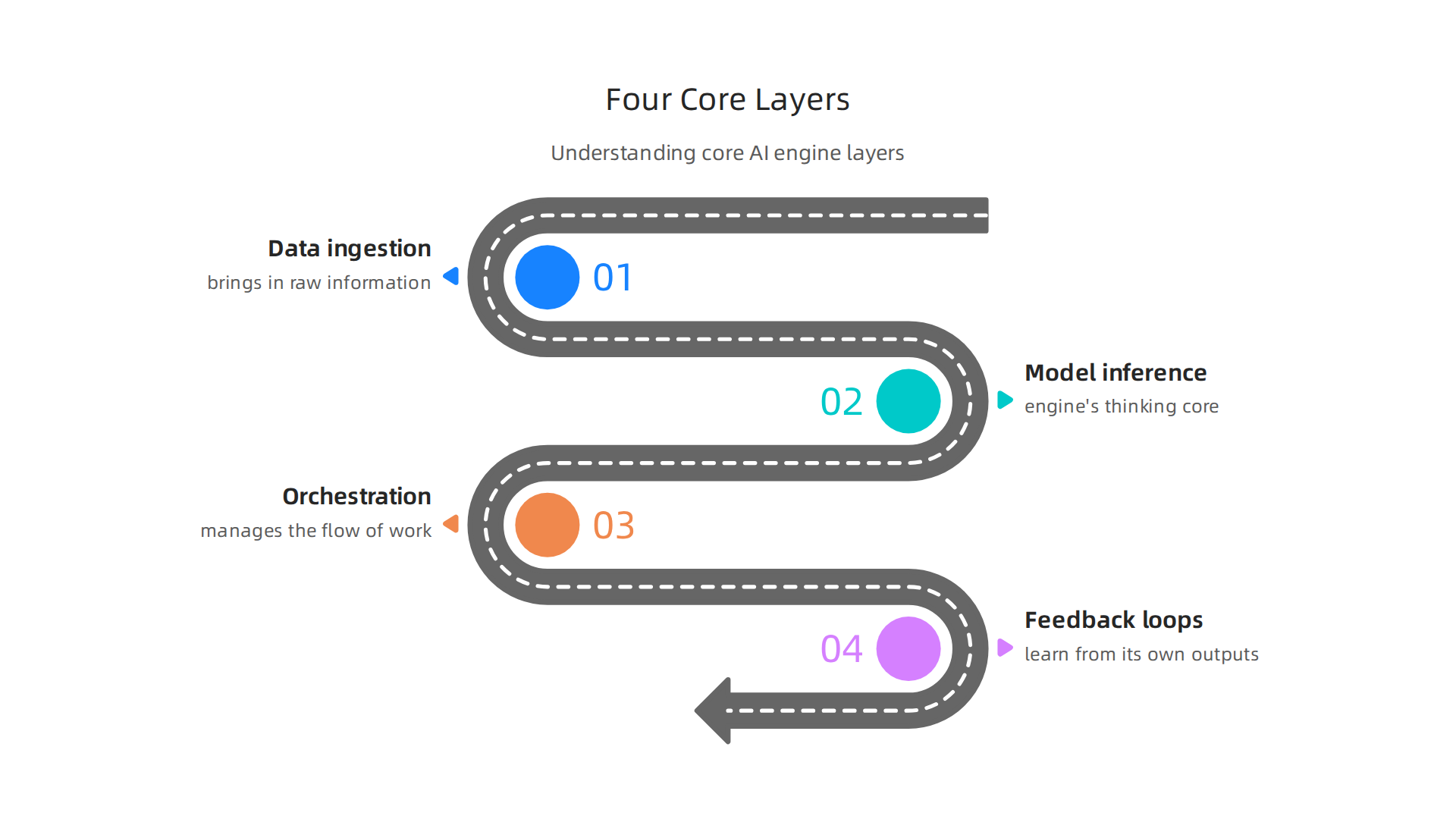
Data ingestion brings in raw information text, images, audio, or sensor data. This layer cleans and organizes the data so the rest of the system can work with it.
Model inference is where the trained model processes the data. This is the engine’s thinking core. It applies patterns learned during training to make decisions or generate content.
Orchestration manages the flow of work. It handles memory, context, and the sequence of steps. This layer decides which model to call, what data to pass, and how to combine results.
Feedback loops allow the engine to learn from its own outputs. The system monitors results, detects errors, and adjusts over time. This is what separates a static script from a learning system.
Understanding these layers helps you ask better questions when evaluating vendors. Is the data ingestion secure? How does the orchestration handle context? Does the feedback loop actually improve the AI response quality?
If you are comparing vendors right now, our guidance for CIOs and CTOs on evaluating AI companies gives you a practical checklist to separate genuine AI engines from marketing hype.
That architecture is the foundation. In the next section we will look at how different AI engines handle these layers in practice, and what that means for your enterprise.
Key Capabilities of Modern AI Engines
Now that you know the core architecture, let’s talk about what a modern AI engine can actually do.
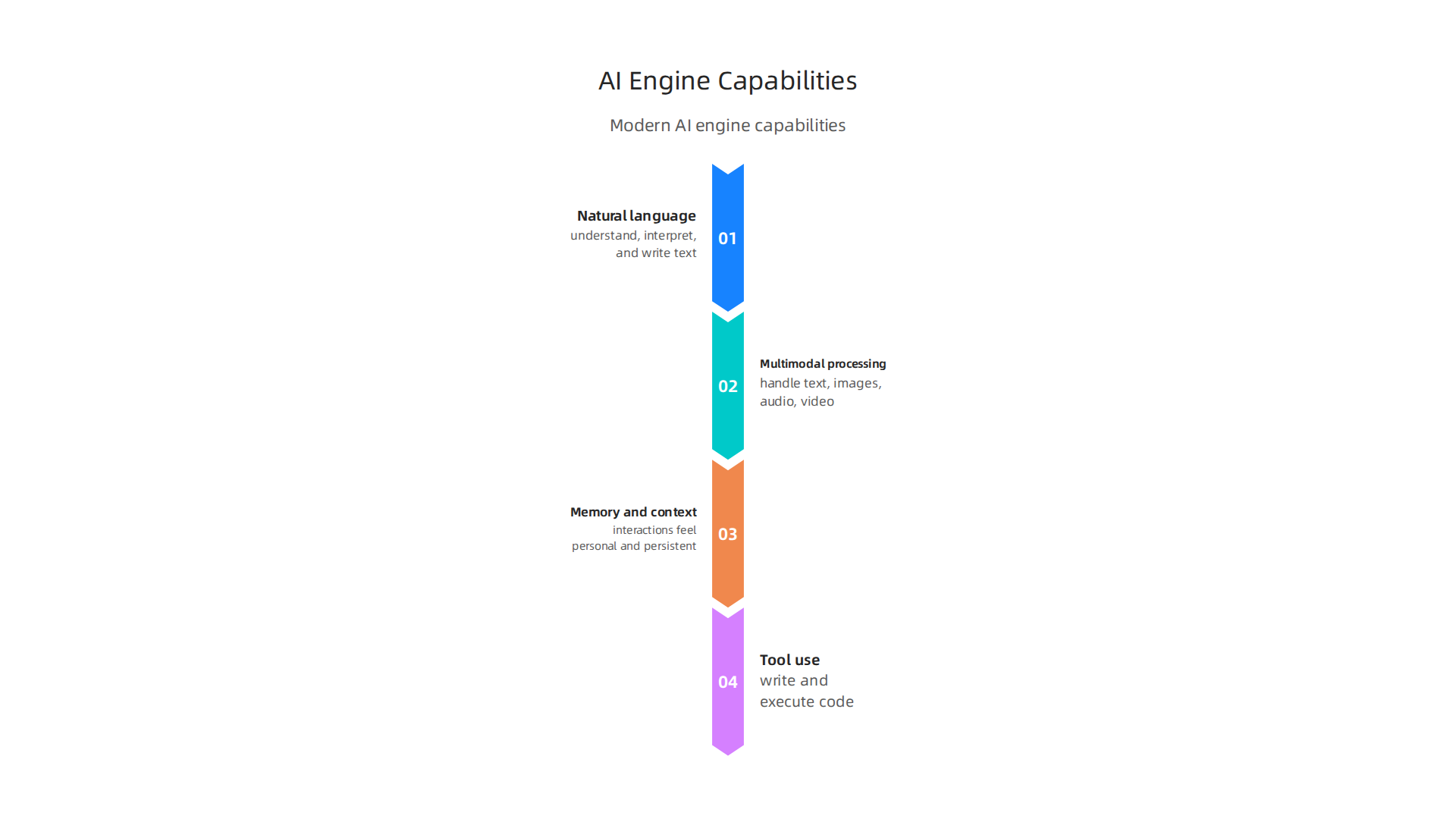
The capabilities have expanded fast. What was impressive two years ago is now table stakes.
Natural language understanding and generation are the most visible features. An AI engine today reads, interprets, and writes text at a human level. It can summarize reports, draft emails, answer customer questions, and even hold conversations that feel natural. This is the engine that powers chatbots, virtual assistants, and content tools across the enterprise.
Multimodal processing takes things further. The same engine can handle text, images, audio, and video. Show it a chart, ask a question about it, and get a spoken explanation back. This is becoming standard in enterprise AI engines. The AI engine Wikipedia page explains how hardware engines like AMD’s architecture are optimized for these multimodal workloads, running vector and scalar operations in parallel to process different data types efficiently.
Memory and context management is what makes interactions feel personal and persistent. Without memory, every conversation starts from zero. With it, the engine remembers what you talked about last week, your preferences, and your ongoing projects. This enables a personal AI assistant that actually knows your work style. Our guide on how to unlock enterprise value from your AI personal assistant shows how context management transforms AI from a novelty into a daily productivity tool.
Tool use, code generation, and reasoning are the new battlegrounds. The best AI engines can write and execute code, query databases, call APIs, and walk through multi-step logic problems. This is where engines really separate themselves. An engine that can reason through a complex supply chain problem and write the code to fix it is far more valuable than one that just generates text.
These capabilities sound exciting. But remember, an engine is only as good as the data and orchestration behind it. A 2026 guide on building an AI engine emphasizes that the best approach starts with good evaluations and measuring performance.
If you want to stay current on which AI engines are delivering on these capabilities and which are just marketing, The AI Newsletter Worth Reading delivers clear daily updates so you never fall behind.
AI Engines vs. Traditional Software: The Paradigm Shift
Here is where things get really different. Traditional software follows a simple rule: same input, same output every time. When you click "Save" in a word processor, the file saves exactly the same way every single time. That is deterministic behavior. It is predictable. It is safe.
AI engines do not work that way. They produce non-deterministic outputs. Give the same prompt to an AI engine twice, and you might get two different answers. That is probabilistic reasoning at work. The engine calculates the most likely correct response based on patterns in its training data, not on hard coded logic. This is a huge shift for anyone used to traditional software.
This difference changes everything about how you deploy, maintain, and govern these systems. With traditional software, you install it, test it once, and it runs the same way for years. With an AI engine, you need ongoing retraining. The model can drift over time as new data comes in. You need monitoring to catch when an AI response starts to degrade in quality or accuracy. And you need feedback loops so the engine learns from its mistakes.
Governance becomes a whole new challenge. Traditional software has clear audit trails. You know exactly what code ran. With an AI engine, the "code" is a statistical model.

It is harder to explain why it gave a certain answer. Enterprise leaders must build new frameworks for risk management. They need to check for bias, monitor for hallucinations, and set up guardrails that traditional systems never required.
The speed of adoption makes this even more urgent. The 2026 State of Enterprise AI and Operational Execution report shows that by early 2026, OpenAI held 55% of enterprise API volume, followed by Anthropic at 28%.

Companies are moving fast. But moving fast without adjusting procurement and risk management is dangerous.
If you are a CIO or CTO, your vendor evaluation process needs an update. You cannot buy an AI engine like you buy a database. You need to assess the model’s accuracy, its training data, its update cadence, and its governance tools. Our guide on how CIOs and CTOs should evaluate AI companies in 2026 walks through the exact criteria you need.
The paradigm is not just different. It demands a whole new way of thinking about what "working software" even means.
How AI Engines Power Personal Assistant Technologies in the Enterprise
Imagine having a smart coworker who never sleeps. You ask it a question, and it pulls answers from your company’s data. You give it a task, and it completes the work across multiple systems.

That is what an AI engine does inside enterprise personal assistant tools today.
These are not simple chatbots that follow a script. Modern enterprise AI assistants use powerful language models to understand natural language, reason through problems, and take action. They can handle complex requests like "Find all open support tickets from last week, summarize the top issues, and draft a response for each one." The AI engine behind the scenes processes that request, searches your knowledge base, generates the summary, and creates draft replies, all in seconds.
Where do companies actually deploy these assistants? The most common place is customer support. An AI assistant can triage incoming tickets, assess urgency, and match each issue against your knowledge base. It then delivers a reply draft for a human agent to review and send. Teams using this approach report faster first response times and happier customers.
Another big area is internal IT helpdesks. Employees can ask the AI assistant to reset passwords, provision software, or troubleshoot common issues without waiting for a human technician. This frees up your IT team to focus on more complex problems.
Sales teams also benefit. A sales assistant can pull product data from your ERP system, check current pricing, and generate custom quotes in minutes instead of hours. One analysis of enterprise rollouts found that sales reps save up to six hours per week using this kind of assistant.
The financial impact is real. Organizations implementing AI assistants for customer support have seen up to a 50% reduction in call costs while actually improving customer satisfaction scores. For routine inquiries, teams report a 60 to 80 percent drop in ticket handling time.
If you want to dig deeper into how to measure and maximize this value, our guide on unlocking enterprise value from your AI personal assistant in 2026 breaks down the metrics that matter.
The bottom line is simple. An AI engine turns a passive search tool into an active, productive team member. And that changes what your workforce can accomplish.
Want to stay ahead of every major AI shift?
The AI Newsletter Worth Reading delivers clear daily updates straight to your inbox.
Evaluating AI Engines: Criteria for Enterprise Decision-Making
But not every AI engine is built the same way. When it comes time to pick one for your company, you need a clear set of criteria. Without a structured approach, you might end up with a tool that looks good on paper but fails in real use.
So what should you actually look for? Let’s break down the dimensions that matter most.
Accuracy and Reliability
First, does the ai engine give correct answers every time? You need to test for precision, recall, and consistency across repeated runs. Watch out for hallucinations and make sure the system stays grounded in your source documents. A helpful list of evaluation dimensions for enterprise AI includes task accuracy, factual grounding, and citation correctness.
Latency and Cost per Token
Speed matters. How fast does the ai response come back? Measure end-to-end response time. Also look at cost per request or per token. A cheap model that takes forever is not a bargain. A fast model that costs too much won’t scale.
Scalability
Can the engine handle peak loads without slowing down? Test it under heavy traffic. Also check if it can grow with your data. Some engines get slower as you add more documents. The best ones stay fast even as your knowledge base expands.
Security and Governance
This is a big one for enterprise buyers. Your ai engine must keep your data safe. Ask about encryption, access controls, and audit trails. You need to know who accessed what, when, and with which data. Also check for compliance with regulations like GDPR or SOC 2. One enterprise platform evaluation matrix stresses that security, risk, and governance are non-negotiable pillars.
Integration Ease
Does the engine connect to the systems your teams already use? Common ones include CRM, ERP, SharePoint, and Jira. The less custom coding you need, the better. Also make sure it respects existing permissions so users cannot see data they should not have.
Explainability and Auditability
Your team should understand why the engine gave a certain answer. Look for platforms that let you trace the reasoning. This helps with debugging and with internal audits. Regulators are starting to require it too.
A Structured Evaluation Framework
With so many options, how do you compare them fairly? The best approach is to build a scoring model with weighted criteria. For example, you might assign 20% weight to security and governance, 15% to deployment flexibility, 15% to data integration, and so on. Score each platform against your list. This removes bias and gives you a clear winner.
For a deeper look at how to select the right technology partner, check out our guide on how to evaluate AI companies.

Once you have a shortlist, run real tests with your own data before signing a contract. Ask for a proof of concept with a representative set of queries. This will tell you more than any marketing page ever could.
By following these criteria, you can pick an ai engine that delivers real value, not just hype.
The AI Engine Landscape: Major Players and Trends in 2026
Before you start applying those evaluation criteria, it helps to know who the players are and what trends are shaping the space in 2026. The AI engine market has grown fast, and the landscape now has a clear structure.
The Major Players
Developer API call volume tells you who is really leading. Based on Q1 2026 data, the breakdown is clear. OpenAI holds about 55% of the market with models like GPT-4.5 and GPT-5. They remain the default choice for complex reasoning and general-purpose enterprise work. Anthropic follows at 28% with Claude 3.5. Teams that need huge context windows and agentic workflows often pick Anthropic. Meta captures roughly 12% with Llama 3 and 4. They lead the open-source space, especially for companies that need to host models locally. Google’s Gemini sits at about 5%, deeply integrated into specific enterprise ecosystems. You can see the full picture in this detailed look at the state of enterprise AI in 2026.
Beyond these four, many other engines serve specialized needs. Perplexity AI, Microsoft Copilot, and Baidu’s Ernie Bot all play key roles in different markets. The overall market is massive. The global AI market generated about $514.5 billion in revenue in 2026, up 19% from the year before, according to the global AI market statistics for 2026.
Key Trends Driving Change
Three big trends are reshaping what an ai engine can do.
First, multimodality is now standard. Engines no longer just handle text. They process images, audio, video, and code all in one model. This expands what you can build with a single engine dramatically.
Second, smaller models are rising fast. Not every task needs a giant model. Small language models, or SLMs, are gaining popularity for specific jobs. They run faster, cost less per token, and can even run on edge devices like phones or local servers. This makes AI cheaper and more accessible.
Third, edge deployment is growing quickly. More companies want their ai response to happen locally, not just in the cloud. Privacy needs, latency requirements, and offline use cases are driving this shift. Engines that support on-device inference are becoming more valuable by the month.
A Diverse and Growing Ecosystem
The market is both consolidating and specializing at the same time. Big players keep getting bigger. But specialized engines for healthcare, finance, law, and creative work are thriving too. This means you have more choices than ever. It also means you need to be more careful about which engine fits your specific use case.
For a deeper look at how companies are adopting these tools, check out our enterprise AI adoption roadmap. It covers the steps from evaluation to full integration.
Staying on top of these changes is tough. New models drop every week. Market shares shift. If you want to keep up without spending hours digging through news, The AI Newsletter Worth Reading delivers clear daily updates straight to your inbox. It helps you stay informed without the noise.
Implementation Considerations and Risk Mitigation
Choosing the right ai engine is just the first part. Actually putting it to work in your organization comes with real challenges.
You need to plan for these before you start.
The Main Challenges
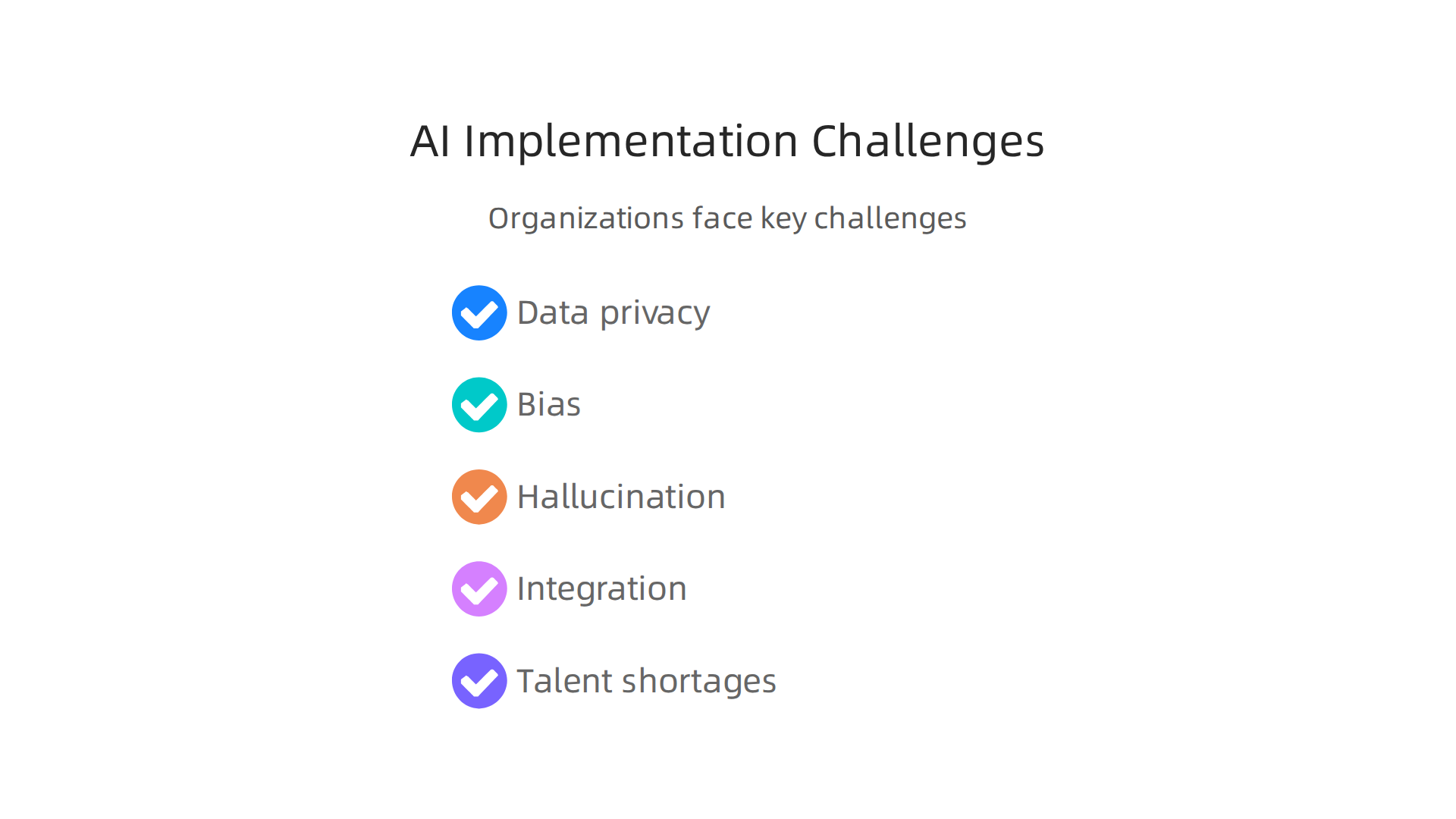
Data privacy is often the biggest concern. When you send data to an ai engine, who sees it? Can it be used for training? You need clear answers from your vendor on data handling and retention. You also need to make sure your own data is properly classified and secured.
Bias is another major issue. AI models learn from data, and if that data contains bias, the ai response will too. This can lead to unfair decisions or reputational damage. Testing for bias should be a regular part of your workflow.
Hallucination is a well-known problem. Models sometimes make things up that sound convincing. You need systems in place to catch these errors before they reach customers or affect business decisions.
Integration with legacy systems is often harder than expected. Older databases and software were not built with AI in mind. You may need custom middleware or data pipelines to connect everything. The 2026 Enterprise Guide to AI-Ready Data covers how to prepare your data infrastructure for these integrations.
Talent shortages are real too. Skilled AI engineers are hard to find and expensive to hire. Many teams start small and train existing staff.
Governance Frameworks Are Now Standard
Smart organizations are putting governance in place from day one. Model risk management, or MRM, is becoming a must-have framework. It covers validation, versioning, approval gates, and ongoing monitoring. You can see how leading companies approach this in the Enterprise AI Platforms 2026: The CIO Evaluation Matrix article, which breaks down evaluation criteria including governance.
AI ethics committees are also becoming common. These groups review use cases, check for bias, and make sure your AI aligns with company values. They provide a safety net before things go wrong.
Practical Steps to Get Started
Don’t try to do everything at once. Start with a small pilot project focused on one clear use case. Set strict vendor SLAs for uptime, latency, and data handling. Monitor performance continuously using tools that track accuracy, cost, and safety. And invest in employee training so your team knows how to work with AI effectively.
For a deeper look at the evaluation process, check out our guide on how CIOs and CTOs should evaluate AI companies. It walks through vendor assessment, pilot design, and governance checklist items.
Remember, the goal is not to avoid risk entirely but to manage it smartly. With the right framework and a steady, careful approach, you can deploy your ai engine safely and effectively.
Future Outlook: Where AI Engines and Personal Assistants Are Headed
The world of AI engines is changing fast. What used to be simple chatbots are turning into something much more powerful.

Here are the three biggest shifts coming your way.
Agentic AI Changes the Game
The biggest change is agentic AI. Instead of just answering a question, an ai engine with agentic abilities can plan, act, and learn on its own. It breaks down big goals into small steps. It uses tools and fixes mistakes without you stepping in.
This shift is happening now. Gartner predicts that 40% of enterprise applications will include task-specific AI agents by the end of 2026, up from less than 5% just a year earlier. Companies using multi-agent systems are already seeing big results. Teams report 70% faster invoice processing and a 10x increase in data-driven decisions. The latest data on the shift to autonomous AI agents shows multi-agent workflows growing by 327% on one major platform.
On-Device AI Keeps Your Data Private
The second big shift is real-time AI that runs on your own device. Instead of sending everything to the cloud, your personal ai assistant can work directly on your phone or laptop. This keeps your data private and cuts out delays.
Small language models that run on edge devices are now matching bigger models at a fraction of the cost. This opens up new possibilities in healthcare, finance, and other fields where privacy matters most. For teams already using AI, you can unlock enterprise value from your AI personal assistant by focusing on these private, on-device use cases.
Open Standards Make Everything Work Together
The third shift is about standards. Protocols like MCP (Model Context Protocol) and A2A (Agent-to-Agent) let different AI systems talk to each other easily. Instead of building custom connections for every tool, companies can plug into one standard framework. This saves time and money. The growing support for the MCP protocol and agent interoperability is making multi-vendor agent setups possible for the first time.
The path forward for any ai engine is clear. Systems that act on their own, protect your data, and work well with others will lead the way.
To keep up with these fast changes, you need reliable information. That is why we recommend The AI Newsletter Worth Reading for clear daily updates on AI and technology.
Summary
This article explains what an AI engine is, how it’s built, and why it matters for enterprise buyers in 2026. It describes the four core layers—data ingestion, model inference, orchestration, and feedback loops—and the modern capabilities organizations expect, from advanced language understanding and multimodal processing to memory, tool use, and reasoning. The guide contrasts AI engines with traditional deterministic software, showing the governance, monitoring, and retraining demands unique to probabilistic systems. It lays out concrete evaluation criteria—accuracy, latency, scalability, security, integration, and explainability—and recommends a weighted scoring approach plus real-data pilots. The piece covers practical deployments of AI-powered personal assistants across support, IT, and sales, quantifying potential time and cost savings, and discusses major market players and trends like small models, edge inference, and agentic AI. Finally, it highlights implementation risks (privacy, bias, hallucination) and governance best practices to deploy AI engines safely and effectively.