
A Strategic Guide to Doctor AI for Enterprise Adoption in 2026

Why ‘Doctor AI’ matters for enterprise leaders now
In 2026, the world of Artificial Intelligence isn’t just about general tools that can do many things. We are now seeing very special kinds of AI pop up, like what some call "doctor AI." This isn’t just a fancy name. It points to a new group of AI solutions built to handle very specific and important jobs, especially in fields like healthcare. For leaders in big businesses, this means it’s time to pay close attention.

Think of "doctor AI" as a smart assistant that helps experts do their jobs better, not a robot taking over. For example, in healthcare, this kind of AI can help doctors make smarter decisions by looking at lots of patient information quickly. These tools are designed to work alongside human judgment, making sure that doctors still have the final say, but with much more data at their fingertips. This approach is key, especially as new rules and guidelines for AI in health are put in place this year, stressing that the human clinician remains the decision-maker and the AI should show how it got its recommendations FDA Clinical AI Rules for Health Systems.
For Chief Information Officers (CIOs), product leaders, and people who start new software companies, understanding these special AI tools is super important. It’s not enough to just know about AI in general. You need to get smart about how these focused AI tools fit into your business plans. This type of ai for business can bring big changes, but it also comes with big questions.
Before you jump into using or building these advanced AI solutions, you need to ask some practical questions:
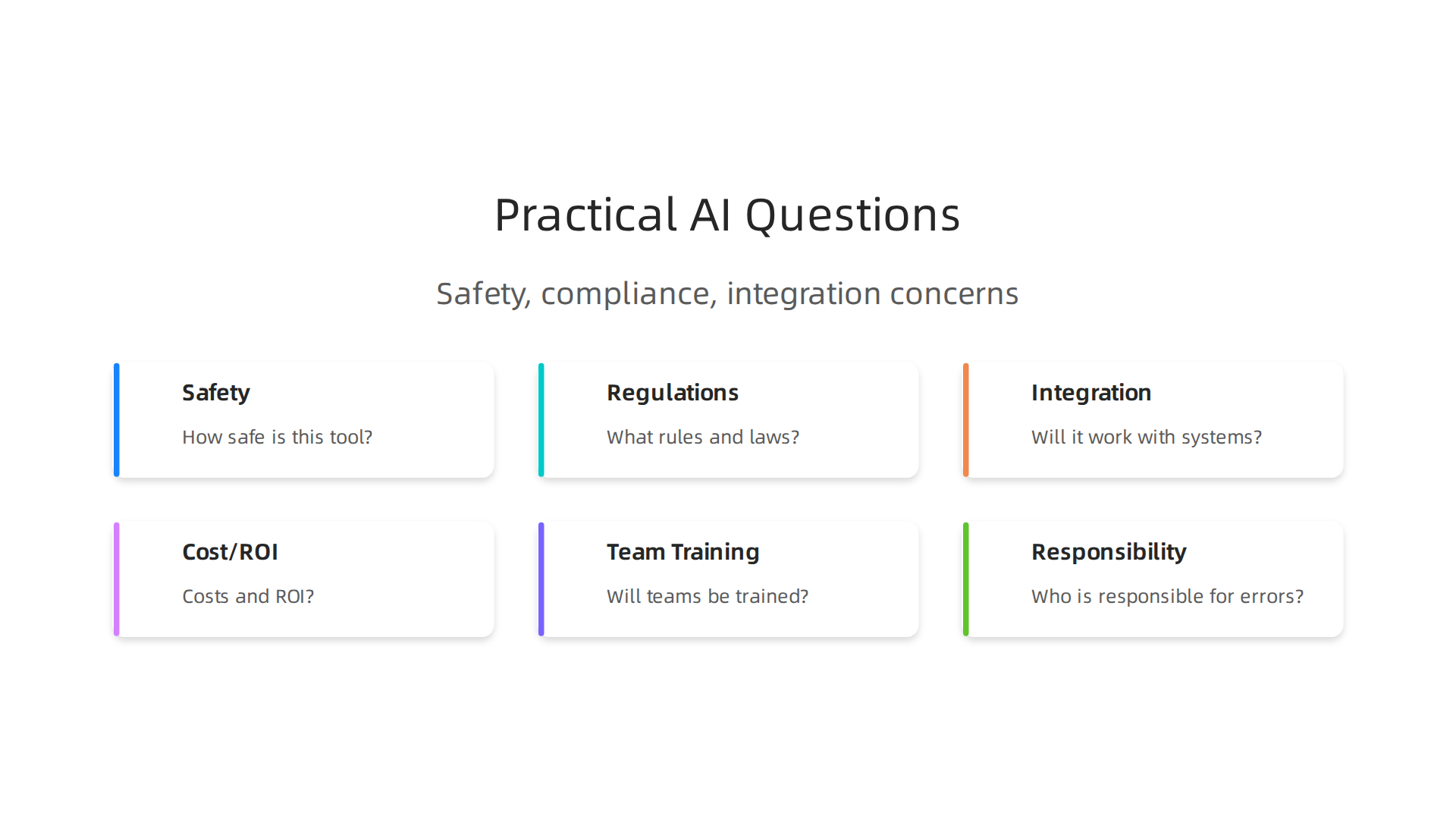
- How safe is this "doctor AI" tool? How do we make sure it works well and doesn’t make mistakes?
- What are the rules and laws about using AI in sensitive areas? How do we make sure our AI doesn’t have restrictions that stop it from being useful, but also stays compliant?
- Will this new AI work with the computer systems we already have?
- How much will it cost to get this AI up and running, and how much will it save or earn us?
- How do we help our teams learn to work with these new AI tools? This is a big part of building good AI literacy within your company.
- What happens if the AI gives a wrong answer? Who is responsible?
These questions are crucial for any enterprise leader looking to explore the benefits of highly specialized AI. Getting these answers right will help you make smart choices for your company in 2026 and beyond. If you want to dive deeper into how to pick the right AI tools for your business, check out our Best AI for business 2026 enterprise strategy guide.
Keeping up with fast-moving AI trends can be tough, but you don’t have to do it alone. Get clear daily AI updates directly in your inbox. Subscribe to The AI Newsletter Worth Reading.
What ‘Doctor AI’ really means: taxonomy and use cases
Let’s dig a little deeper into what we mean by "doctor AI." It’s not just one type of smart tool. Actually, it’s a whole family of special AI programs. These programs are made to help human experts in very clear and important ways. They are different from the general AI tools that can do many things. "Doctor AI" tools focus on helping with specific tasks that need expert knowledge, especially where the rules are strict, like in healthcare.
We can think of these special AI tools in a few main groups:
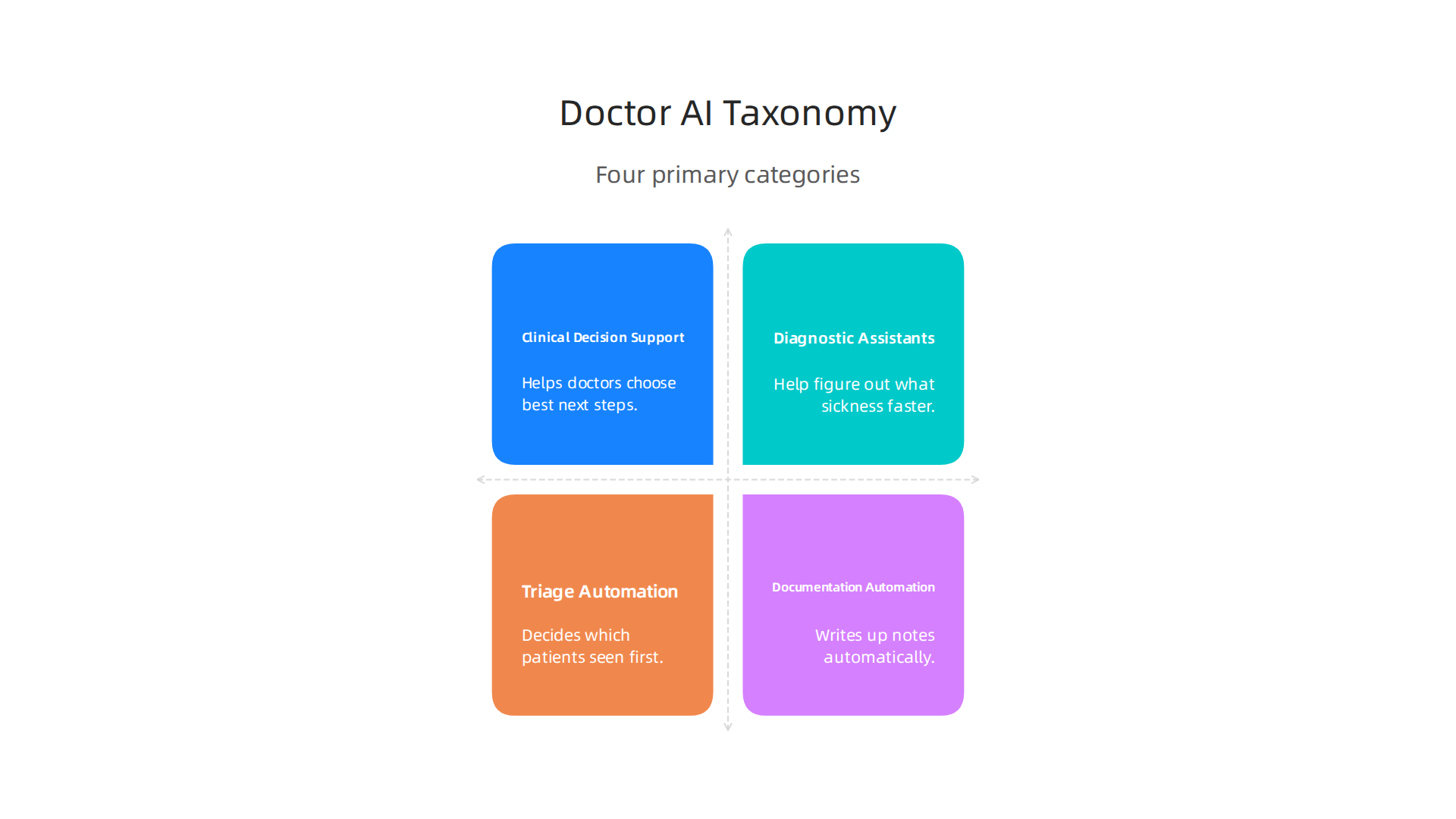
- Clinical Decision Support (CDS): This is like an experienced helper for doctors. It looks at all a patient’s health info and suggests what might be the best next steps. It helps doctors choose the right tests, treatments, or medicines. For example, a trial in primary care found that an AI support tool improved how clinicians made decisions in real patient settings AI improved clinical decisions in primary care trial.

Other studies show that these systems can be very accurate, like an AI-Driven Clinical Decision Support System for Enhanced … that was 99.8% accurate in finding diabetes.
- Diagnostic Assistants: These AI tools help figure out what sickness a person might have. They can look at scans, lab results, and patient symptoms much faster than a human. This helps doctors make a diagnosis more quickly and sometimes more accurately. Some AI tools have even been shown to reduce diagnostic errors by 16% in real patient care settings OpenAI just announced results from the largest real-world study of AI clinical decision support to date..
- Triage Automation: Imagine a busy emergency room. Triage AI helps decide which patients need to be seen first based on how serious their condition is. This can make care faster and safer for everyone. For instance, an AI for sepsis detection caught 82% of cases, helping reduce patient deaths The Evolution of AI in Clinical Decision Support Systems.
- Documentation Automation: Doctors and nurses spend a lot of time writing notes. This AI can listen in on doctor-patient talks (with permission, of course) and write up notes automatically. This frees up medical staff to focus more on patients and less on paperwork. This kind of "agentic AI clinical assistant" can help save time and improve satisfaction DR. INFO at the Point of Care: A Prospective Pilot Study of an Agentic AI Clinical Assistant.
These types of "doctor AI" are not just for hospitals. They are also being used in other big businesses where special rules and expert knowledge are key.
- Insurance Companies: AI can help review claims faster, check for mistakes, and make sure everything follows the rules. This is a type of ai for business that helps process lots of information quickly and fairly.
- Legal Services: AI can help lawyers sort through many legal documents, find important facts, and even help predict how a case might go.
- Financial Advising: AI can help financial experts look at market trends and a client’s money situation to give better advice.
The main idea is that "doctor AI" tools are built for jobs where getting things right is super important. They are not about having ai without restrictions; instead, they work within clear rules and often with human oversight. For enterprise leaders, knowing these different kinds of specialized AI helps you see how they can truly change how your business works for the better. This deep understanding is part of building a strong enterprise AI apps strategy.
Regulation, Safety, and Trust: Compliance Requirements for Clinical AI
When we talk about using "doctor AI" tools, especially in healthcare, safety and trust are the most important things.

Because these tools are so powerful and help with big decisions, there are strict rules to make sure they work correctly and fairly. These rules help everyone feel safe about using AI in important ways.
In the United States, bodies like the FDA (Food and Drug Administration) are very involved in setting up these rules for medical AI tools. For example, by 2025, there were new rules asking for ongoing checks of AI-powered medical devices even after they are used AI in Health: Regulatory & Policy Tracker — Q2 2026.
This means companies must show that their AI keeps working well and safely in the real world. A key rule is that AI tools should always help doctors, not replace their thinking. Doctors must still make the final decisions and understand why the AI made a certain suggestion FDA Clinical AI Rules for Health Systems. This way, AI acts as a smart helper, not a full replacement. Other groups, like the European Medicines Agency (EMA), also work with the FDA to create shared guidelines for how AI should be used safely in developing medicines EMA and FDA Align on Good AI Practice in Drug Development.
For any business, especially in healthcare, using "doctor AI" means you need to have good plans in place. This is part of what we call organizational governance.
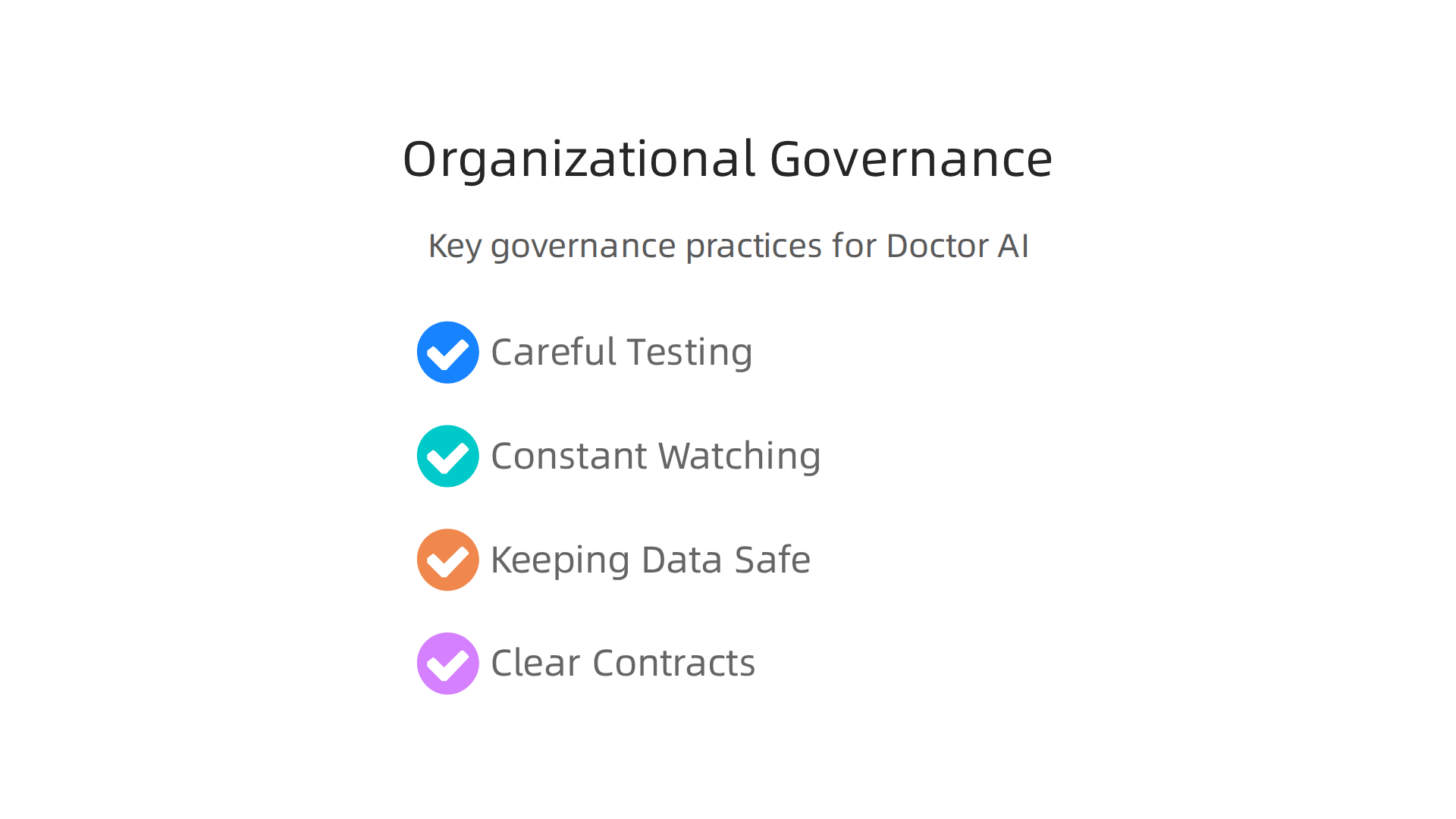
It’s about how your company makes sure AI is used responsibly.
- Careful Testing: Before any AI tool is used with patients, it needs a lot of testing. This is called validation. Experts check if the AI is accurate and fair for different groups of people. The FDA expects companies to describe how they train their AI and check for any unfairness or bias US FDA Latest Guidelines 2026 Explained.
- Constant Watching: Even after an AI is in use, it needs to be watched closely. This is called monitoring. Companies need to keep detailed records, like a diary, of what the AI does and how it makes decisions. This helps find any problems quickly MLHOps: Machine Learning for Healthcare Operations. Tools are used to check if the AI’s performance changes over time.
- Keeping Data Safe: Patient information is private. So, any AI system must protect this data with strong security, like encryption. Rules such as HIPAA in the US mean that businesses using AI must make sure patient health information (PHI) is kept safe Healthcare AI Deployment: Compliance Through Contracting, BAAs, and Data Governance.
- Clear Contracts: If you get AI tools from another company, your contracts need to be clear about who is responsible for what. You must make sure your AI partners also follow all the safety rules Healthcare AI Regulation Compliance Guide.
Putting these steps in place is key to building trust in AI. It shows that the AI is not working "ai without restrictions" but is carefully controlled and supervised. For enterprise leaders, having this clear understanding, or "ai literacy," is super important. It helps you pick the right tools and use them in ways that truly help your business and your customers. This focus on building trust with human oversight and guardrails is vital for any enterprise using advanced technology. To learn more about how to set up trusted AI systems, read about building enterprise AI trust with human oversight and guardrails.
Understanding these strict rules and what it takes to follow them is a big part of successful "ai for business." It’s not just about how smart the AI is, but how safely and ethically it works.
If you want to stay updated on the fast-changing world of AI and how it affects businesses, there’s a great resource that can help.
Get clear daily AI updates from The AI Newsletter Worth Reading.
Using "doctor AI" tools in healthcare isn’t just about making them safe; it’s also about making sure they can actually connect and work with the systems doctors and hospitals already use every day. This is the technical side of things, where we look at how these smart tools fit into a big company’s computer setup. For any "ai for business" project, especially in healthcare, planning this integration is super important.
Technical architecture: integrating ‘doctor AI’ with enterprise systems
Bringing a "doctor AI" tool into a healthcare system means making sure it can talk to all the other programs.

Think of it like adding a new, very smart helper to a busy office. This helper needs to know how to get information from the patient files and how to share its suggestions back. This is where technical architecture comes in.
A main way to connect these tools is through EHR connectors. EHR stands for Electronic Health Records, which are digital patient files. AI needs to plug into these systems to get patient data in real-time, like lab results or past diagnoses EHR-Integrated Clinical Decision Support 2026. Many of these connections use special "language" rules, like HL7 FHIR, that help different systems understand each other EHR Implementation Guide 2026: Healthcare IT Playbook. This ensures that the AI isn’t working "ai without restrictions" but within the trusted flow of patient information.
Here’s how these connections often work:
- API Gateways: These are like doorways that let different computer programs send and receive information safely. The "doctor AI" uses these gateways to get patient data from EHRs or other hospital systems and then send its suggestions back.
- Inference Layers: This is where the AI does its main thinking. It takes the patient data, processes it, and then comes up with a recommendation. This "inference" can happen in different places.
- On-Premise vs. Cloud Inference:
- On-premise means the AI’s "brain" is running on computers right inside the hospital or company. This can be good for keeping sensitive data very close.
- Cloud inference means the AI’s "brain" runs on powerful computers managed by a company like Amazon, Google, or Microsoft over the internet. This often offers more power and flexibility. Building a strong enterprise data architecture is key no matter where the AI lives.
For any "doctor AI" to work well, it needs good data. This means:
- Data Requirements: The AI needs lots of accurate patient data to learn from. This data must be clean and organized.
- Labeling: This is like putting tags on data. For example, marking which parts of a medical image show a tumor, so the AI knows what to look for.
- Domain-Specific Fine-Tuning: AI models are often built for general tasks, but they need to be specially adjusted, or "fine-tuned," to understand the specific rules and language of healthcare. This helps the AI become a true expert in its specific medical area.
- Knowledge Retrieval: AI systems often need to pull information from vast libraries of medical knowledge, not just patient records. They might look up the latest guidelines or drug interactions to make informed suggestions.
When setting up "ai for business," especially with a "doctor AI," leaders need a good grasp of these technical details. It’s part of building "ai literacy" within the organization. Understanding these architectural choices and data needs is crucial for successfully deploying AI that truly supports healthcare professionals. If you’re planning your enterprise AI adoption in 2026, thinking about how AI systems will connect and work with your existing data is a critical first step.
Choosing the right "doctor AI" vendor is just as important as knowing how the tech works. It’s about finding a partner you can trust. For any "ai for business" project in healthcare, selecting the right provider means looking closely at many things, not just how smart their AI seems.
Here’s a checklist to help you pick a trustworthy "doctor AI" provider:
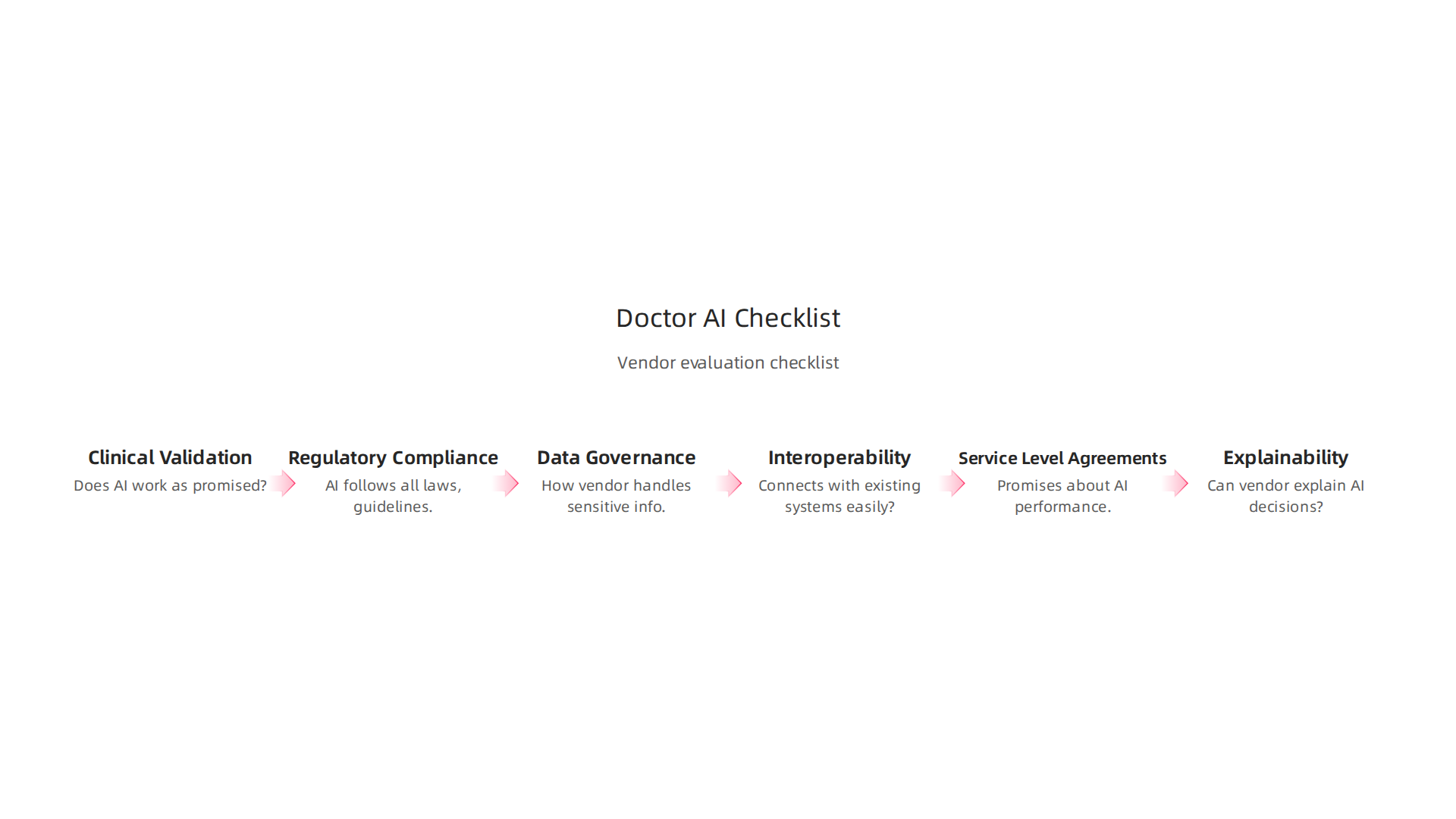
- Clinical Validation: Does the AI really work as promised in a real-world setting? Ask for clear proof that it has been tested and shown to be helpful and safe for patients. You want to see evidence that matches what you plan to use it for Clinical AI Procurement Checklist for Hospitals (2026).
- Regulatory Compliance: Healthcare has many rules. Make sure the AI tool follows all important laws and guidelines, like those for patient privacy and medical devices. This helps ensure the "doctor AI" is not operating "ai without restrictions" but within legal and ethical boundaries.
- Data Governance and Security: How will the vendor handle sensitive patient information? Look into their plans for keeping data safe, who can access it, and what happens to the data over time. Reviewing how they manage patient health information is a must before you even start a small trial Third-Party AI Risk and Supply Chain Transparency Guide.
- Interoperability: Can the AI easily connect and share information with your existing hospital systems, like Electronic Health Records (EHRs)? This goes back to the technical architecture we talked about earlier. Good connections make the AI a true team player.
- Service Level Agreements (SLAs): What promises does the vendor make about how well the AI will perform? This includes how accurate it will be, how fast it will work, and how often it will be available. Clear agreements help hold the vendor accountable AI Vendor Evaluation Checklist for Healthcare Procurement Teams (2026).
- Explainability: Can the vendor explain how the AI makes its decisions? It’s important to understand the logic, especially in healthcare, so doctors can trust and review the AI’s suggestions.
Piloting and Contracts
Once you have a few good vendors in mind, the next step is often a pilot program. This is a small test to see how the "doctor AI" works in your specific environment.
- Structure Pilots: Start small, perhaps in just one department. This lets you learn and build confidence before using the AI more widely.
- Define Success Metrics: Before you start, decide what "success" looks like. Will the AI save doctors time? Help with more accurate diagnoses? Improve patient outcomes? Set clear ways to measure these goals. Think about the total cost, not just the upfront fee, including things like integration, training, and ongoing support AI Total Cost of Ownership (TCO) Guide | Calculate True AI….
- Procurement Contracts: Your contract should clearly spell out who is responsible for what. It should cover risks, data ownership, how errors are handled, and what happens if the AI does not meet its promises. This helps transfer some of the risk from your organization to the vendor. To learn more about selecting the best fit, read about How CIOs and CTOs Should Evaluate AI Companies in 2026.
Making these smart choices helps ensure your "doctor AI" project is safe, effective, and truly helps your team and patients.
Get clear daily AI updates from The AI Newsletter Worth Reading.
Once you have chosen the right "doctor AI" vendor and set up your pilot program, the next big step is to clearly measure its impact.

It’s not enough for an AI to just look smart; it needs to show real benefits. We need to look at three main areas: how it helps patients, how it makes work easier, and if it saves money.
Clinical Efficacy: Helping Patients Better
Clinical efficacy is all about how well the "doctor AI" helps patients get better or stay healthy. This is the most important part in healthcare. Does the AI help doctors make more accurate choices? Does it lead to fewer mistakes? Does it speed up recovery times?
To measure this, you need to track patient outcomes very closely. During pilot programs and then over a longer time, you would compare how patients do with and without the AI’s help. For example, some AI tools help with clinical decision support, giving doctors smart tips at the right time. How well these tools are used in electronic health records (EHRs) can really make a difference for patient care Integrating Clinical Decision Support Into Electronic Health Records. It’s also vital to make sure these AI systems are built to be trustworthy and that their safety is always watched, as experts have recommended for AI-enabled clinical decision support recommendations for AI-enabled clinical decision support.
Operational Efficiency: Making Work Easier
Operational efficiency looks at how the "doctor AI" changes how daily work gets done. Think of it like this: Does the AI save nurses time on paperwork? Does it help doctors spend more time with patients instead of looking up facts? This is about making the healthcare system run smoother for everyone.
You can measure this by watching how much time tasks take before and after the AI is put in place. You might look at things like:
- How quickly reports are completed.
- How many fewer steps are needed for a specific task.
- How much time staff spend on certain activities.
An AI for business in healthcare should reduce wasted time and effort, letting staff focus on what only humans can do.
Financial ROI: Saving or Making Money
Financial Return on Investment (ROI) is about the money. Does the "doctor AI" save your organization money, or does it help bring in more money? This could happen in many ways. For instance, better diagnoses might mean fewer expensive tests are needed, or faster treatment could mean patients leave the hospital sooner.
To measure ROI, you would compare the costs of buying and running the AI system with any savings or new income it creates. This includes:
- Reduced costs from fewer errors or complications.
- Savings from more efficient staff work.
- Better use of resources like hospital beds or equipment.
Making sure your "ai for business" project is a good investment means tracking these financial details carefully. For leaders, understanding how to measure these impacts is key for successful enterprise AI adoption in 2026.
Frameworks for Monitoring Success
Both during pilots and for long-term use, you need clear plans to watch the AI’s performance.
- Set Clear Goals: Before starting, define what success looks like for each type of impact (clinical, operational, financial).
- Gather Data Regularly: Keep collecting information on how the AI is doing. This helps you see if it’s still working well and if anything needs to change.
- Review and Adjust: Look at the data often. Are patients benefiting? Is staff workload truly lighter? Is the investment paying off? If not, you might need to adjust how the AI is used or even talk to the vendor about changes.
- Encourage AI Literacy: Make sure everyone who uses the "doctor AI" understands how it works and what its results mean. This helps them trust the tool and use it effectively.
By keeping a close eye on these three types of impact, your organization can make sure that your "doctor AI" projects are not only safe but also truly valuable for your patients and your bottom line.
After we know how well our "doctor AI" works, the next big step is to make it run smoothly for everyone and grow its use. This is called operationalizing and scaling. It means making sure the AI can be used reliably, safely, and widely across your healthcare group. To do this, you need the right people, good work steps, and strong technology.
People and Processes for Smooth AI
To scale a "doctor AI" project, organizations need key teams and ways of working.
- MLOps (Machine Learning Operations): Think of MLOps as the factory for your AI models. It’s a set of practices that help you build, test, and deliver AI solutions over and over again. This includes keeping track of different versions of your AI models and automatically training and checking them to make sure they work well before they are used. Good MLOps helps ensure safe deployment for advanced clinical AI systems, including those that use federated learning to keep data private Toward Production-Ready Federated Learning in Healthcare.
- Clinical Governance: This is about having clear rules and people in charge to make sure the AI is used ethically and safely. It means setting up ways to audit and monitor AI systems to ensure they follow healthcare laws, protect patient privacy, and deliver fair outcomes. A good governance framework covers things like how data is kept private and how human experts oversee the AI’s suggestions responsible deployment framework. Having proper governance helps ensure that your "doctor AI" is used wisely, not "ai without restrictions."
- SRE (Site Reliability Engineering) for Model Monitoring: This team or way of working focuses on keeping the AI system healthy and reliable once it’s in use. They continuously watch the AI to make sure it’s running correctly, catching problems early, and making sure patients can always get the help the AI offers. This includes checking logs and keeping data safe, which are vital for a strong AI cyber governance framework.
Avoiding Common Pitfalls
Even with good planning, scaling specialist AI can have bumps. Here are some common problems and how to avoid them:
- Data Drift: AI models learn from the data they are given. But real-world patient data can change over time. For example, new diseases might appear, or patient groups might shift. If the AI is not updated, it might start making less accurate predictions. This is called data drift.
- Mitigation: To fix this, you need to keep watching the data the AI sees and regularly retrain the AI model with new information. This way, your "doctor AI" stays smart and relevant.
- Model Updates: AI models get better over time, and you’ll want to update them. But changing an AI that’s already helping patients needs care.
- Mitigation: Have a clear plan for testing new versions thoroughly and rolling them out slowly. This helps avoid new problems when updating the "ai for business" tools.
- Incident Response: Sometimes things go wrong. An AI might give a strange suggestion, or a system might slow down.
- Mitigation: Have a quick plan ready to find and fix problems. This includes knowing who to call, what steps to take, and how to learn from mistakes so they don’t happen again.
By focusing on these areas, you can make sure your "doctor AI" systems grow in a safe and helpful way. It’s also important that everyone who uses these tools has good AI literacy so they understand how the AI works and how to trust its insights, all while remembering that human oversight is key for building enterprise AI trust.
Want to stay on top of the latest in AI and technology that impacts businesses like yours? Get daily, in-depth insights straight to your inbox.
The AI Newsletter Worth Reading
As "doctor AI" systems become more common, what comes next? In 2026, we are seeing some clear paths forward for these smart tools: more rules, very focused AI helpers, and big companies buying smaller ones. These changes will affect how businesses use and plan for AI in healthcare.
Tighter Rules for Doctor AI
Right now, many countries are working on new rules for AI, especially in important areas like healthcare. It makes sense because these "doctor AI" tools help with patient care. We can expect stricter rules to make sure AI is safe, fair, and trustworthy. This means companies making AI tools will need to be very careful about how they build and test them. These rules will prevent "ai without restrictions" from being used in hospitals and clinics. Already, studies are looking closely at how AI supports doctors’ decisions, and some suggest we need more evidence on patient outcomes, as highlighted in a 2026 report on Clinical Decision Support AI in 2026.
Specialist AI Models on the Rise
Instead of one AI trying to do everything, we will see more and more "doctor AI" tools that are experts in very specific areas. Imagine an AI that is super good at finding early signs of one type of disease or another that helps manage a specific long-term illness. This is already happening. For example, some AI systems show high accuracy in predicting conditions like diabetes, as noted in research on an AI-Driven Clinical Decision Support System. This means doctors will have access to a catalog of highly specialized AI helpers, each designed for a particular medical task. A pilot study even explored an agentic AI clinical assistant at the point of care to help clinicians save time and support decision-making.
Big Companies Buying Up Smaller AI Firms
The market for "ai for business" in healthcare is growing fast. Because of this, we’re likely to see bigger tech and healthcare companies buying smaller AI companies. This is called market consolidation. It means fewer but larger players will offer AI solutions. This trend can lead to more complete AI systems and better support, but it also means businesses will need to be smart about choosing their AI partners. It’s crucial for leaders to understand how to select top AI companies in 2026 that truly offer value beyond the hype.
What This Means for Businesses
For healthcare groups and companies, these changes mean a few things. You will need to keep up with new rules and make sure your AI tools follow them. You will also want to look for specialist AI models that can solve very specific problems in your clinics. And as the market changes, choosing the right AI partners will be key to making sure your "doctor AI" strategy works well. Understanding the broader Artificial Intelligence In Clinical Decision Support Market can help in making these important choices. Organizations should also develop a clear AI engine evaluation framework for enterprise leaders in 2026 to make informed decisions.
Summary
This article explains why specialized "doctor AI" solutions matter for enterprise leaders in 2026, describing what these domain-focused systems do, where they are already used, and why they differ from general-purpose AI. It reviews the main categories—clinical decision support, diagnostic assistants, triage automation, and documentation automation—and shows how similar specialist models apply in insurance, legal, and finance. The piece also covers regulatory expectations (FDA, EMA), safety and monitoring practices, and the data and integration requirements needed to plug AI into EHRs and enterprise stacks. Practical guidance includes how to evaluate vendors, structure pilots, define success metrics, and measure clinical, operational, and financial ROI. Finally, it addresses how to operationalize and scale safely—MLOps, governance, incident response—and points to market trends like tighter rules, niche models, and consolidation. After reading, leaders will know the questions to ask, the technical and compliance steps to plan, and how to test and scale specialist AI responsibly.