
Study AI with Purpose How Business Leaders Build Real AI Literacy

Introduction: Why Business Leaders Must Learn AI Strategically
AI is no longer a future trend. It is here, and it is transforming how businesses operate. In 2026, 88% of organizations regularly use AI in at least one business function, according to recent AI adoption statistics. But here is the catch. Most of these organizations are still experimenting. Only a small fraction have scaled AI across their enterprise.
As a business leader, you probably feel the pressure. Every day brings new tools, new research, and new claims. The information overload is real. Without a structured approach, it is easy to waste time on hype and miss what actually matters.

That is why you need to study AI strategically. Not just read headlines or try random tools. You need a framework that helps you build real, actionable AI literacy. One that focuses on the best AI for business and teaches you how to work alongside AI systems. You will also learn how to pick the best AI tools for your specific needs and avoid the traps that stall so many projects.
This article gives you exactly that approach. We will walk through a proven method for learning AI that blends practical tool knowledge with the mindset of co-intelligence. The same ideas from books like Co-Intelligence: Living and Working with AI applied to real enterprise decisions.
Ready to cut through the noise and build real skill? The AI Newsletter Worth Reading delivers clear daily updates so you can stay informed without the overwhelm.
Let us dive in.
Why Business Leaders Need to Study AI in 2026
Here is the hard truth. Companies are pouring money into AI. Global AI spending is set to hit $2.59 trillion in 2026, according to Gartner. That is a huge number. Yet most of that money does not deliver results. MIT researchers found that 95% of enterprise generative AI pilots failed to produce a measurable impact on profits.
Why? The answer is simple. Most organizations jump into AI without building internal expertise first. They buy tools, hire vendors, and hope for the best. But hope is not a strategy. Without a solid understanding of how AI works and where it fits, you end up with wasted budgets and projects that never leave the pilot stage.
That is exactly why you need to study AI with intention. Not as a casual reader, but as a business leader who wants real results. When you learn AI strategically, you gain the ability to separate useful tools from hype. You learn to ask the right questions before signing a contract. And you build the internal confidence needed to lead your teams through change.
A structured learning approach also protects you from vendor lock-in. Many AI vendors offer flashy demos and big promises. But once you commit, changing course can be expensive and painful. When you understand the core technology, you can evaluate options on merit instead of marketing. You can build a flexible stack that grows with your business.
The numbers back this up. Early adopters of AI literacy programs report much higher project success rates. According to Deloitte’s 2026 report, organizations that prioritize workforce education and upskilling are far more likely to move AI experiments into production.
In fact, The State of AI in the Enterprise report shows that educating the broader workforce is the top talent action companies are taking to improve AI outcomes.
Think of it this way. AI knowledge is not just a nice to have. It is a competitive advantage in 2026. The leaders who invest time in learning will make smarter decisions. They will avoid costly mistakes. And they will be the ones driving real business value from AI.

If you want to go deeper on how to pick the right AI tools without getting stuck, check out this guide on enterprise AI app selection and integration. It gives you a practical framework for making those decisions with confidence.
The Co-Intelligence Framework: Humans + AI in Practice
So you have decided to study AI with purpose. What does that look like in your daily work? The best answer for 2026 is not "use more AI." It is something smarter. It is a concept called co-intelligence.
Co-intelligence is the systematic collaboration between human judgment and AI analysis. Think of it as a team where each side brings something the other lacks.
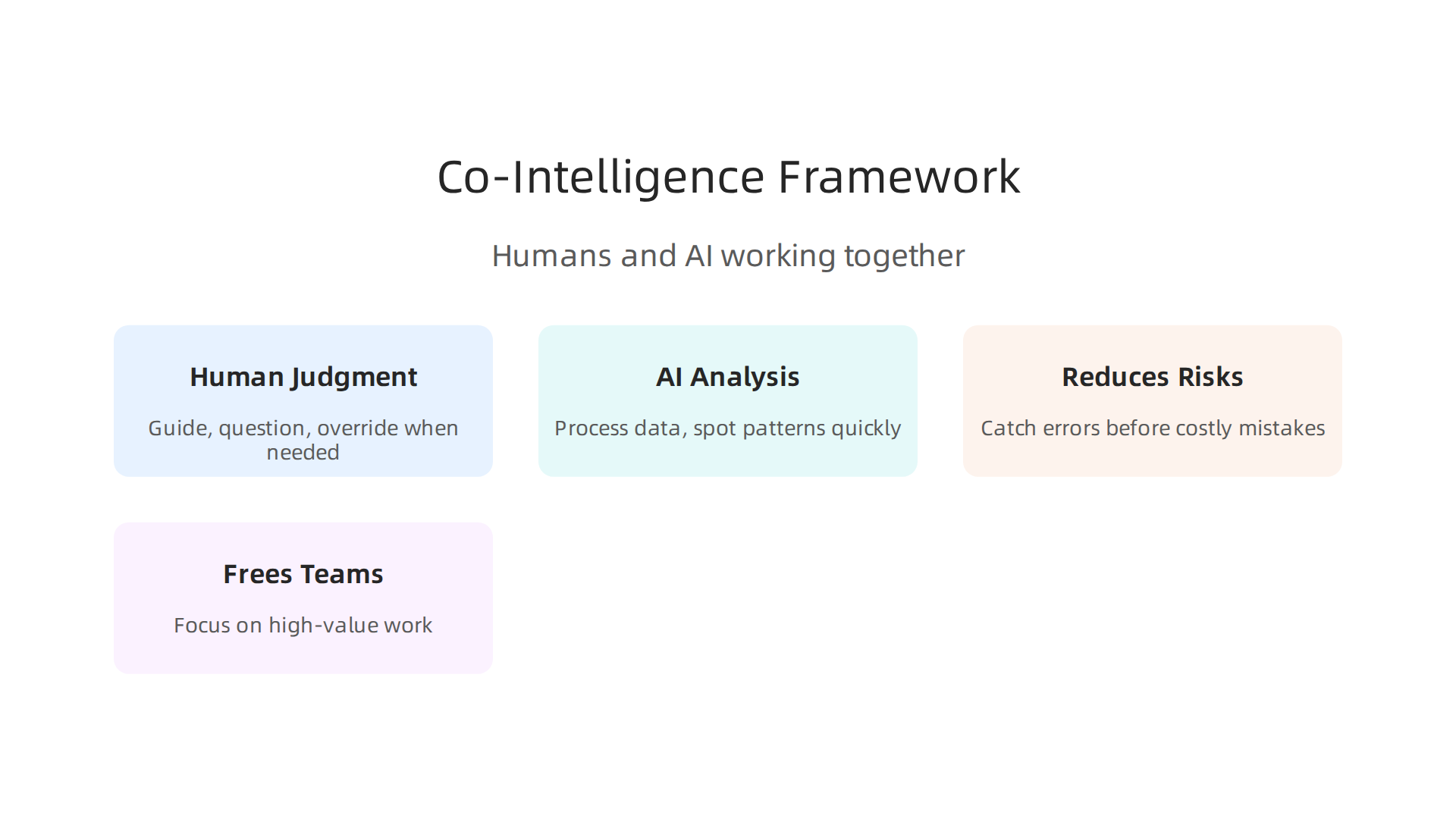
AI can process huge amounts of data in seconds. It can spot patterns a human would miss. But AI also has blind spots. It can hallucinate facts. It can amplify bias. It lacks context about your specific business, your customers, and your values.
That is where you come in. Your job as a leader is not to compete with AI. It is to guide it, question it, and override it when needed.
Recent research from Carnegie Mellon University and other top schools created a human-AI teaming complementarity framework. This framework shows that human-AI teams outperform either side working alone when conditions are right. The key is keeping the human in the loop. You provide the reasoning, the ethical check, and the final call.
This approach does two big things for your business. First, it reduces serious risks. When you treat AI output as a draft instead of a final answer, you catch errors before they become expensive mistakes. Second, it frees your team to focus on high-value work instead of repetitive tasks. That is how smart leaders move past pilots and into production.
To really make this work, you need a clear plan for where human oversight lives in your AI workflows. A good place to start is reading about building enterprise AI trust with human oversight and guardrails. It gives you practical steps for setting up those checks.
Co-intelligence is not a future concept. It is the foundation of how the best teams work right now. And the leaders who practice it will be the ones who get real value from AI without falling for the hype.
Staying current on how to balance human and machine roles takes daily learning. One smart way is to subscribe to The AI Newsletter Worth Reading. It delivers clear, practical AI updates straight to your inbox so you never fall behind on what works.
Now that you understand the co-intelligence mindset, the next question is practical. Where do you actually learn these skills? The good news is 2026 offers more options than ever. The bad news is choice itself can be overwhelming.
The key is matching the platform to your goal. Let me break down the best options for business leaders who want to study AI with purpose.
Top Tools for Learning AI: Courses and Platforms in 2026
Not all AI learning is the same. A developer needs different training than a sales director. A CEO needs different depth than a data analyst. The platforms that work best depend on what you want to achieve.
For leaders who want recognized credentials, Coursera and LinkedIn Learning remain strong choices. They offer university-backed courses and broad awareness programs. But if your goal is real behavior change in how your team works, you need something more hands-on.
A 2026 review of the best AI learning platforms for employees found that applied training beats passive video every time. The top recommendation goes to platforms that combine live instruction with real project work. Teams that practice skills during training transfer those skills to work much faster.
For enterprise teams that need measurable results fast, Correlation One stands out. It provides fully customized curriculum with live instructors and documented ROI within a single quarter.
Their clients include Amazon and Coca-Cola. It is the top ranked enterprise AI training company for 2026 because of this focus on outcomes over course completions.
If you want to run training inside your own organization, Docebo and 360Learning lead the list of AI-powered learning platforms. Docebo is best for enterprises that need to train employees, customers, and partners at scale. 360Learning excels at turning internal expertise into courses quickly.
For leaders early in their journey, Go1 offers more than 2,500 AI courses with role-based learning paths. It is a strong option if you want a complete AI learning ecosystem that grows with your team.
The bottom line is simple. Choose based on the outcome you want. Credentials point you to Coursera. Behavior change points you to applied platforms. Running your own training points you to an AI-native LMS. Pick the one that matches your specific need, not the one with the biggest marketing budget.
One important note. Before committing to any platform, read about the advantages and disadvantages of AI in enterprise data management. It helps you understand the risks that come with any AI tool you adopt.
How to Build Your AI Learning Roadmap
Once you understand the risks and have chosen your tools, the next step is building a plan to actually use them.

A platform without a roadmap is just an expensive library of unfinished courses.
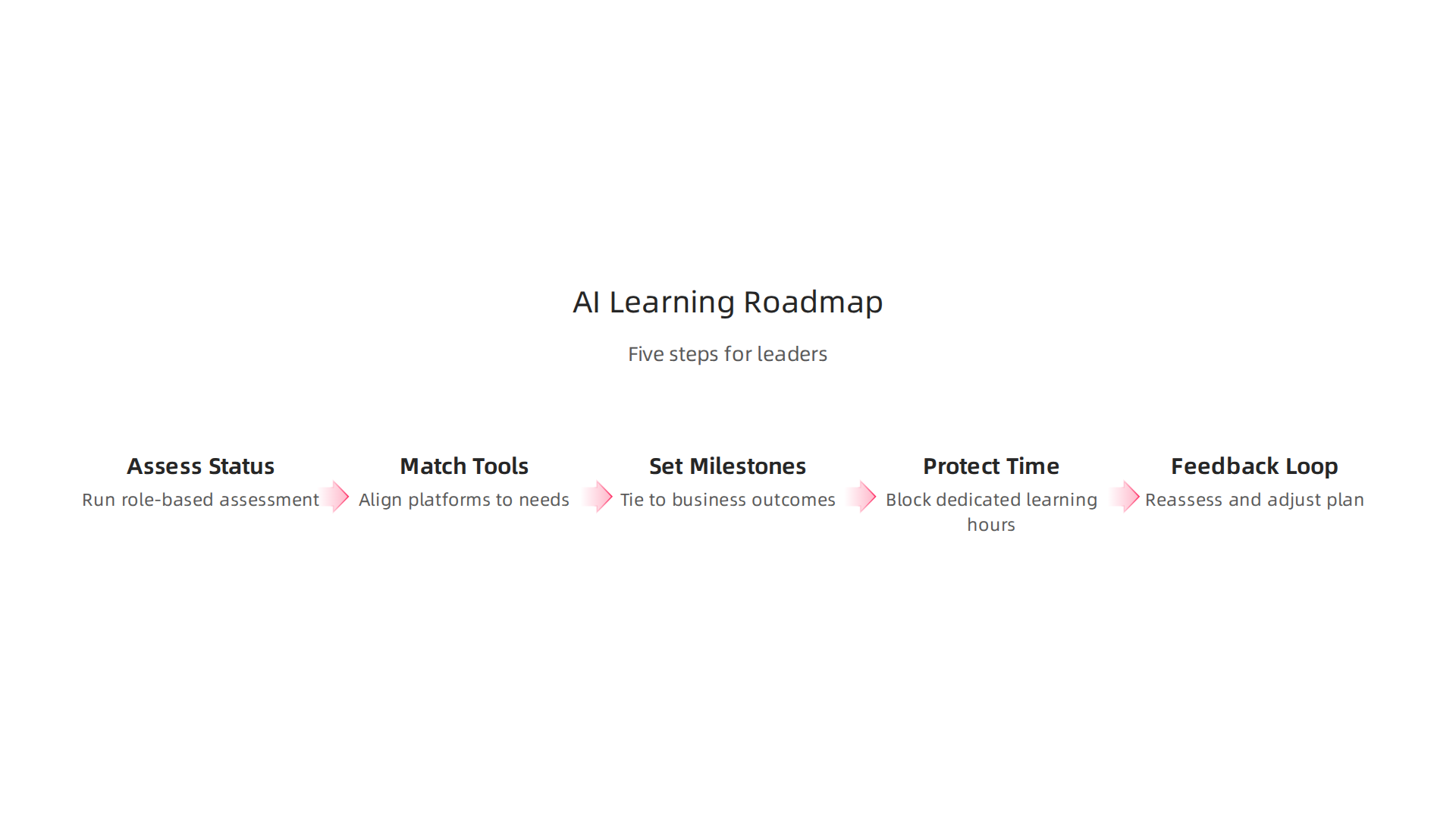
Here is a five-step process that works for busy leaders.
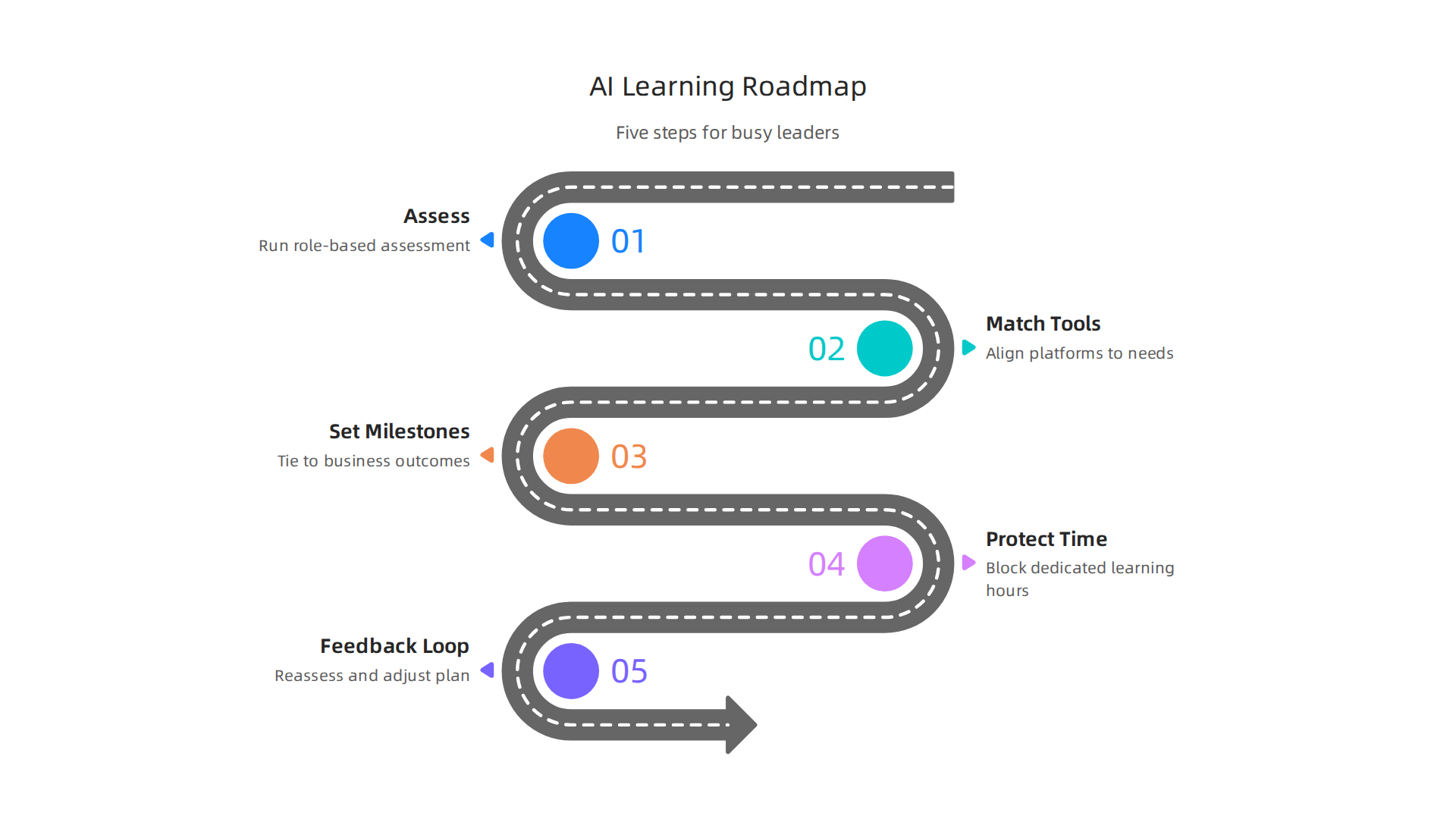
Step 1: Assess where you really stand
Do not guess. Measure. A 2026 DataCamp survey on the AI skills gap found that 59% of enterprise leaders report an AI skills gap, yet only 35% have a mature AI literacy program. Most leaders are flying blind.
Run a simple role-based assessment. Ask each team member to rate their ability to interpret AI outputs, apply AI tools to daily tasks, and communicate insights. The results will show you real gaps, not imagined ones.
Step 2: Match tools to your specific gaps
Now that you know where the gaps are, go back to the platform list from earlier. Broad awareness needs a course library. Applied skills need hands-on training. Internal expertise needs an AI-native LMS. Do not force one tool to do everything.
Step 3: Set milestones that actually matter
Course completion is a vanity metric. Real milestones look different. For example, "the marketing team reduces content drafting time by 50% using AI." Or "the support team resolves 40% more tickets with AI assistance." Tie every milestone to a business outcome you already track.
Step 4: Protect time like it is revenue
This is the hardest part. Block two hours every week for deliberate learning. Treat it like a client meeting or a board session. If you do not protect the time, the training will not survive the first month.
Step 5: Build a 90-day feedback loop
After 90 days, reassess. What changed? What did not? Adjust the plan and go again. The best AI learning roadmap is one you actually follow.
Staying current on AI trends is part of that roadmap too. The AI Newsletter Worth Reading delivers clear daily updates so you never fall behind on what matters most.
For a deeper look at how AI skills connect to your broader business goals, check out our enterprise AI strategy roadmap for 2026.
Applying AI Knowledge: From Learning to Business Impact
Once your team has a roadmap in place, the real work begins: turning that knowledge into measurable business impact. Learning is only half the battle. The other half is applying what you learned to real problems.
Leaders who study AI with a clear goal in mind get better results. They do not just learn for the sake of learning. They learn to solve specific business challenges.
Real-world examples from leaders
Some of the best examples come from companies that took AI learning seriously. A large pharmaceutical company reduced the time to create clinical study reports from 12 weeks to just 10 minutes. That is a 99.3% time reduction. Another enterprise saved 39,000 hours per year just by improving AI literacy across the workforce. A global mining company saved 2,200 hours every month by using an AI assistant for daily tasks like drafting emails and analyzing data. These are not hypothetical numbers. These are real AI ROI case studies from industry leaders that show what happens when you apply knowledge.
The pattern is clear. Companies that study AI and then put that knowledge into practice see huge returns in productivity and cost savings.

Metrics that actually matter
You cannot improve what you do not measure. When you move from learning to application, track the right metrics. Do not just count course completions. Look at:
- Cost per interaction: How much does AI save per customer contact?
- Average handling time: Is AI making your team faster?
- Revenue per employee: Are your people producing more with AI help?
- Time to value: How quickly do new AI projects pay for themselves?
One study found that organizations with well-planned AI investments see up to 3.7 times return on their spending. The fastest returns come from customer service, where first-year ROI can reach 340%.
Cross-functional projects embed the skills
The best way to make AI stick is to let different teams work on it together. Have your marketing team partner with IT to test an AI content tool. Let your sales team work with data analysts to build a lead scoring model. When people from different departments team up, they learn from each other and find new ways to apply AI.
For example, a financial services company combined customer service and data science teams to build a chatbot. The result was a 25% drop in customer service costs and a 10% jump in customer satisfaction. That kind of impact only happens when learning crosses department boundaries.
To get the full picture on how to plan AI adoption for your whole organization, check out this data-backed roadmap for AI adoption. It will help you connect the dots between learning, application, and business results.
Remember: the goal is not to study AI forever. The goal is to study AI just enough to start using it, then learn as you go. That is how you turn knowledge into revenue.
Common Pitfalls and How to Avoid Them
You have the motivation to study AI. You have the roadmap. But there are traps along the way that can slow you down or stop you completely.
The biggest one is getting caught up in the hype.
Avoiding AI hype, vendor lock-in, and analysis paralysis
Every AI vendor promises to transform your business overnight. But the truth is more boring and more reliable. Most successful AI adoptions start small with one clear problem to solve.
Here is the trap. You see a flashy demo and rush to buy the tool. Then you spend months trying to force the tool to fit a problem you never defined. That is vendor lock-in without any return.
The fix is simple. Define the business problem first. Then find AI tools that solve it.
Analysis paralysis is just as dangerous. You study AI for months but never try it. The fix is to start with a tiny project. One workflow. One team. One week. Learn by doing.
According to Data & AI literacy research from 2026, 59% of enterprise leaders report an AI skills gap and only 35% have a mature upskilling program. Most training is fragmented and disconnected from real work. That disconnect wastes time and money.
The risk of building skills without alignment
It is easy to let your team take random AI courses without tying them to real business needs. That is a mistake. Skills without a problem to solve fade fast. Every course should connect to a real workflow or a real pain point in your company.
For example, do not teach your sales team generic prompt engineering. Teach them how to use AI to write better outreach emails based on your actual customer data. That is how skills stick.
Overcoming the talent gap through partners and platforms
You probably cannot hire enough AI experts. The market is too tight. U.S. postings for AI roles jumped 163 percent from 2024 to 2025, and AI engineer is the fastest-growing job title heading into 2026.
So partner instead. Use platforms that bring AI capabilities without requiring a PhD. Work with consulting partners who fill your specific gaps. And invest in training your existing people rather than hiring from scratch.
To cut through the noise and find vendors that actually deliver, check out this guide on selecting top AI companies beyond the hype. It will help you avoid wasting money on tools that do not fit.
And to stay sharp on what is actually working in AI, The AI Newsletter Worth Reading delivers clear daily updates so you never fall for the hype or miss real opportunities.
Now that you know how to avoid the common pitfalls, let’s look at what is coming next. The future of AI in business is moving fast, and these trends will shape how you study AI and apply it in your company.
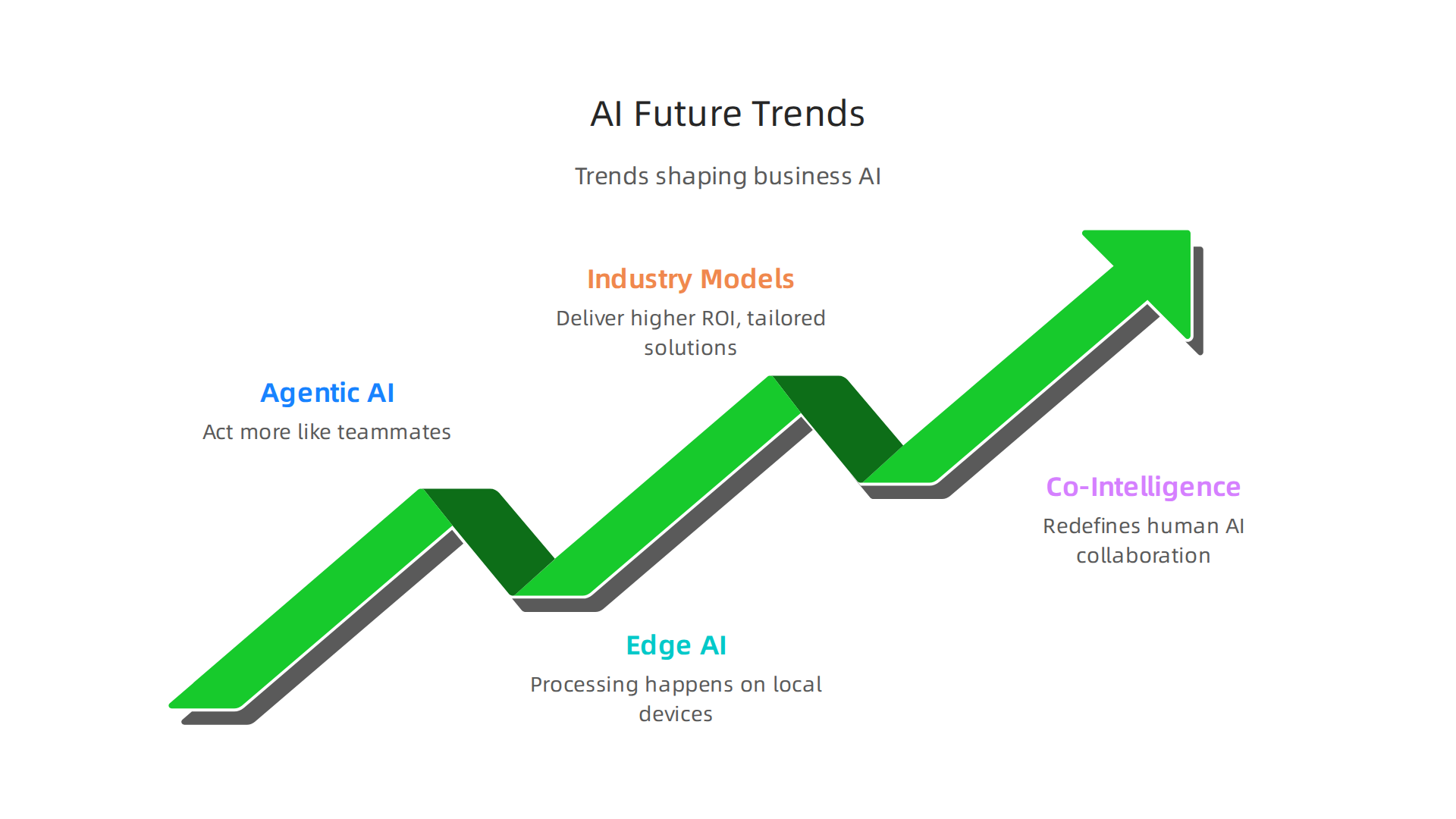
Trend 1: Agentic AI Takes the Spotlight
Instead of just answering questions, AI agents will act more like teammates. They can coordinate workflows across different tools and departments. According to IBM’s 2026 AI and tech predictions, agent control planes and multi-agent dashboards are becoming real. You will be able to kick off tasks that run across your browser, editor, and inbox without managing separate tools. This shift makes agentic AI one of the best AI trends for business to watch.
Trend 2: Edge AI Brings Processing Closer
Edge AI is another big shift. Instead of sending all data to the cloud, processing happens on local devices like phones, sensors, or factory machines. This means faster responses and better privacy. Industries like manufacturing, retail, and healthcare will see the biggest gains. Leaders who study AI for edge use cases will find new ways to cut latency and improve customer experiences.
Trend 3: Industry-Specific Models Deliver Higher ROI
General AI tools are giving way to specialized solutions. Tailored models for healthcare diagnostics, financial fraud detection, and predictive maintenance deliver more accuracy than one-size-fits-all tools. As AI trends for 2026 show, these industry-specific applications are becoming the standard for companies serious about return on investment. The best AI for your business is the one built for your sector.
Trend 4: Co-Intelligence Redefines Collaboration
The concept of co-intelligence is also growing. It describes a deep partnership where humans and AI work together to create outcomes neither could achieve alone. A recent proposal for human-AI co-intelligence defines AI as an intellectual partner that augments human capabilities. As AI becomes more autonomous, your teams will need to learn how to collaborate with these systems rather than just use them as tools. This is where concepts from books like Co-Intelligence: Living and Working with AI become essential reading.
The Bottom Line: Keep Studying
The trends above are not just predictions. They are already shaping how companies compete. Leaders who study AI continuously will maintain a clear edge. If you want a practical guide to aligning your AI strategy with real business goals, explore this data-backed enterprise AI strategy roadmap. It will help you turn these trends into action plans that actually deliver results. The companies that invest in learning today will be the ones leading tomorrow.
Summary
This article explains why business leaders in 2026 must study AI with a clear, strategic approach rather than chasing every new tool or headline. It lays out the co-intelligence mindset—how humans and AI should collaborate—and shows why keeping humans in the loop reduces risk and creates more value. The guide reviews leading learning platforms and training models for enterprises, from credential-focused courses to applied, outcome-driven programs, and explains how to choose the right option for your goals. You get a five-step roadmap to assess skills gaps, match tools to needs, set outcome-based milestones, protect learning time, and run 90-day feedback loops. The piece also covers how to measure business impact with meaningful metrics, highlights common adoption traps like hype and vendor lock-in, and points to future trends such as agentic and edge AI. After reading, leaders will know how to plan training that moves projects from pilot to production, select appropriate vendors, and embed AI skills into real workflows to drive ROI.