
Enterprise LLM Adoption in 2026 How to Deploy Fine Tune and Measure ROI

Introduction: Navigating the LLM Revolution
If you are an enterprise leader in 2026, you already know the big shift. Large language models are no longer just experiments in a sandbox. They are now production-critical systems that touch everything from code generation to customer support. By mid-2026, roughly 85-90% of large enterprises have at least one LLM deployment in production, according to the latest enterprise LLM adoption statistics.

That number jumped from about 65% just a year earlier.
But here is the hard part. With that rapid shift comes information overload, dizzying vendor choices, and real strategic uncertainty. How do you choose the right model? How do you measure ROI? How do you keep security and governance in check when every team wants to build something new? A recent survey found that 79% of organizations say they face serious challenges in adopting AI, and only 13% report enterprise-wide business impact so far.
This article is built to cut through the noise. Think of it as your structured, evidence-based roadmap for adopting advanced LLM AI concepts in your organization. We will walk through the key decisions, the common pitfalls, and the practical strategies that work in 2026. No hype, just what works.
For a broader look at how to build your strategy from the ground up, check out our enterprise AI adoption roadmap for 2026 with data-backed guidance for business leaders. And if you want to keep your finger on the pulse of everything happening in AI, get clear daily AI updates from The Deep View Newsletter.

Understanding LLM Architecture and Its Business Impact
Now that you have seen how fast LLMs are spreading across enterprises, let us talk about what makes them tick. You do not need to be a data scientist to get this. But understanding the basic machinery helps you make smarter calls on where to invest and what to expect.
At the core of every major LLM today is something called a transformer architecture.
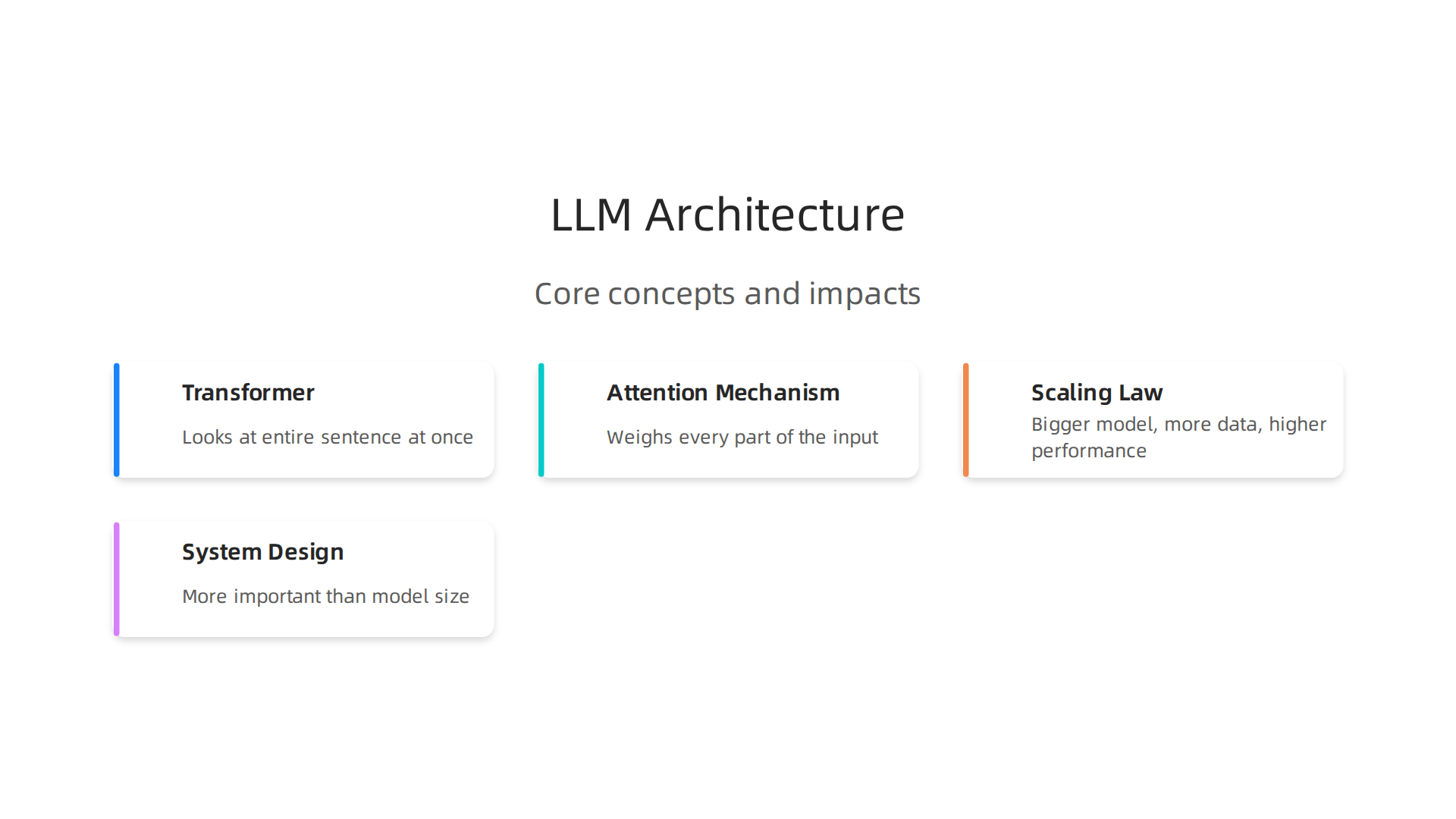
Think of it as a very smart reader that can look at an entire sentence at once and decide which words matter most to each other. It does this through an attention mechanism. Instead of reading left to right and forgetting the start, the model weighs every part of the input. That is why a modern LLM can handle long documents, follow complex instructions, and even catch subtle references across paragraphs.
This architecture is what separates today’s LLMs from older types of AI. Understanding the different types of AI helps you see why LLMs are suddenly useful for tasks that used to require months of custom development.
The Scaling Trade Off
There is a famous rule in AI called the scaling law. It says that if you make the model bigger and feed it more data, its performance keeps going up. And that has been true for a while. But here is the catch in 2026: those gains come with shrinking returns. Doubling the model size does not give you double the smarts. It often gives you a small improvement while doubling your compute costs. The enterprise LLM playbook from RITS Center explains that the real secret is not the model size but the system around it. Most failures come from weak data pipelines or poor integration, not from the model itself.
So when you evaluate a vendor, do not just ask about model specs. Ask about how they handle retrieval, monitoring, and cost control. That is where the business impact lives.
Matching Architecture to Your Use Case
Not every problem needs a giant frontier model. Code generation works well with a mid sized model fine tuned on code. Customer support might need a retrieval augmented generation setup that pulls from your knowledge base. Financial analysis demands high accuracy and low latency. You have to match the architecture to the task.
For a deeper look at how to align your LLM choices with business needs, check out our guide on enterprise AI apps and integration. It walks through the exact steps to evaluate and deploy the right solution.
The takeaway is simple. You do not need to understand every technical detail. But knowing that attention drives capability, scaling has limits, and system design matters more than model size will save you a lot of money and frustration.
To stay ahead of every new development in LLM AI and enterprise technology, get clear daily AI updates from The AI Newsletter Worth Reading. It is the fastest way to keep your strategy sharp.
Fine‑Tuning vs. Retrieval‑Augmented Generation (RAG): Choosing the Right Approach
Once you understand the basic architecture of an LLM, the next big question is how to tailor it to your specific business. Do you train the model further on your own data? Or do you keep the model as‑is and feed it fresh information at query time? That choice comes down to two main techniques: fine‑tuning and retrieval‑augmented generation (RAG). Let us break them down in plain terms.
Fine‑tuning takes an existing base model and continues training it on a smaller, domain‑specific dataset. You are essentially updating the model’s internal weights so it learns your vocabulary, tone, and format. This works great when you need the model to behave a certain way, like writing support tickets in your company’s voice or generating structured reports. The downside? You need labeled data, ML expertise, and compute power. A LoRA fine‑tune on a 13B model with 50,000 examples costs between $400 and $1,200 per training run on cloud GPU in 2026, according to a detailed comparison of RAG vs fine‑tuning for enterprise.
RAG, on the other hand, does not change the model at all. Instead, it adds a retrieval step before the model answers. When a user asks a question, the system first searches an external knowledge base, pulls the most relevant chunks, and hands them to the LLM along with the question. The model then answers based on those fresh documents. This is why RAG is better for frequently changing information. You update the knowledge base, and the model instantly knows the new facts. No retraining needed. RAG also gives you citations, which builds trust and helps with compliance.
Here is a quick side‑by‑side of the key tradeoffs:
| Aspect | Fine‑Tuning | RAG |
|---|---|---|
| Knowledge freshness | Stale after training | Real‑time upon re‑index |
| Source attribution | None (memorized) | Native (cites chunks) |
| Setup cost | $5K – $60K | $15K – $80K |
| Per‑query cost | Lower (no retrieval) | Higher (retrieval + larger context) |
| Behavior shaping | Strong (tone, format) | Limited (bound by base model) |
| Best for | Stable domains, high volume | Changing knowledge, regulated fields |
Many teams in 2026 are finding that the smartest move is a hybrid approach.

You fine‑tune a small, open model for behavior and tone, then layer RAG on top for up‑to‑date facts. As one analysis of the fine‑tune vs RAG debate highlights, the winning pattern is "tune the interface, retrieve the content." That combination gives you the best of both worlds: a model that sounds and acts like your brand, yet never gets caught with stale information.
For a deeper look at how to build the data infrastructure that makes RAG work well, check out our guide on the blueprint for real‑time data pipelines.
The bottom line is simple. Fine‑tuning is for form. RAG is for facts. Use both together, and you will get far more value from your LLM AI investment.
To stay on top of which approach is winning in real production environments, get clear daily AI updates from The AI Newsletter Worth Reading. It is the fastest way to keep your deployment strategy sharp.
Enterprise Deployment Strategies for LLMs
Once you decide on the right approach for your LLM AI, the next big question is where to run it. Your deployment strategy affects cost, speed, security, and how easy the system is to update. In 2026, enterprises typically choose between three main options: cloud-based, on-premise, or a hybrid mix.
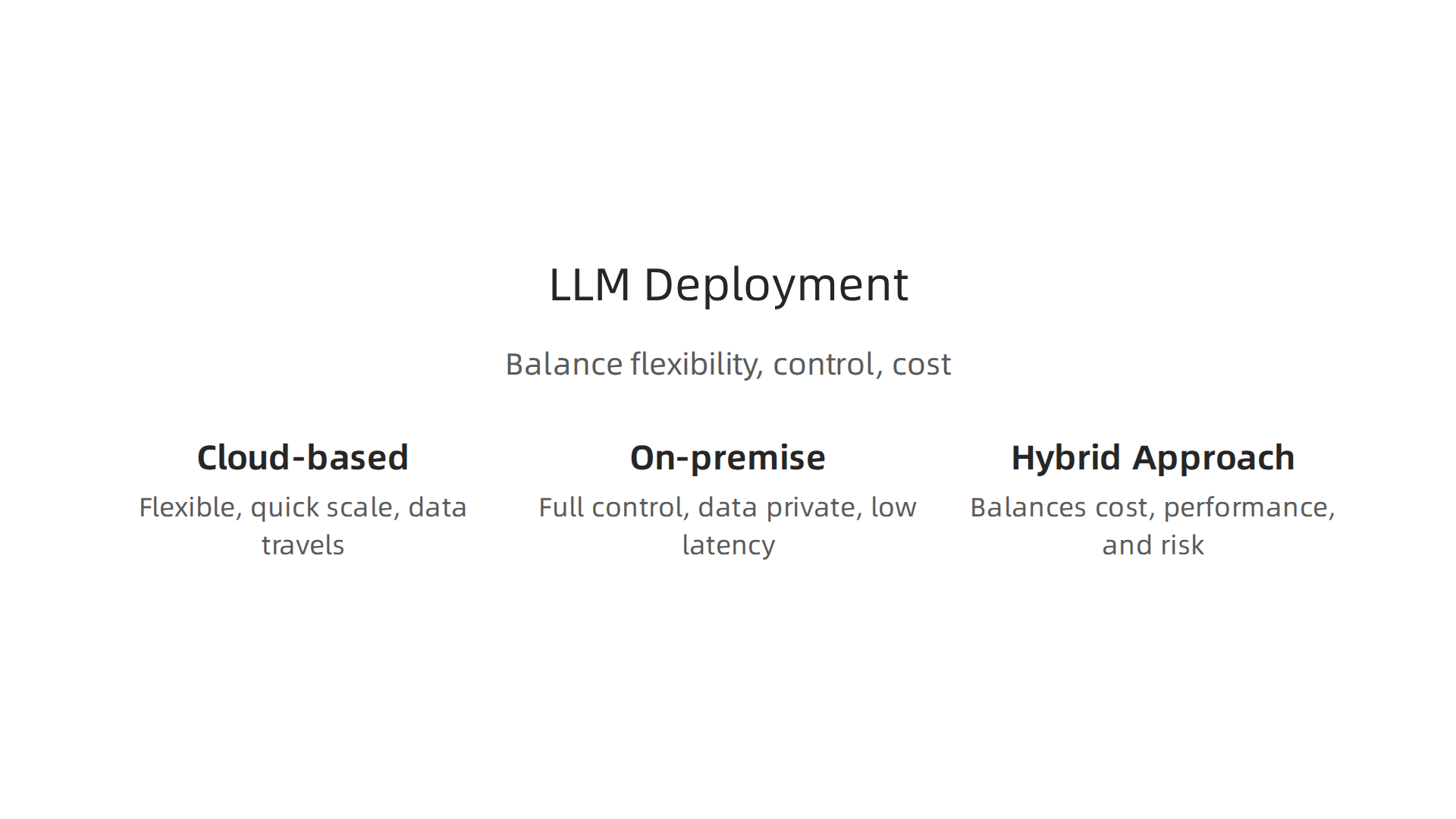
Cloud-based inference is the most flexible choice. You rent GPU time from providers like AWS, Azure, or Google Cloud. This lets you scale up quickly, test new models, and avoid buying expensive hardware. But it comes with a catch. Your data travels over the internet to the provider’s servers. For sensitive information like customer records, financial data, or internal documents, this can raise data sovereignty and compliance concerns. Many regulated industries have strict rules about where data can live. So while cloud is great for speed and experimentation, it might not work for every use case.
On-premise deployments give you full control. You run the LLM on your own servers inside your company’s network. This keeps data private and reduces latency because there is no round-trip to an external API. For tasks that need instant responses, like a customer service chatbot handling sensitive account details, on-premise is often the safer bet. The downside? You need to buy and maintain your own GPUs, handle power and cooling, and manage model updates yourself. That upfront cost can be significant, but for high-volume workloads, it often pays off over time.
Many teams in 2026 are choosing a hybrid approach to get the best of both worlds. They run sensitive or latency-critical models on-premise, while using cloud resources for burst traffic or less sensitive tasks. This balances cost, performance, and risk.
Your infrastructure choices directly affect total cost of ownership (TCO). The type of GPU you pick, the model serving framework you use, and whether you optimize for batch or real-time inference all matter. For example, using a framework like vLLM or TensorRT can cut inference costs by 30-50% compared to basic setups. A detailed guide on how to evaluate cloud decisions for enterprise AI can help you weigh these tradeoffs.
The key takeaway is simple. Cloud offers flexibility. On-premise offers control. Hybrid offers balance. Map your data sensitivity, latency needs, and budget before picking a path. That upfront planning saves you from costly re-architecture later.
Measuring LLM Performance and Business ROI
How do you know if your LLM is actually working for your business?

Technical metrics like accuracy, latency, and hallucination rate matter a lot. But they only tell part of the story. The real question is whether those numbers translate into business outcomes like faster customer support, lower costs, or higher revenue.
In 2026, the smartest teams start with the business outcome first. They then map it directly to evaluation dimensions. As explained in this guide on the LLM evaluation framework for enterprise AI, you need to define clear thresholds for things like task-specific accuracy, safety violations, and cost per request. If a model fails those gates, you do not deploy it.
Hallucination remains one of the biggest worries for enterprise teams. A model can sound confident while giving wrong answers. That is dangerous in customer facing or regulated environments. The latest approaches combine automated factuality checks with human review. An enterprise LLM evaluation guide recommends using automated evaluators and drift detection to catch these issues early. Model behavior changes over time even when you change nothing. Catching that drift is critical.
So how do you build a solid ROI case? You start by translating executive priorities like lower cost per ticket or reduced escalation rates into three to five clear KPIs. Then you assign one targeted metric to every risk in your user journeys. This approach is laid out in detail in a guide on building an effective LLM evaluation framework. It helps you turn technical numbers into real business wins.
For a broader view on how other teams have built their business cases, check out this enterprise AI apps roadmap for ROI. It walks through selection, integration, and measurement step by step.
Staying on top of these evaluation methods requires ongoing learning. A simple way to stay informed is to get clear daily AI updates from The Deep View Newsletter. It covers the latest in enterprise AI, evaluation trends, and real world case studies.
Cost Optimization and Efficiency for LLMs
Getting a handle on costs is just as important as measuring performance. You can have the most accurate LLM in the world, but if it costs too much to run, your business case falls apart. In 2026, smart teams focus on cost optimization from day one.
When you run an LLM AI model in production, the biggest ongoing expense is inference cost. Every time a user sends a request, your model uses compute power to generate a response. Those small costs add up fast, especially at scale. That is why leading companies bake cost optimization into their infrastructure choices.
Model Distillation and Quantization
Two powerful techniques can slash your inference costs without killing quality.
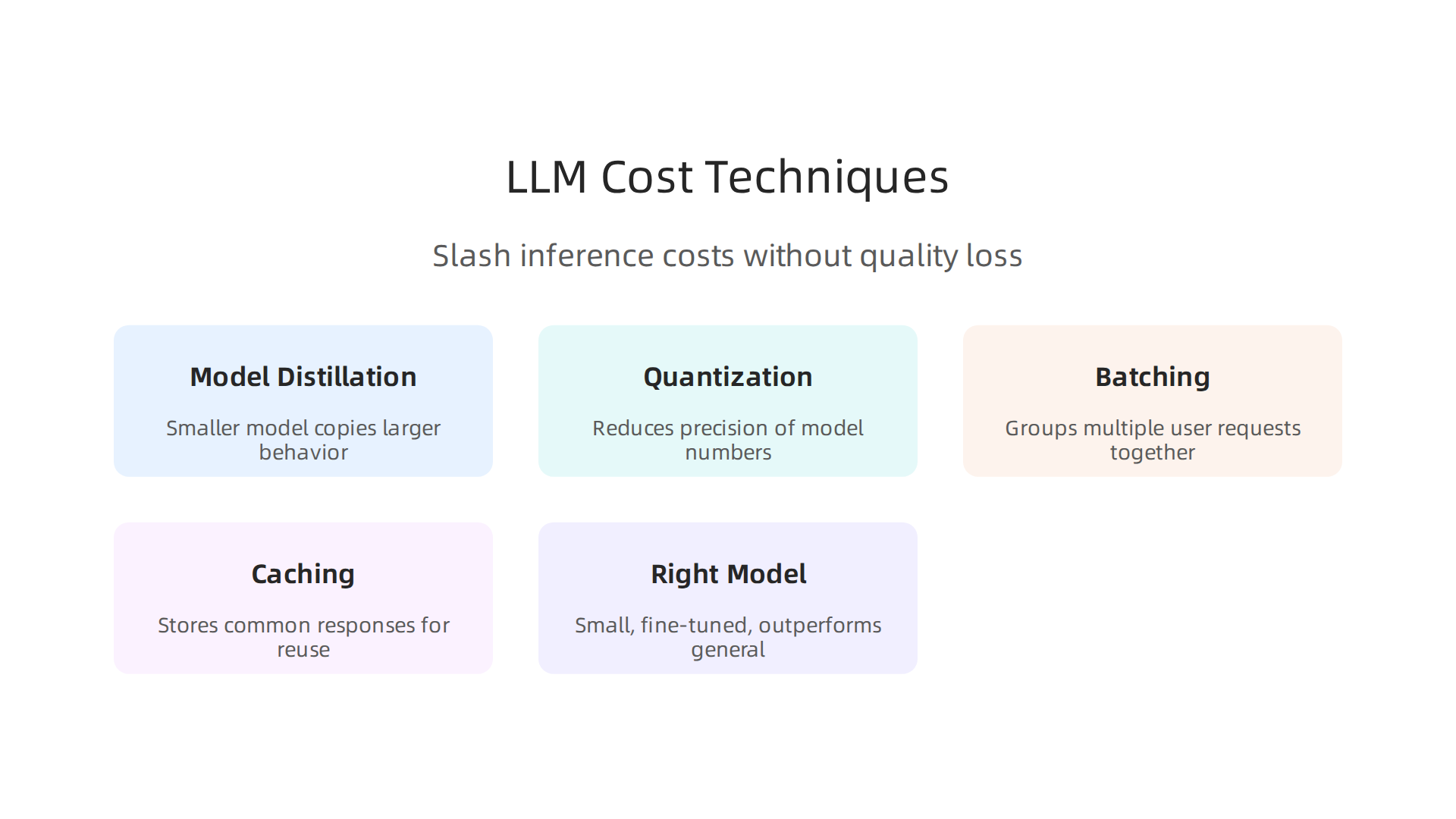
Model distillation works by training a smaller "student" model to copy the behavior of a larger "teacher" model. The smaller model is faster and cheaper to run but keeps most of the accuracy. Many teams use distillation for internal tools where speed matters more than perfection.
Quantization reduces the precision of the model’s numbers. Instead of using 32-bit floating points, you drop to 8-bit or even 4-bit. This makes the model fit on less expensive hardware and run faster. The tradeoff is a small dip in accuracy, but for many tasks that dip is barely noticeable.
Efficient Infrastructure Choices
Your infrastructure setup also plays a huge role. Smart teams use techniques like batching and caching to get more out of each request.
Batching groups multiple user requests together and processes them at once. This uses your hardware more efficiently and lowers your cost per request. Caching stores common responses so the model does not have to recompute them. If many users ask the same question, you serve the answer from cache instead of running the full model again.
Different types of AI models have very different cost profiles. A small model fine-tuned for a specific task often outperforms a massive general model at a fraction of the cost. For simpler tasks like summarizing meeting notes, AI models can be much smaller and cheaper than the latest flagship model.
Choosing the Right Model
The smartest choice is often a free or open-source model that you fine-tune for your specific task. For example, a robotics software engineer designing a voice-controlled arm might start with a small open-source model and tune it on instructions for that arm only. That approach costs pennies per day compared to calling a big API thousands of times.
When weighing options, treat cost as a key part of your evaluation. This article on cost as a key evaluation criterion for LLMs explains how to balance accuracy, security, and cost when choosing a model. You want a model that delivers acceptable accuracy at the lowest possible inference cost.
Finally, never forget that cost optimization is an ongoing process. As your usage grows, revisit your choices. Maybe a newer smaller model can replace your current one. Maybe you can switch from a paid API to a self-hosted open-source model. For deeper guidance, check out this cloud research to drive smarter cloud decisions. It helps you evaluate your infrastructure costs and find savings.
In the end, the teams that win are the ones that treat cost as a first-class metric, right alongside accuracy and latency. Your evaluation framework is incomplete without a clear view of what every request actually costs.
Future Trends: Multimodal LLMs and Autonomous Agents
Cost efficiency matters today, but the smartest teams are already looking ahead. The next big shift in llm ai is about two things: multimodal models and autonomous agents. Both will change how enterprises use AI in 2026 and beyond.
Multimodal models go beyond text. They can process images, audio, video, and code all at once. That opens up powerful new use cases. For example, a robotics software engineer can upload a photo of a broken part and ask the model to find the repair instructions in a manual. A document processor can scan a PDF with charts, tables, and text and extract all the key data in one go. These models make notes ai more useful because they understand context across formats.
One of the most practical benefits is in document processing. Instead of scanning a PDF for text and separately analyzing images, a multimodal model does it all together. This speeds up workflows in legal review, insurance claims, and financial reporting. For a deeper look at how businesses are using this today, check out these multimodal AI use cases in enterprise.
But the even bigger leap forward is autonomous agents. These are types of ai systems that don’t just answer questions. They can plan, use tools, and take actions on their own. An agent might search your company database, run a calculation, send an email, and update a spreadsheet without you lifting a finger. It combines an LLM with the ability to call external APIs and follow multi step plans.
This is where governance becomes critical. An autonomous agent that can take actions across your systems needs clear guardrails. Who decides what the agent is allowed to do? How do you audit its decisions? Enterprises need to prepare for these questions now. The future of llm ai will include many of these agent architectures, and teams that build safe frameworks early will have an advantage.
One key skill for managing these systems is understanding how to guide agent behavior. That is where context engineering vs prompt engineering becomes a strategic choice for enterprise AI teams. The better you are at designing the context an agent operates in, the safer and more reliable it becomes.
As you explore these trends, staying informed is half the battle. To keep up with the fastest changes in AI and enterprise technology, get clear daily AI updates from The AI Newsletter Worth Reading.
Governance, Ethics, and Regulatory Compliance for LLMs
As llm ai systems become more embedded in business workflows, governments are stepping in.

In 2026, new regulations like the EU AI Act and emerging frameworks in the United States impose real obligations on how companies use these models. If your enterprise deploys any of these types of ai, you need to understand the rules.
The EU AI Act classifies AI systems by risk level. High risk applications, such as those used in hiring, credit scoring, or critical infrastructure, require strict transparency, bias testing, and documentation. You must be able to explain how your model makes decisions and show that it treats people fairly. That is not optional. Even lower risk systems need basic disclosures about their use.
In the US, while no single federal law exists yet, several states are passing their own AI regulations. The trend is clear: regulators expect enterprises to prove their llm ai systems are safe and fair. This means systematic testing for bias, fairness, and accuracy needs to become a standard part of your development process.
So what does that look like in practice? First, you need clear governance structures. Many enterprises are creating internal AI ethics committees or governance boards. These groups review new use cases, set policies on data usage, and audit model behavior. They make sure your team stays compliant even as regulations evolve.
Second, documentation is critical. You need records of your training data, model testing results, and any decisions made about deploying the system. This is where notes ai tools can help. They can automate the process of logging every step, so your compliance documentation is always ready for an audit.
According to recent enterprise research, governance, data quality, and integration maturity are now essential pillars for scaling LLMs securely and cost effectively across enterprises. You can read more about these enterprise LLM advancements in 2026 and how top CIOs are approaching governance.
Building a safe, compliant llm ai strategy is not just about avoiding fines. It builds trust with your customers and your team. For a broader look at how to plan your AI initiatives with governance in mind, check out this enterprise AI adoption roadmap for 2026. It covers the practical steps to align your technology choices with regulatory requirements.
Building a Talent and Organizational Strategy for LLM Adoption
Here is the hard truth many leaders are facing in 2026. The demand for people who understand llm ai is way higher than the supply. According to recent data, the global AI talent shortage has demand outpacing supply by a ratio of 3.2 to 1 across key roles. You can see the full breakdown in these global AI talent shortage statistics for 2026. Competing for the same small pool of experienced hires drives up costs and slows down every project.
The smarter move is to grow your own talent. Upskilling your existing workforce is not a nice to have. It is a necessity. Reports show that 80% of the workforce will need some form of AI upskilling by 2027. A practical AI upskilling guide for 2026 outlines a 60 day roadmap to move employees up one skill tier. The key is integrating llm ai tools into real daily tasks instead of sending people to generic training courses. Employees learn faster when they use AI on the actual work they already do.
But training alone is not enough. You also need to rethink how your teams are structured. The most successful organizations build cross functional groups that combine data scientists, software engineers, and domain experts. A robotics software engineer might handle the automation pipeline while a business analyst focuses on the use case. Each person brings a different strength. When these groups collaborate, adoption of new types of ai systems speeds up dramatically.
The hardest part is often the organizational change itself. People resist new workflows. Processes that have worked for years feel threatened. Leaders need to communicate clearly why the shift matters and what is in it for each team member. One practical approach is to create an internal AI champions network where power users in each department mentor their peers. For a deeper look at building a talent pipeline from scratch, check out this guide on building your engineering workforce from within.
Getting the talent and organizational strategy right takes time, but it separates companies that just talk about llm ai from those that actually deliver results. If you want to stay on top of the latest AI developments across the enterprise, consider subscribing to The AI Newsletter Worth Reading. It delivers clear daily updates so you never miss a key shift in the landscape.
Summary
This article is a practical, evidence‑based roadmap for enterprise leaders adopting large language models in 2026. It explains how modern LLMs work at a high level, why transformer attention and system design matter more than raw model size, and how to match model architecture to business use cases. You’ll learn the tradeoffs between fine‑tuning and retrieval‑augmented generation (RAG), deployment choices (cloud, on‑premise, hybrid), and how those decisions affect cost, latency, and compliance. The guide walks through measurable evaluation frameworks and KPI mapping so teams can translate technical metrics into business impact, and it covers cost‑saving techniques like distillation, quantization, batching, and caching. It also previews future trends—multimodal models and autonomous agents—and explains the governance, documentation, and organizational changes required to scale safely. After reading, you’ll have a clear checklist to choose approaches, estimate costs, set evaluation gates, and plan talent and governance for production LLMs.