
The Strategic Imperative of Developer Support for Enterprise Leaders

Why developer support is a strategic priority for enterprise leaders
In today’s fast-moving world, software is at the heart of nearly every business. For companies to do well in 2026, they need great software. But here’s the thing: even the best software won’t help much if the developers using it don’t get the support they need. This is where strong developer support becomes a huge deal for big companies.
Think about it: when developers struggle with a new tool or system, it slows everything down. New software might not be used fully (this is called low adoption), and it takes a long time for the company to see the real benefits. This delay in getting value from new tools can make it hard for a company to stand out from others. In fact, reports show that investing in developers can open up many chances for new ideas and better ways of working for a company, making customers happier too Accelerating developer experience.
This means that good software maintenance and support services are not just for the tech team. They are a main concern for top business leaders.

When a business makes sure its developers are well-supported through the entire development cycle software, it helps the company grow faster and innovate better. This includes everything from the first idea to keeping the software running smoothly. Picking the right partners for custom software development services companies also depends on how well they support their own developers, and yours.
This guide will walk you through how to set up clear ways to measure success, strategies to grow your support as your company grows, and the best tools to use. You will also learn how to pick the right vendors when looking at new software solutions for your business. Understanding the full software lifecycle development is key to making smart choices that move your company forward. To learn more about how to make the most of your software development, check out our guide on how to optimize enterprise software with strategic software development lifecycle models.
Stay informed on the latest tech trends shaping enterprise decisions.
The AI Newsletter Worth Reading
Why developer support matters for enterprise software purchasing and adoption
When companies think about buying new software for their business, they often look at what the software can do. But what’s even more important, and sometimes overlooked, is how well the people who will actually use that software, the developers, are supported. Strong developer support is super important for getting developers to use new tools, making sure they fit into existing systems, and getting everyone in the company on board.
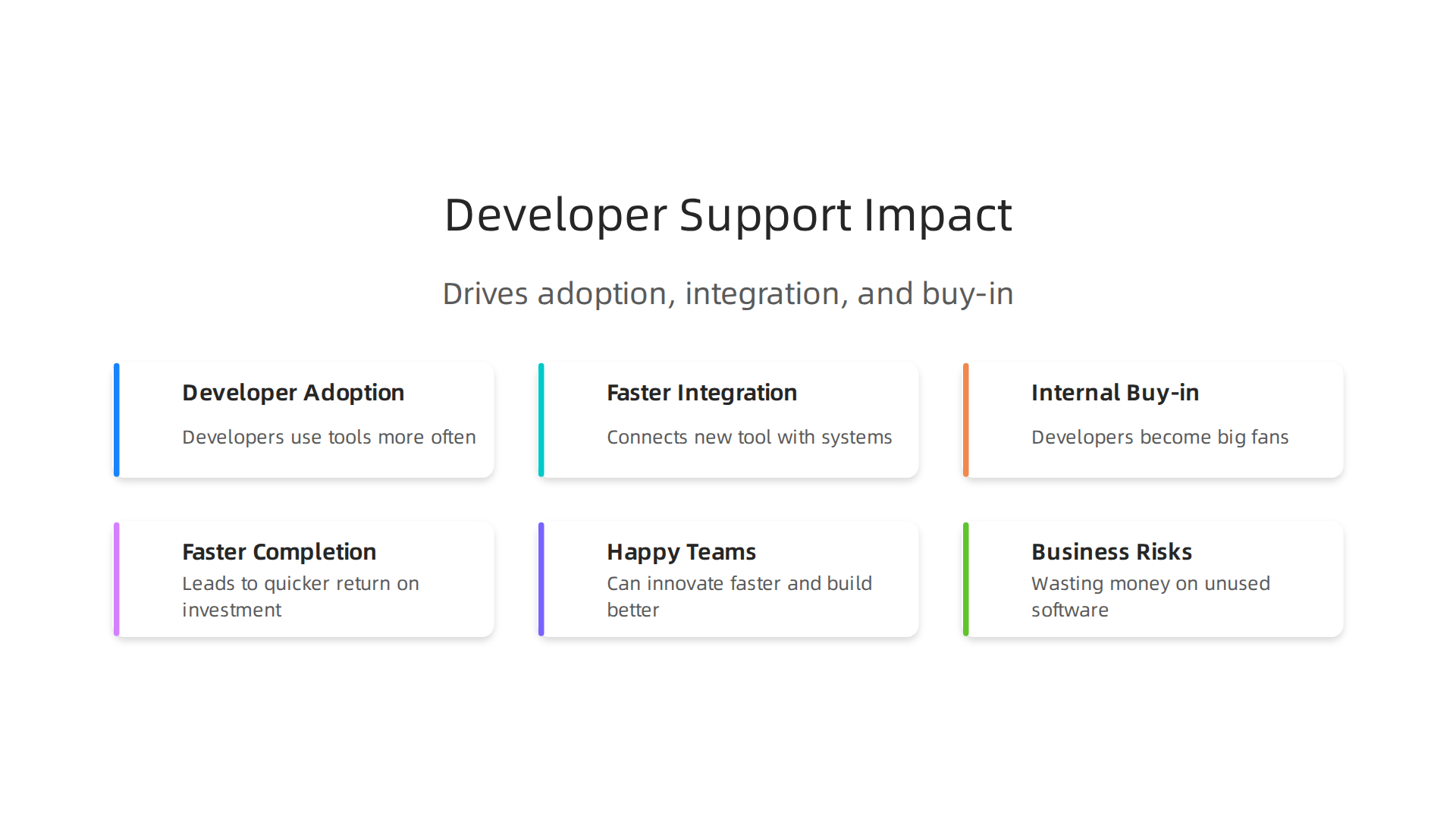
First, let’s talk about developer adoption. If developers don’t feel supported, they might not use the new software, even if it’s the best tool out there. Imagine buying a fancy new machine but not getting any instructions or help when it breaks. It would just sit there, right? The same goes for software. When developers get good help, they learn faster and use the tools more often. This makes sure the company gets its money’s worth from the software. Studies show that when developers have a bad experience, many think about leaving their jobs, which can make it hard to get new software used in the company New Atlassian research on developer experience highlights a major ….
Next, consider how long it takes to integrate new software. This is about connecting the new tool with all the other systems a company uses. If developer support isn’t good, developers might spend a lot more time trying to figure things out on their own. This slows down projects and means the company has to wait longer to see the benefits of its investment. Good support, like clear guides, helpful tools, and quick answers from experts, can cut down this time a lot. It helps developers focus on building new things instead of getting stuck on technical problems. Things like good documentation, tutorials, and training courses are key for speeding up this process Developer Program Benchmarking.
Then there’s internal buy-in. If developers are frustrated because they’re not getting enough help, they’ll likely share their feelings with other teams and leaders. This can make it hard to get everyone excited about the new software. But when developers feel supported, they become big fans of the tools. They tell others how easy and helpful the software is, which helps everyone in the company accept and use it. This positive buzz is crucial for any new technology to succeed across a large organization.
The business risks of weak developer support are clear. Companies risk wasting money on software that isn’t fully used, seeing projects get delayed, and even losing talented developers due to frustration or "burnout." In 2026, some reports show that about half of developers who leave their jobs do so because of burnout 2024 State of Developer Experience Report – Harness. This can severely impact a company’s ability to innovate.
On the flip side, strong developer support creates many opportunities. It leads to faster project completion, happier development teams, and quicker return on investment for new software.

It means the company can innovate faster, build better products, and stay ahead of its rivals. This kind of support covers the entire development cycle software, from choosing tools to providing ongoing software maintenance and support services. When looking at custom software development services companies, their approach to supporting their own developers often shows how well they’ll support yours too. Choosing the right software lifecycle development models can help a lot with this. For more about different ways to manage the journey of software development, explore SDLC Methodologies for Enterprises Choosing the Right Software Development Life Cycle.
Key components of effective developer support (people, content, tooling)
Effective developer support isn’t just one thing. It’s like a strong three-legged stool, with each leg being equally important: people, content, and tooling.
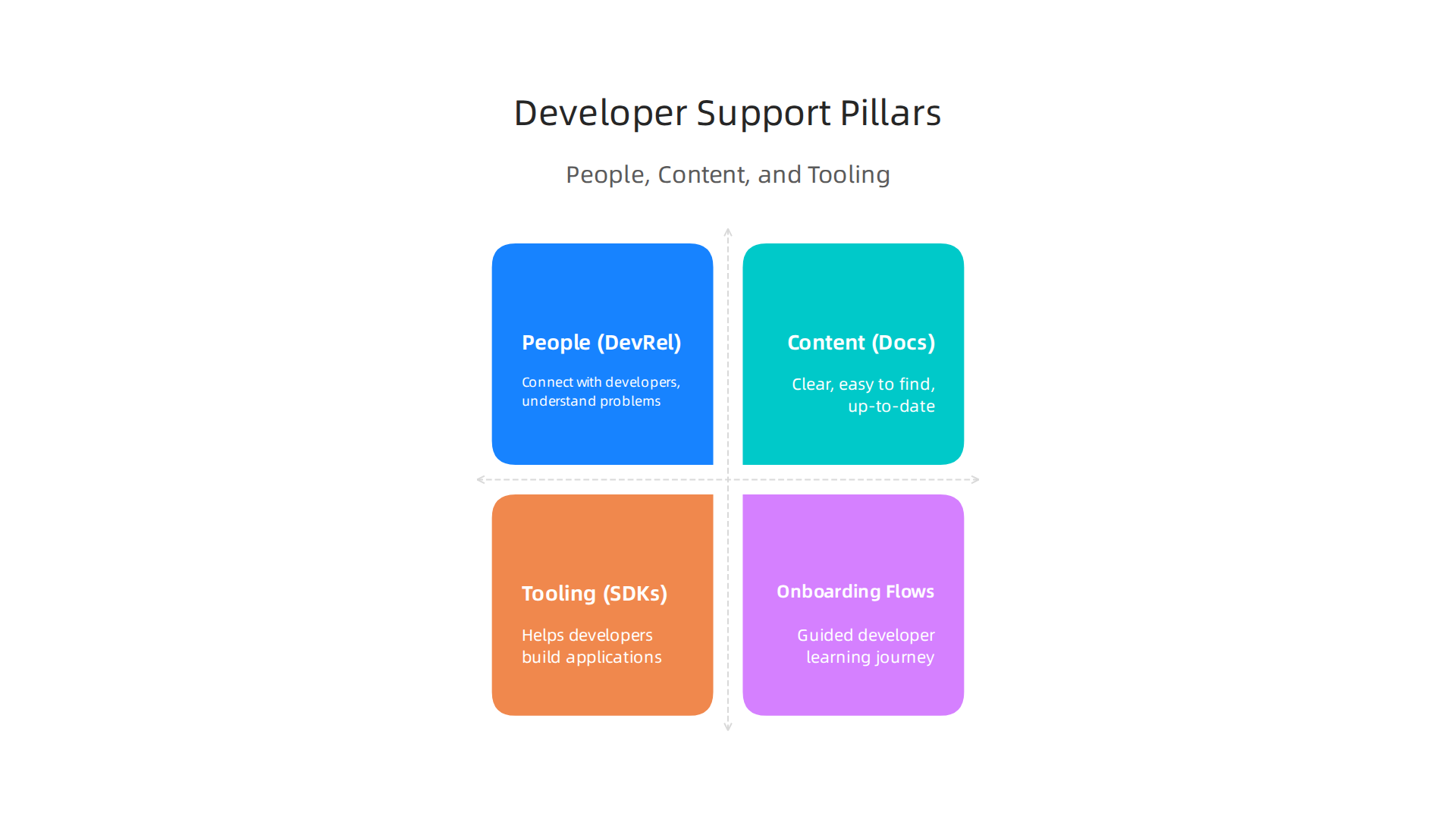
When all three work well together, developers have a great experience (DX), which helps them do their best work. This smooth process helps with the entire development cycle software.
People: Developer Relations (DevRel)
Developer Relations, or DevRel, is all about the human side of support. These are the people who connect with developers, understand their problems, and help them succeed. Think of them as friendly guides. Their job is to:
- Listen to feedback: They gather what developers like and don’t like about the software.
- Share knowledge: They explain how to use new features and best practices.
- Build a community: They help developers talk to each other and share solutions.
DevRel teams are key for making sure a company’s tools are easy to use. They often work closely with internal development teams, too, making sure everyone is on the same page. This personal touch is very important for enterprise software, especially when dealing with unique needs from custom software development services companies.
Content: Docs, Onboarding, and Sample Apps
Good content is like a helpful map for developers. It makes finding their way around new software much easier. This includes:
- Documentation (Docs): These are like instruction manuals. They need to be clear, easy to find, and always up-to-date. Without good docs, developers can get stuck quickly. A clear explanation of what a Software Development Kit (SDK) Definition Explained for Enterprise Leaders is and how to use it is crucial.
- Onboarding Flows: This is the guided journey new developers take when they first start using a new tool. A smooth onboarding process teaches them the basics step-by-step, making them feel ready to build something quickly.
- Sample Apps: These are small, working examples of how to use the software. Developers can look at these examples, understand how things work, and then change them for their own projects. This saves a lot of time and guesswork.
Clear content makes developers happy and productive. In fact, many reports show that developer satisfaction, also known as DSAT, improves greatly with better learning resources Quickstart metrics guide: DSAT – LinearB. When developers have what they need to learn, they can start working faster and with fewer headaches.
Tooling: SDKs and Support Channels
The right tools are essential for any craft, and software development is no different.
- Software Development Kits (SDKs): An SDK is a set of tools that helps developers build applications for a specific platform. Think of it as a toolbox with all the right wrenches and screwdrivers for a particular job. Good SDKs make it simple to connect with the software and add new features.
- Support Channels: These are the ways developers can get help when they’re truly stuck. This might be:
- Direct support: Like talking to an expert from the DevRel team.
- Forums: Where developers can ask questions and get answers from the community.
- Ticketing systems: For more complex issues that need specific attention.
These tools and channels are part of the broader software maintenance and support services that keep everything running smoothly. Using the right set of tools can greatly improve a developer’s daily work, as highlighted in "The Modern Software Development Toolkit for Enterprise Teams in 2026".
A strong focus on these three areas of developer support makes sure that developers don’t just use new software but truly embrace it. This leads to better products, faster innovation, and a happier team. Staying updated on the latest in technology is crucial for leaders.
For business leaders looking to stay informed about the cutting-edge of enterprise technology and AI, consider: The AI Newsletter Worth Reading
Moving from simply having developer support to making sure it actually works well means we need to measure it. Think of it like a sports team. You don’t just play games; you track scores, passes, and how fast players run. In the same way, for developer support, we use special numbers called metrics and Key Performance Indicators (KPIs) to see if things are getting better. These numbers help us understand if developers are happy and productive, which is super important for the whole development cycle software.
Here are some key ways to measure how well your developer support is doing:
Time-to-First-Success (TTFS)
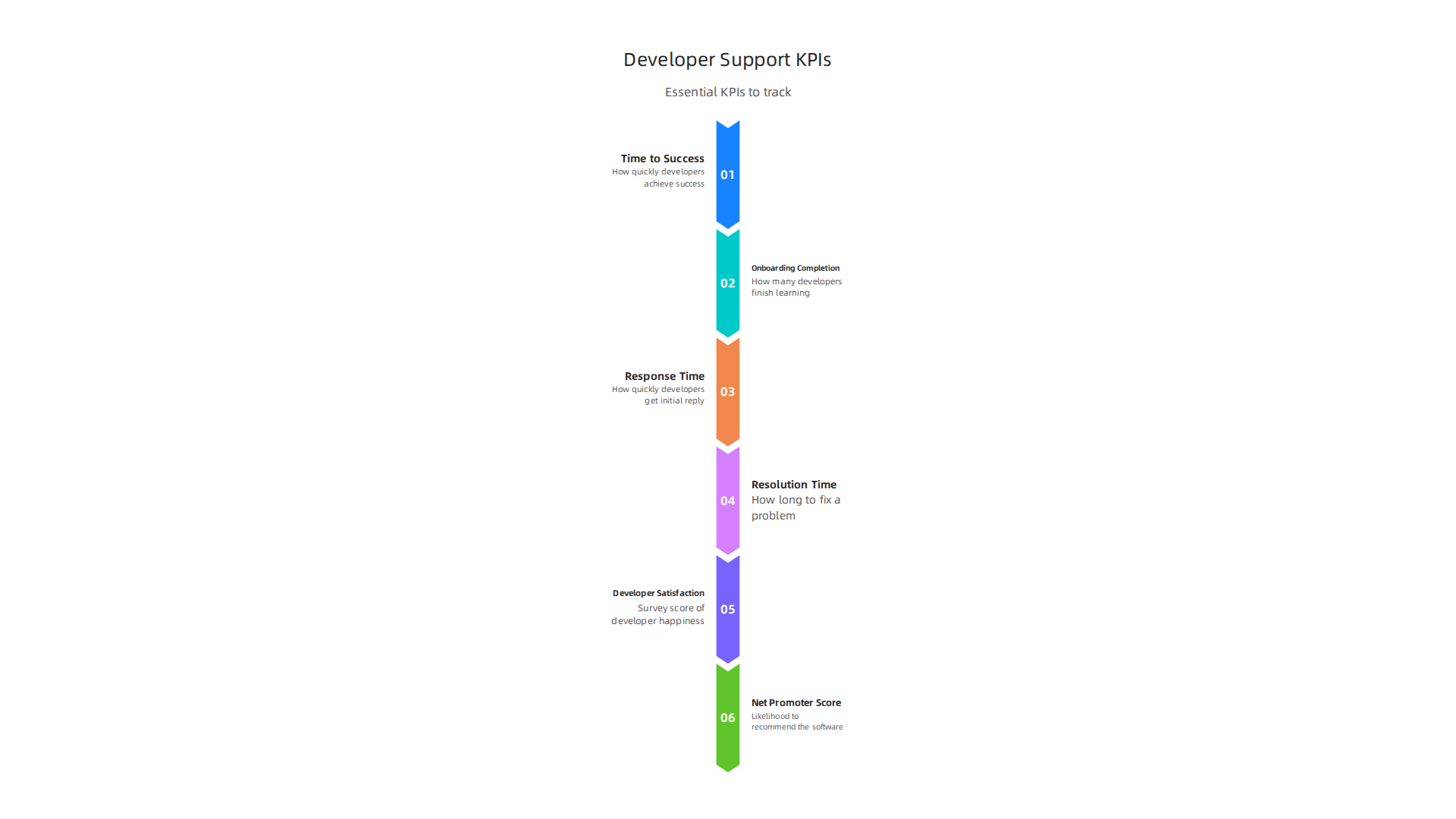
This metric looks at how quickly a new developer can achieve something useful with your software. For example, how fast can they set up their first project, run a sample app, or make a simple call to your API? A shorter TTFS means your onboarding content and tools are working well. It shows that developers can jump in and start contributing to the software lifecycle development faster. This speed is vital, especially for companies offering custom software development services companies where every minute counts.
Onboarding Completion Rate
This is about how many developers finish their initial learning steps. If many developers start your onboarding guide but don’t finish, it might mean the process is too hard, too long, or not helpful enough. A high completion rate suggests that your guides and tools are easy to follow and keep developers engaged.
Support Response and Resolution Times
These KPIs measure how fast your support team (the "people" part of developer support) answers questions and solves problems.
- Support Response Time: How quickly does a developer get an initial reply after asking for help?
- Issue Resolution Time: How long does it take for a problem to be fully fixed?
Faster times here mean developers spend less time stuck and more time building. These are key parts of good Software Development KPIs: Top Metrics & Practical Guides for 2026.
Developer Satisfaction (DSAT) / Net Promoter Score (NPS)
Sometimes, the best way to know if developers are happy is just to ask them.
- Developer Satisfaction (DSAT): This is a specific survey score that shows how happy developers are with your tools and support.
- Net Promoter Score (NPS): While often used for customers, you can use a similar idea to ask developers how likely they are to recommend your software to others.
Gathering direct feedback like this is very powerful. It helps you find out what developers love and what still needs work. You can even use surveys to assess their overall Developer Experience Assessment.
Tying KPIs to Business Outcomes
Measuring these numbers isn’t just for fun. It helps your business. Good developer support with strong KPIs can lead to:
- Reduced integration time: When developers can use your software easily, they finish projects faster.
- Increased usage and adoption: Happy developers use your tools more and bring more features to life.
- Better software quality: Less frustration means developers can focus on building well, not just fixing problems.
- Faster innovation: Tools that help developers be productive, like AI-assisted coding tools, can greatly boost performance and overall Developer Experience (DevEx), as shown in a 2026 study on Quantitative Data.
- **Lower costs for software maintenance and support services: Fewer issues mean less time and money spent on fixing things later.
By setting clear targets for these KPIs and regularly checking your progress, you ensure that your investment in developer support is truly paying off. This means better products, happier developers, and a stronger company. Leaders who understand these metrics can also identify key trends and benchmark their teams against industry standards for Developer Productivity Benchmarks 2026. This holistic approach ensures your team is not just busy, but truly effective.
When a company grows really big, with many developers working on different projects, giving good developer support becomes a bigger challenge. It’s like having a small neighborhood shop that suddenly needs to serve a whole city. You can’t just do things the same way; you need new plans to make sure everyone still gets the help they need. This is what we call scaling developer support.
Here are smart ways big companies can make sure their developers always feel supported:
Smart Ways to Offer Support
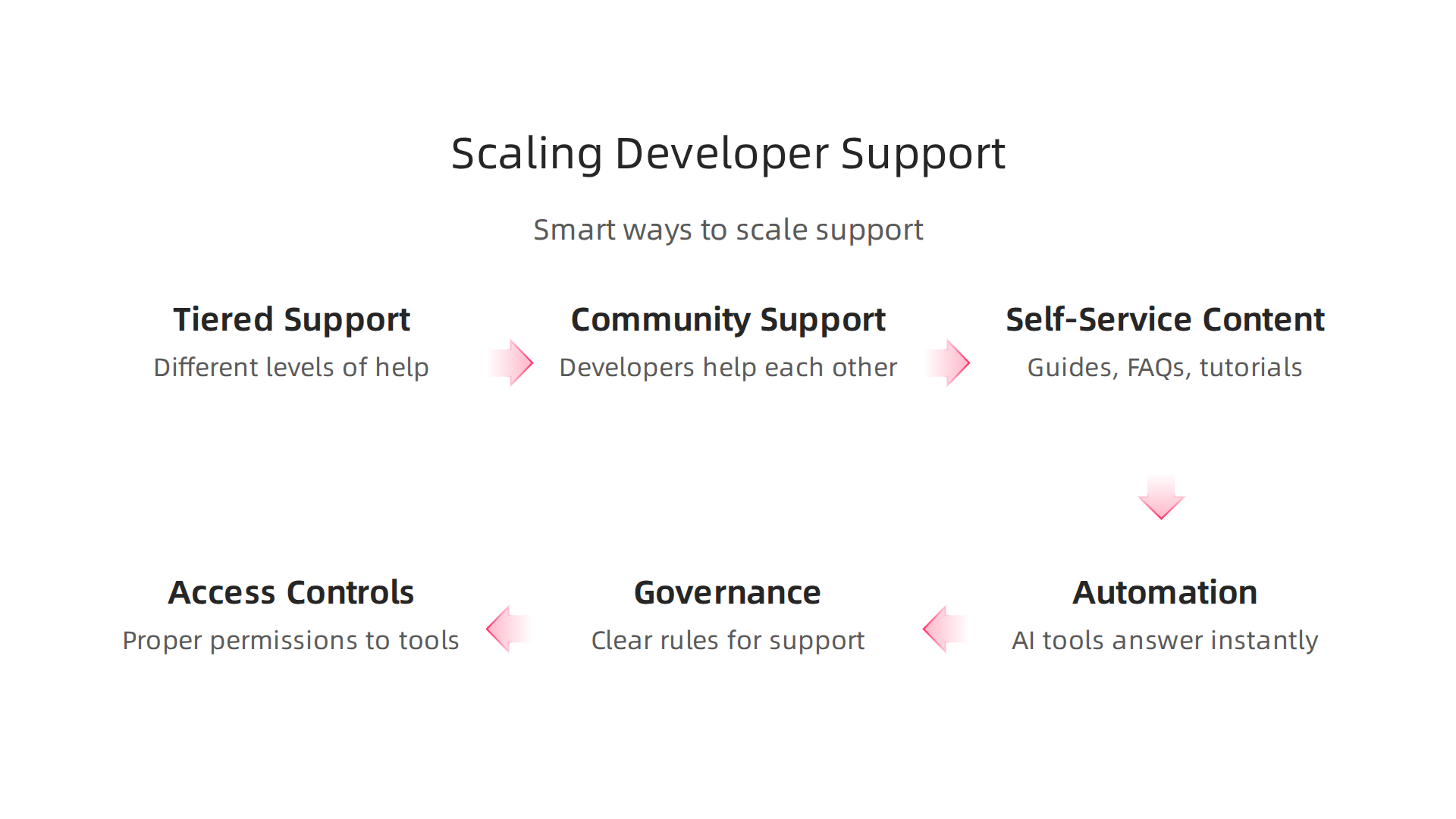
- Tiered Support Teams: Imagine different levels of help. For simple questions, there’s a quick help desk. For harder problems, there are expert teams ready to step in. This makes sure every question goes to the right person, so problems get solved faster.
- Community-Led Support: Sometimes, the best help comes from other developers. Companies can create online places where developers can ask questions and help each other. This builds a strong group of users and takes some of the load off the official support team.
- Self-Service Content: This means giving developers all the tools to help themselves. Think of really clear how-to guides, detailed FAQs, or video tutorials. When developers can find answers on their own, it speeds up the whole development cycle software and reduces the need to wait for a person to help.
- Automation: Using smart tools, especially AI, to help developers is a big trend in 2026. These tools can answer common questions instantly or guide developers to the right information. This makes support super fast and helps developers keep building without delays. Reports from 2026 highlight how agentic coding trends are making this possible, moving from simple assistants to more capable teams of AI tools that support developers proactively Anthropic’s 2026 Agentic Coding Trends Report: From Assistants to ….
Making Sure Everything is Safe and Follows Rules
For large organizations, scaling developer support also means thinking about important things like rules and security.
- Governance: This is about having clear rules for how developer support works. Who is in charge? What are the steps for getting help? A well-planned IT strategic report from 2026 shows how important data governance and operational excellence are for large organizations HECC-IT-Strategic-Plan Progress-Report-2026. ….
- Access Controls: Not everyone should have access to everything. Access controls mean making sure only the right developers can reach certain tools or information. This keeps projects safe.
- Integration with Enterprise Processes: When a big company brings in new software or tools for its developers, it needs to fit smoothly with how the company buys things (procurement) and keeps things secure (security processes). This is especially true for custom software development services companies where special software is often made. Making sure these tools meet company security standards from the start is key for the software lifecycle development. For example, some companies, like Ambience Healthcare, have found ways to manage IT and security even as they grew a lot Ambience Healthcare Case Study | Zip Security. Plus, adopting good security practices in the software development process can lead to better outcomes, including less risk Adopting security practices in software development process.
For businesses looking to understand the core tools used in today’s large teams, exploring The Modern Software Development Toolkit for Enterprise Teams in 2026 can offer valuable insights.
By putting these strategies in place, big companies can make sure their developer support is not just good, but also smart, safe, and efficient, no matter how many developers they have. This helps reduce software maintenance and support services needs in the long run.
Stay on top of the latest advancements and strategies in AI that are reshaping enterprise technology and developer support.
The AI Newsletter Worth Reading
To make these strategies work well, big companies need the right tools. Tools and platforms play a big part in how smoothly developers get help, reducing the need for constant software maintenance and support services. Here’s a look at the important tools that boost developer support in 2026.
Tooling and Platforms That Improve Developer Support
Having the right tools is like giving your team superpowers. These tools make it easier for developers to find answers, test their work, and get help quickly when they need it, speeding up the whole development cycle software.
- Developer Portals: Think of a developer portal as a one-stop shop online. It’s a central place where developers can find everything they need. This includes clear documentation, tools they can use, and information on how to connect different software parts (APIs). When everything is in one easy-to-find place, developers waste less time searching and more time building.
- Integrated Documentation, APIs, and SDKs: Clear instructions are key. When companies provide well-written guides for their Application Programming Interfaces (APIs) and Software Development Kits (SDKs), developers can quickly understand how to use them. These are like instruction manuals for building with specific software pieces. Good documentation means fewer questions for the support team. If you want to dive deeper into what an SDK is, you can check out this guide on Software Development Kit Definition Explained For Enterprise Leaders.
- Sample Projects and Sandbox Environments: Imagine learning to build something new without being able to try it out first. Sample projects are like small, working examples that developers can look at to understand how things fit together. Sandbox environments are safe play areas where developers can test their code without worrying about breaking anything important. These tools help developers learn by doing, which reduces the need for direct hand-holding from support.
- Observability Tools: These are tools that help support teams "see" what’s happening inside the software. They can track how well programs are running, find errors, and understand why things might not be working. When a
developer supportteam has good observability, they can quickly pinpoint problems and help developers fix them. For example, some companies use these tools to keep an eye on their systems and improve how they work, as seen in cases like MaestroQA optimizing AWS observability. - Support Systems: These are the actual software systems that help manage support requests. They keep track of questions, assign them to the right people, and make sure no one waits too long for an answer. These systems often include ways for developers to log their own issues and track the progress of their requests.
Choosing the right tools has a big impact on software lifecycle development. When a company, especially custom software development services companies, picks tools that fit well with their existing systems, it speeds up how fast new software can be put into place. On the other hand, bad tool choices can create more work for the support team and slow down the entire process. When evaluating new tools, it’s smart to look at things like their technical abilities and how well they can integrate with your current setup, as highlighted in The Essential IT Vendor Selection Criteria Checklist. Picking the right tools from the start can save a lot of headaches later on.
Good tools are a big help, but how your team is set up and the rules you follow are just as important for good developer support. This is especially true for companies that offer custom software development services companies. How you organize your support, what promises you make, and how you handle tough problems can make a huge difference in how happy developers are and how smoothly the software lifecycle development goes.
Organizing Teams for Developer Support
First, let’s talk about how support teams can be structured.
- Centralized Support: This is like having one big team of experts that handles all developer questions. They know a lot about many different parts of your software. This can be great because experts are easy to find, and they keep all the knowledge in one place.
- Embedded Support: In this setup, support people work directly within the teams that build the software. So, if a team makes a certain part of the software, their support person is right there with them. This means they know that specific software part inside and out, which can lead to faster and more detailed help. It also helps to create better feedback loops, as the support person can quickly tell the developers about common problems.
No matter how teams are set up, keeping track of issues is vital. For leaders looking to understand how to guide their teams through the process, learning about SDLC Methodologies for Enterprises Choosing the Right Software Development Life Cycle can provide valuable insights.
Service Level Agreements (SLAs)
An SLA, or Service Level Agreement, is like a promise a company makes to its customers about how quickly they will get help and how good that help will be.

For enterprise customers, these promises are very important. SLAs usually spell out things like how fast the support team will respond and how long it should take to fix a problem [1]. These agreements often have different levels, or tiers, based on how important the issue is or how much a customer pays.
Here are common SLA levels you might see in 2026:
- Standard Support: This level might promise a response within 1 or 2 business days for issues that are not super urgent. For example, some companies guarantee a response within two business days for standard support [2].
- Business Support: For more important issues, this level offers faster help, perhaps a response within one business day [3].
- Enterprise Support: This is the highest level of support, often for mission-critical systems. It promises the quickest help, sometimes within a few hours, or even as fast as 30 minutes for very serious problems, 24/7. It may also include a dedicated support engineer [4]. This level of support often comes with a higher cost because it guarantees a fast response, which is crucial for big businesses that can’t afford long downtimes [5].
It is important to clearly define what counts as a high-priority problem versus a low-priority one. This helps everyone understand what to expect.
Escalation Paths and Feedback Loops
Even with great initial developer support, some problems are complex and need more help. This is where escalation paths come in. An escalation path is a clear plan for who to contact when a problem can’t be solved by the first person who gets the request. It’s like moving up a ladder: if level one support can’t fix it, it goes to level two, then maybe to a special engineering team if needed [6]. This ensures that no difficult problem gets stuck.
Feedback loops are also super important. This means that information about common problems or bugs found by the developer support team gets sent back to the product and engineering teams. This way, those teams can learn from the issues and make the software better in the future, reducing the need for software maintenance and support services. It helps to fix the root cause of problems, not just the symptoms.
Knowledge Management
Lastly, keeping all the helpful information in one place is key. This is called knowledge management. It means creating and updating a library of answers, guides, and how-to articles. When developers can easily find answers themselves, they don’t need to ask for help as often. This makes developer support more efficient and helps developers move faster in their development cycle software. This central hub can be part of a developer portal, making it easy to access everything needed.
For business leaders trying to stay on top of the latest in tech, especially with how fast AI is changing things, it’s good to have trusted sources. To get clear daily updates on AI and technology directly to your inbox, subscribe to The AI Newsletter Worth Reading.
Future trends: AI, automation, and the next frontier of developer support (2026 outlook)
Now, let’s look at what’s new and exciting in developer support for 2026. A big part of this is how smart computer programs, called AI, are changing how support works. AI and automation are making things faster and smarter, especially for custom software development services companies.
AI Makes Support Smarter
Think about how AI can help build up that library of knowledge we just talked about.
- AI-assisted documents: Generative AI can now help write user guides, articles with answers to common questions, and how-to steps. This means developers can find what they need even faster without waiting for a human. It speeds up the whole
development cycle software. - Faster answers: When a developer asks a question, AI tools can quickly search through tons of information. They can give an answer right away, sometimes even suggesting code fixes. This makes
developer supportmuch quicker. - Automated problem solving: AI can also look at error messages or logs from software. It can often figure out what’s wrong and suggest how to fix it, even before a person gets involved. This helps reduce the need for constant
software maintenance and support servicesby catching problems early. In fact, many organizations expect to use AI to make their software engineering teams stronger by 2030, which will change howsoftware lifecycle developmenthappens [7].
Keeping AI Answers Right and Trustworthy
While AI is super helpful, we also need to be careful.
- Checking for accuracy: AI is still learning, so sometimes its answers might not be perfect. It’s important to have people check the information AI gives out to make sure it’s correct and safe to use. This is called governance, and it means having rules for how AI is used.
- Building trust: Developers need to trust the information they get from AI. If AI gives wrong answers too often, people will stop using it. Companies must put in place ways to make sure AI is reliable and fair. This often means having human experts oversee the AI’s work and provide corrections when needed [8].
The way we provide developer support is changing fast with AI. Companies are learning how to use these new tools to offer better, faster help while also making sure the help is accurate and can be trusted. It’s an exciting time for technology and how teams work together.
References
[1] SLA-поддержка: полный гайд по выбору модели в 2026 году. (2026). mwi.me.
[2] Essential Studio Support SLA Updates: Response Times … (2026). syncfusion.com.
[3] Essential Studio Support SLA Updates: Response Times … (2026). syncfusion.com.
[4] How to Create a Dedicated Enterprise SLAs & Support Page … (2026). truto.one.
[5] What Support SLAs Should You Offer for Different Open … (2025). getmonetizely.com.
[6] Tiered Help Desk Structure: Guide for MSPs. (2026). msp360.com.
[7] 2026 Global Software Industry Outlook. (2026). deloitte.com.
[8] Building enterprise AI trust with human oversight and guardrails. (n.d.). enterprisesoftwarenews.com.
Summary
This article explains why developer support is a strategic priority for enterprise leaders and how strong support accelerates software adoption, shortens integration time, and protects innovation capacity. It outlines the three core components—people (DevRel), content (docs, onboarding, sample apps), and tooling (SDKs, portals, observability)—that make developer support effective across the full software development lifecycle. The guide shows which KPIs to track (TTFS, onboarding completion, response/resolution times, DSAT/NPS) and how those metrics tie to business outcomes like faster ROI and higher product quality. It also offers practical approaches to scale support in large organizations—tiered teams, community-led help, self-service content, automation—and the governance and access controls needed for enterprise environments. The article reviews tooling choices that reduce maintenance overhead and explains how SLAs, escalation paths, and knowledge management should be organized. Finally, it looks ahead to 2026 trends where AI and automation make support faster but require oversight to ensure accuracy and trust. After reading, leaders will understand how to measure, scale, and invest in developer support to speed delivery and protect engineering productivity.