
Platform Engineering in 2026: A Strategic Guide for CIOs and CTOs

Introduction
If you are leading a technology team in 2026, you already know the pain. Enterprise software teams today face a level of complexity that was hard to imagine just a few years ago. Your software architecture sprawls across dozens of microservices. Your cloud bills confuse everyone. And your agile software development cycles often feel more chaotic than "agile." Simply picking the right tools from the endless devops tools list takes up too much time.
This growing complexity directly hits your bottom line. Operational costs climb. Developer morale dips. And your ability to respond to the market slows to a crawl.
There is a better way. Platform engineering offers a structured approach to building what is known as an internal developer platform (IDP). Think of it as a paved road for your engineers.

Instead of every team wrestling with infrastructure, security, and tooling on their own, an IDP gives them a standardized, self-service layer. It streamlines workflows and reduces friction.
For senior leaders like you, understanding platform engineering is not just a technical curiosity. It is a strategic necessity. In this article, we will provide a research-backed overview of what platform engineering is, its core components, the real benefits your teams can expect, and the common pitfalls you need to watch out for.
Part of mastering this complexity involves selecting the right digital environment for your organization. For a broader view of the strategic landscape, check out our Enterprise Technology Analyst Insights 2026: A Guide for CIOs and CTOs. And if you are currently evaluating tools to support your teams, our guide on Cloud-based Productivity Tools: How to Evaluate and Select the Best Tools for Your Enterprise in 2026 is a great next step.
But let us start with the hard part: the problems platform engineering is actually trying to solve.
What Is Platform Engineering?
So what exactly is platform engineering? In simple terms, it is the discipline of designing and maintaining an internal developer platform (IDP). Think of this platform as a layer of standardized tools and services that your engineering teams can use on their own. Instead of every developer worrying about infrastructure, security, and deployment, the IDP handles the heavy lifting. According to a comprehensive guide by Sonar, platform engineering focuses on creating a robust and efficient ecosystem for developers.

This directly tackles the chaos many teams feel in modern agile software development, where complex software architecture often slows everyone down.
Platform engineering did not appear out of nowhere. It grew naturally out of DevOps and site reliability engineering (SRE) practices. The core idea is to treat your internal platform as a product. This means it has a dedicated product manager, a clear roadmap, and a focus on user experience, just like any software you would buy. A key goal is to reduce the cognitive load on your development teams. As a 2026 report from Growin explains, platform engineering formalizes enablement and creates a clearer contract between teams and the systems they depend on. This frees up your developers to focus on building features for your customers instead of fighting with infrastructure.
So what does a good IDP actually look like in practice? It usually relies on a few key components.
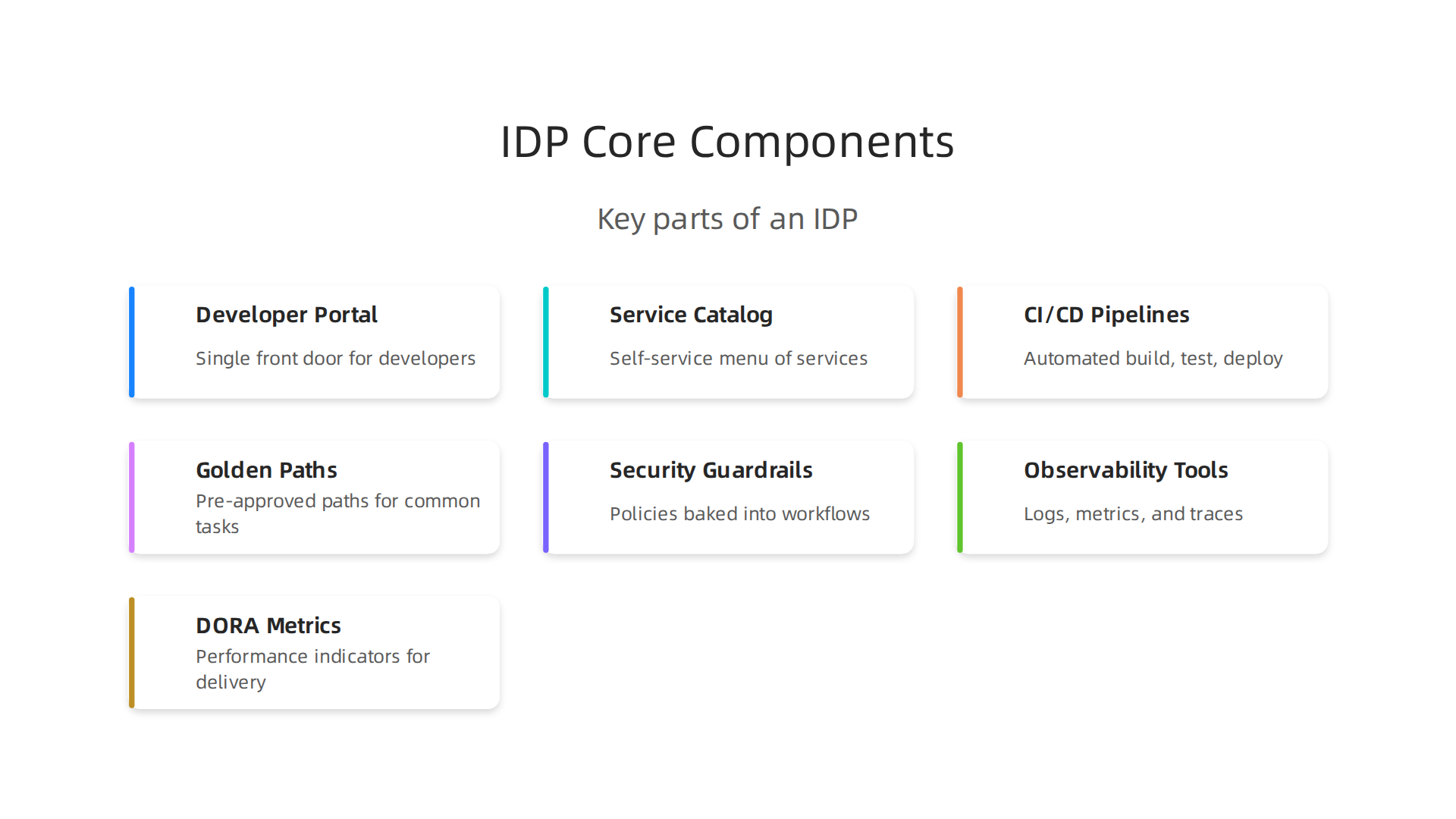
The first is called "golden paths." These are pre-approved, paved roads for common tasks like spinning up a new microservice or setting up a CI/CD pipeline. The second is a "service catalog." This is a self-service menu of infrastructure, tools, and services your teams can request instantly. The third is a "developer portal," which acts as the single front door to the IDP. Instead of maintaining a confusing devops tools list scattered across wikis and Slack channels, your teams get a single, curated interface that follows the best practices your platform team has defined.
For senior leaders evaluating their enterprise technology strategy, platform engineering represents a major shift. It moves your organization from a culture of "every team figures it out alone" to a culture of "we provide the paved road." This leads to safer, faster software delivery. If you are interested in how a well-designed platform can streamline your specific operational workflows, understanding the product ecosystem is crucial. Our guide on Cloud-based Productivity Tools: How to Evaluate and Select the Best Tools for Your Enterprise in 2026 provides a framework for thinking about the tools a platform might standardize. Now, let us look at the specific components of an internal developer platform in more detail.
The Business Case for Platform Engineering
Maybe you are still wondering: Is platform engineering really worth the investment for your organization? The data from 2026 says yes. Companies that adopt a formal internal platform see real, measurable improvements. They ship software faster, make fewer mistakes, and keep their developers happier.

Let us look at the numbers.
Measurable Improvements in Developer Productivity
The most common way teams track success is with DORA metrics. These include deployment frequency and lead time for changes. According to the Platform Engineering Maturity Report for 2026, organizations with mature platforms see significantly shorter lead times and much higher deployment frequencies. Instead of waiting weeks to release a new feature, teams can deploy multiple times a day. This is because the platform handles the boring, repetitive work. A study by Growin explains how platform engineering formalizes enablement and reduces cognitive load. When developers stop wrestling with infrastructure, they focus on building features that matter to your customers.
Faster Onboarding and Fewer Errors
One hidden cost of chaotic software development is onboarding. New engineers can spend months learning your specific setup, tools, and security rules. With a solid internal developer platform, you cut that time dramatically. The platform provides ready-to-use "golden paths" and a self-service catalog. A new hire can spin up a test environment in minutes, not days. According to Sonar, a well-built platform creates a robust and efficient ecosystem. This leads to lower error rates because everyone follows the same best practices. There are no more "works on my machine" surprises.
Calculating the Real ROI
So what does all this mean for your budget? The return on investment for platform engineering comes from several places. First, you ship features faster, which means your business can react to market changes quicker. Second, you reduce infrastructure costs. Instead of every team buying their own tools and servers, the platform provides shared, optimized resources. Third, you improve operational resilience. When a platform team handles security and compliance, you have fewer outages and less downtime.
To track this ROI, many organizations use frameworks like DORA, SPACE, and DevEx. These tools help you measure productivity, satisfaction, and flow. If you are evaluating which tools to include in your platform, a structured approach can save you a lot of time. Our guide on Cloud-based Productivity Tools: How to Evaluate and Select the Best Tools for Your Enterprise in 2026 provides a clear framework for making those choices.
The bottom line is simple. Platform engineering is not just a tech trend. It is a proven strategy that delivers faster software, happier teams, and a healthier bottom line. In the next section, we will walk through the practical steps to start building your own internal platform.
Core Components of an Internal Developer Platform
So you are sold on the idea. Now let us look at what actually goes into building an internal developer platform. Think of it as a well-stocked toolbox that your whole software development team can share. Every platform is a little different, but the best ones share the same basic building blocks.
According to the AWS Prescriptive Guidance on designing internal developer platforms, core components include a developer portal, a service catalog, CI/CD pipelines, infrastructure provisioning, security guardrails, and observability tools.
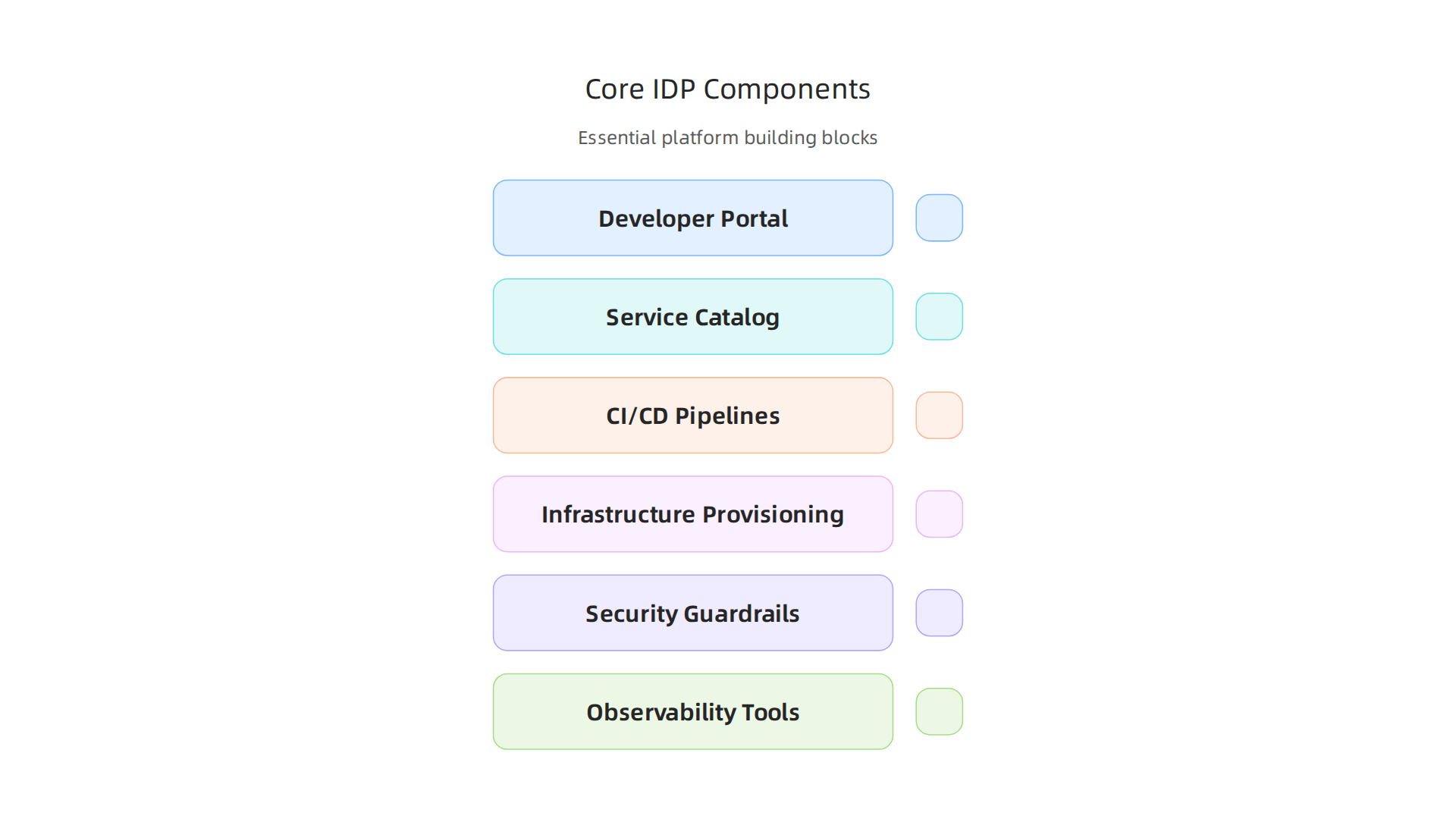
Each part has a specific job.
The Developer Portal (Your Front Door)
This is the main interface your developers see. It is a web-based dashboard where they can find documentation, request resources, and see the status of their work. A good portal makes everything self-service. No more waiting for tickets or asking Ops for help. The platform engineering team at Humanitec calls this the "platform orchestrator" and considers it a core part of any IDP.

The Service Catalog and Golden Paths
Inside the portal, your developers should see a menu of ready-to-use services. This is your service catalog. It lists things like databases, message queues, or compute environments. Each entry comes with a "golden path" or paved road that guides the developer to a production-ready pattern. Instead of asking "how do I set up a PostgreSQL database?", they just click a button and get one that follows all your best practices. MiaPlatform explains that these golden paths are essential for reducing decisions and keeping quality high.
CI/CD Pipelines and Infrastructure as Code
Once a developer picks a service, they need a way to get their code into production safely. That is where continuous integration and continuous delivery pipelines come in. These automated workflows build, test, and deploy your software. Underneath, infrastructure provisioning tools like Terraform or Pulumi handle spinning up servers, networks, and storage. The key is that developers never have to touch the infrastructure directly. They just push code.
Security, Compliance, and Observability
No platform is complete without guardrails. Security policies should be baked into every golden path. If someone tries to deploy a container that is not patched, the platform should stop them. Observability tools give you logs, metrics, and traces so you can see how everything is running. The Flexera blog notes that these components help centralize resources and reduce risk.
The Trick: Integration Over Just Tools
Here is the thing. You can pick the best devops tools list in the world, but if they do not talk to each other, you are back to chaos. The real magic happens when you integrate everything into one smooth experience. When you choose cloud-based productivity tools, think about how they connect. Our guide on Cloud-based Productivity Tools: How to Evaluate and Select the Best Tools for Your Enterprise in 2026 can help you pick tools that work well together.
Remember, the goal is not just to collect components. It is to curate them into a system that feels simple to your developers. The platform hides all the messy details so your team can focus on building features that matter.
Building vs. Buying: Strategic Decisions
You now know the core components of an internal developer platform. But here is the big question that stops every team in its tracks: Should you build your own IDP from scratch, or buy one off the shelf?

Your answer will shape your whole platform engineering journey for years to come.
The truth is, there is no perfect choice. Each path has real trade-offs. Let us break them down simply.
Build Your Own: Full Control, Heavy Lift
Building a custom IDP means you design every piece yourself. You get maximum flexibility. Your platform fits your exact stack, your team’s preferences, and your specific workflows. No compromises.
But that flexibility comes at a cost. A dedicated platform team has to design, code, test, and maintain the whole thing. According to Codiac’s analysis of platform engineering in 2026, building an IDP from scratch is often a 12-month project. That is a year before your developers see any benefit. You also need ongoing maintenance as your tools and cloud providers change. The AWS prescriptive guidance on internal developer platforms outlines how to design this architecture, but it assumes you have the engineering talent to execute it.
Who should build? Large enterprises with big engineering teams, unique requirements, and a long-term commitment to platform engineering. If you have the budget and patience, build gives you total ownership.
Buy Commercial: Speed, But Strings Attached
Buying a commercial IDP speeds things up fast. You get a pre-built platform with dashboards, golden paths, and integrations ready to go. Your team can start using it in weeks, not months. And you avoid the burden of building and maintaining custom code.
However, you trade flexibility for convenience. Vendor lock-in can become a real problem. Licensing costs add up over time. And you may struggle to customize the platform for your unique workflows. The market already has many options. Gart Solutions lists the top platform engineering companies in 2026, showing a mature ecosystem of commercial solutions. But picking the right one requires careful evaluation.
Who should buy? Smaller teams, organizations that need fast time-to-value, and companies that want to focus on product development rather than tool building.
Hybrid Approach: The Best of Both Worlds
Many smart teams choose a middle path. They start with an open-source core like Backstage or a reference architecture from the community. Then they add custom layers on top. The Platform Engineering team at platformengineering.org provides reference architectures that you can use as a starting point.

This hybrid approach gives you a head start without closing the door on customization.
The challenge? You still need some internal expertise to integrate and maintain the pieces. But it is far less than building everything from scratch.
So Which Should You Pick?
Here is the honest answer. It depends on your team size, your budget, your timeline, and your tolerance for risk. Many platform engineering initiatives fail not because of the tool choice, but because of organizational alignment, as noted in a 2025 analysis from platformengineering.org. So before you decide, take a hard look at your team’s capacity and your business goals.
To make this call, many CIOs and CTOs turn to trusted guidance. Our article on Enterprise Technology Analyst Insights 2026: A Guide for CIOs and CTOs offers a framework for evaluating big technology decisions like this. It can help you think through the build versus buy question with a clear head.
No matter which path you choose, remember this: your platform is a product for your developers. Build or buy, make sure it actually makes their lives easier.
Measuring Success: KPIs and Metrics for Platform Engineering
So you have decided whether to build or buy your platform. Great. But now comes another hard question. How do you know if it is actually working?
Here is the truth. Many teams launch their internal developer platform, celebrate the go-live, and then have no idea if it is helping. They guess. They hope. But they do not measure. And without measurement, you cannot prove value to your stakeholders.
Let us fix that.
Start With DORA Metrics
The most proven way to measure platform success starts with DORA metrics. These four metrics have been around for years, and they still work in 2026. As the Platform Engineering blog notes, DORA metrics like deployment frequency and lead time become stronger indicators of systemic engineering improvements as your platform matures.
The four key DORA metrics are:
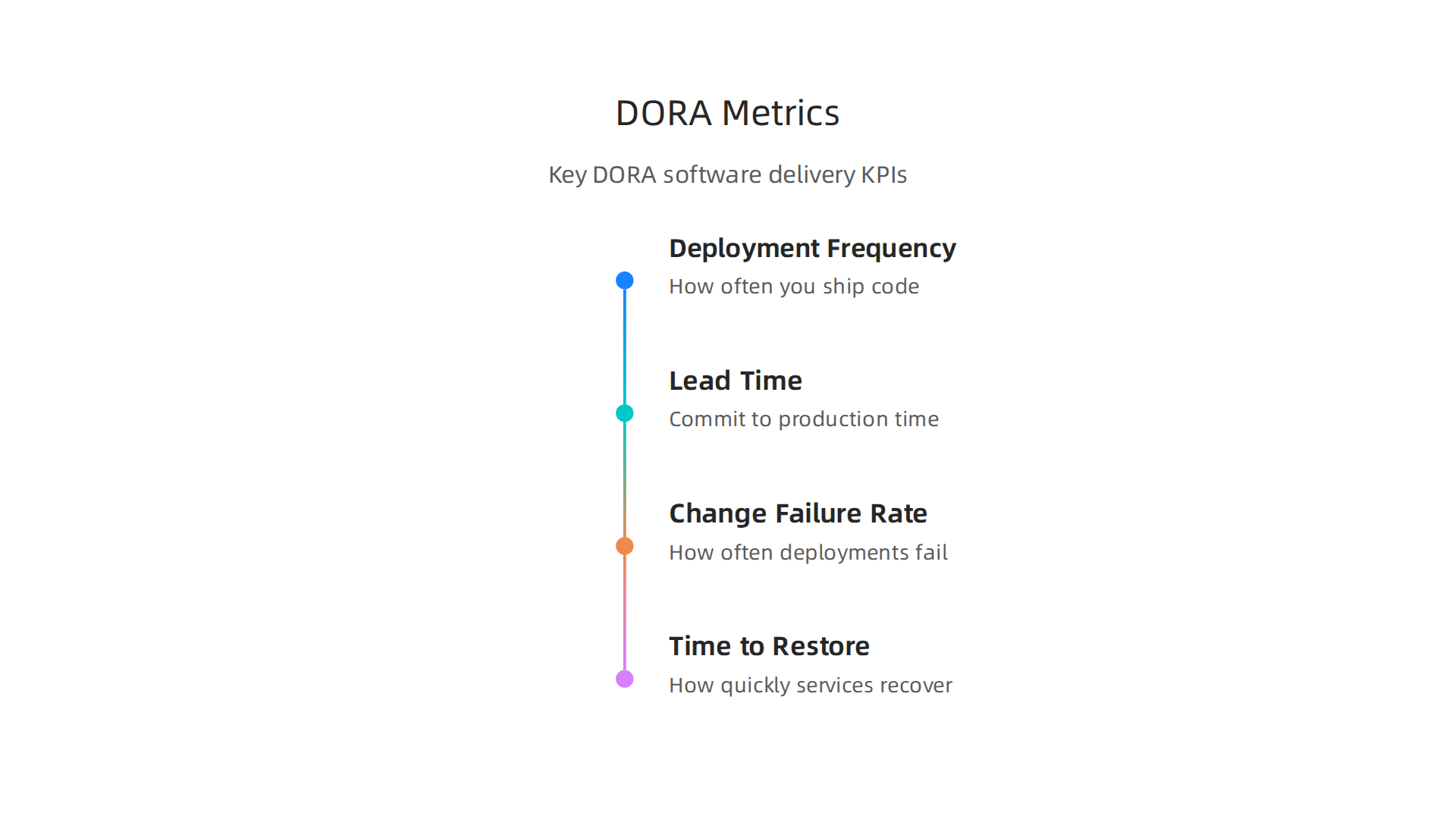
| Metric | What It Measures |
|---|---|
| Deployment frequency | How often your team ships code |
| Lead time for changes | How fast code goes from commit to production |
| Change failure rate | How often deployments cause problems |
| Time to restore service | How quickly you recover from failures |
These metrics give you a clear picture of your software development pipeline. They show whether your platform is actually speeding things up or just adding more complexity.
Add the SPACE Framework
But DORA alone is not enough. It only covers operational speed and stability. It misses the human side. That is where the SPACE framework comes in. According to a 2026 guide from Globy, SPACE measures developer productivity across five dimensions: Satisfaction and well-being, Performance, Activity, Communication and collaboration, and Efficiency and flow.
Why does developer satisfaction matter? Because unhappy developers find workarounds. They bypass your platform. They complain. And your platform adoption rate drops fast. Measuring how developers feel about your platform is just as important as measuring how fast they deploy.
Track Platform Health Indicators
Beyond developer metrics, you need to measure the platform itself. Key health indicators include:
- Adoption rate – What percentage of teams are actively using your platform?
- Number of services onboarded – How many applications or microservices run through the platform?
- Support ticket volume – Are developers filing lots of bugs and complaints?
- Self-service success rate – Can developers do what they need without asking for help?
These indicators tell you if your platform is becoming a true enabler or just another tool nobody wants to use. The team at Mia-Platform offers a detailed guide on calculating platform ROI that covers these dimensions.
Balance Velocity and Stability
Here is the tricky part. You want developers to ship fast. But you also want production to stay stable. If you optimize only for deployment frequency, you might push broken code. If you optimize only for stability, you might slow everyone down.
The best approach is to pick three to five metrics that align with your business outcomes. For example, if your goal is faster time-to-market, focus on lead time and deployment frequency. If your goal is reliability, focus on change failure rate and recovery time.
Your key takeaway? Measure what matters to your business, not just what is easy to count. And if you want a deeper dive on how to evaluate big technology decisions like this, check out our guide on Enterprise Technology Analyst Insights 2026: A Guide for CIOs and CTOs. It provides a solid framework for connecting metrics to strategy.
Common Pitfalls and How to Avoid Them
You have your metrics set up. You know what success looks like. But even the best measurement system won’t save you if you fall into the same traps that sink most platform engineering initiatives.
Here is the hard truth. According to an analysis of anti-patterns by Jellyfish, many platform teams make the same predictable mistakes. And these mistakes kill adoption before the platform ever gains real traction.
The Biggest Mistakes Teams Make
Building too much too soon. You want to solve every problem at once. So you build a massive platform that tries to do everything. But this approach backfires. As the team at Graph AI points out, starting too big leads to complexity that developers reject. Your platform becomes a burden, not a help.
Neglecting user research. You assume you know what developers need. You build features based on your own guesses. But you never actually talk to your users. The result? A platform that solves problems nobody has.
Failing to align with developer needs. This ties back to user research. But it goes deeper. Your developers have their own workflows, their own tools, their own preferences. If your platform forces them to change everything, they will fight it. The InfoWorld article on platform engineering anti-patterns calls this one of the most common reasons initiatives fail.
Underestimating the cultural shift. Platform engineering is not just a technical change. It is a cultural one. Your organization needs to adopt new ways of working. And that takes time, patience, and leadership buy-in. Without it, your platform will sit unused.
Treating the platform as a project, not a product. A project has an end date. A product needs ongoing care. If you build the platform and then walk away, it will rot. Developers will lose trust. And you will have wasted your investment.
Insufficient funding for ongoing maintenance. Platforms need constant updates, bug fixes, and improvements. If your budget only covers the initial build, you are setting yourself up for failure.
Lack of executive support. Without a champion in leadership, your platform will struggle to get resources, attention, and authority.
How to Avoid These Traps
Start small. Pick one golden path a single workflow that solves a real pain point. Prove it works. Get feedback. Then expand.
Measure adoption iteratively. Do not wait for a big quarterly review. Check your metrics weekly. Talk to users constantly. Adjust as you go.
Dedicate a full-time platform team. This is not a side project. It needs people who own it completely.
And most importantly, treat your platform like a product. Give it a roadmap. Give it a backlog. Give it a team that cares about continuous improvement.
Want more guidance on evaluating big technology decisions? Our guide on Enterprise Technology Analyst Insights 2026: A Guide for CIOs and CTOs provides a solid framework for connecting your platform strategy to broader business outcomes.
Summary
This article explains platform engineering and how an internal developer platform (IDP) can tame modern software complexity by offering a standardized, self-service layer for engineers. It covers what platform engineering is, the core IDP components (developer portal, service catalog, CI/CD, provisioning, security, observability), and the measurable business benefits such as faster delivery, lower errors, and improved onboarding. The piece walks through the strategic build-versus-buy decision and a hybrid option, describes the right metrics to track (DORA and SPACE plus platform health indicators), and calls out common anti-patterns that kill adoption. Practical guidance emphasizes starting small with golden paths, dedicating a platform team, and treating the platform as a product with continuous measurement and improvement. After reading, leaders will be able to evaluate whether to build or buy, identify the components to prioritize, and set clear KPIs and governance to maximize ROI.