
Enterprise AI Adoption in 2026 A Data Backed Roadmap for Business Leaders

Introduction
Are you drowning in AI hype in 2026? Every day brings a new headline about another breakthrough, another model launch, or another bold claim. Meanwhile, your inbox overflows with vendor pitches. The global AI market has hit $538 billion this year, with the enterprise AI segment alone valued at $40.45 billion and projected to grow at a stunning 42% CAGR through 2030. More than three-quarters of large companies already actively use AI. But here is the real question: how do you separate what actually works from what is just noise?
That is exactly the problem decision makers face right now. Information overload makes it hard to spot practical, scalable strategies that deliver real operational improvements.

The pressure to adopt AI powered business solutions is real, but so is the risk of investing in the wrong tools or approaches.
This article gives you a data backed roadmap for understanding, evaluating, and implementing enterprise AI for competitive advantage. We will cut through the hype and focus on what matters. Whether you are exploring cloud research platforms like Cluely AI or keeping an eye on frontier models from Anthropic AI, you need a clear framework to guide your decisions.
We will cover how to assess your current AI maturity, choose the right solutions, and avoid common pitfalls. And if you want to stay ahead of the curve with daily, bite sized insights, you can get clear daily AI updates from The Deep View Newsletter. For now, let us start building your roadmap.
The Rapidly Evolving Landscape of AI-Powered Business Solutions
So what exactly are we talking about when we say ai powered business solutions? It is a big umbrella. Enterprise AI covers a lot of ground: machine learning that spots fraud in real time, natural language processing that powers customer service chatbots, and generative AI that drafts reports or writes code. These technologies are not science fiction anymore. They are real tools that companies use every day.
The numbers prove it. The global AI market hit $538 billion in 2026, growing 37.3% year over year, according to data from Grand View, McKinsey, and Bloomberg compiled at Noizz. The enterprise AI segment alone is worth $40.45 billion right now and is expected to grow at a 42% CAGR through 2030, reaching $164.58 billion, as reported by Research and Markets. That is massive growth by any measure.
What is driving this? Cloud adoption and data proliferation are the two main engines. More data flows through organizations than ever before. Cloud platforms make it easier to store, process, and analyze that data. Tools like Cluely AI help teams conduct cloud research faster.
Meanwhile, frontier labs such as Anthropic AI keep pushing what generative models can do.
The result is a compounding effect: better AI requires more data, more data enables better AI.
How many companies are actually using this stuff? A lot. The NVIDIA State of AI Report for 2026 found that 76% of large companies actively use AI. Only 2% say they do not use it at all. Deloitte’s 2026 enterprise report adds that worker access to AI rose by 50% in 2025, and the number of companies with at least 40% of AI projects in production is expected to double within six months. That is a rapid shift from experimentation to real deployment.
Some industries are moving faster than others. Finance uses AI for fraud detection and algorithmic trading. Healthcare applies it to diagnostics and drug discovery. Manufacturing relies on AI for predictive maintenance and supply chain optimization. These sectors lead because they have clear use cases and high data volumes.
If you want to build your own AI capabilities, start with solid foundations. Your data quality and collection strategy will make or break your efforts. That is why it helps to read up on modern data collection methods for enterprise AI before you invest in any platform.
The pace of change is not slowing down. If anything, it is accelerating. You need a reliable way to keep up without drowning in hype. That is where a focused daily briefing can help.
Stay ahead with clear daily AI updates from The Deep View Newsletter.
Key Drivers Behind Enterprise AI Adoption in 2026
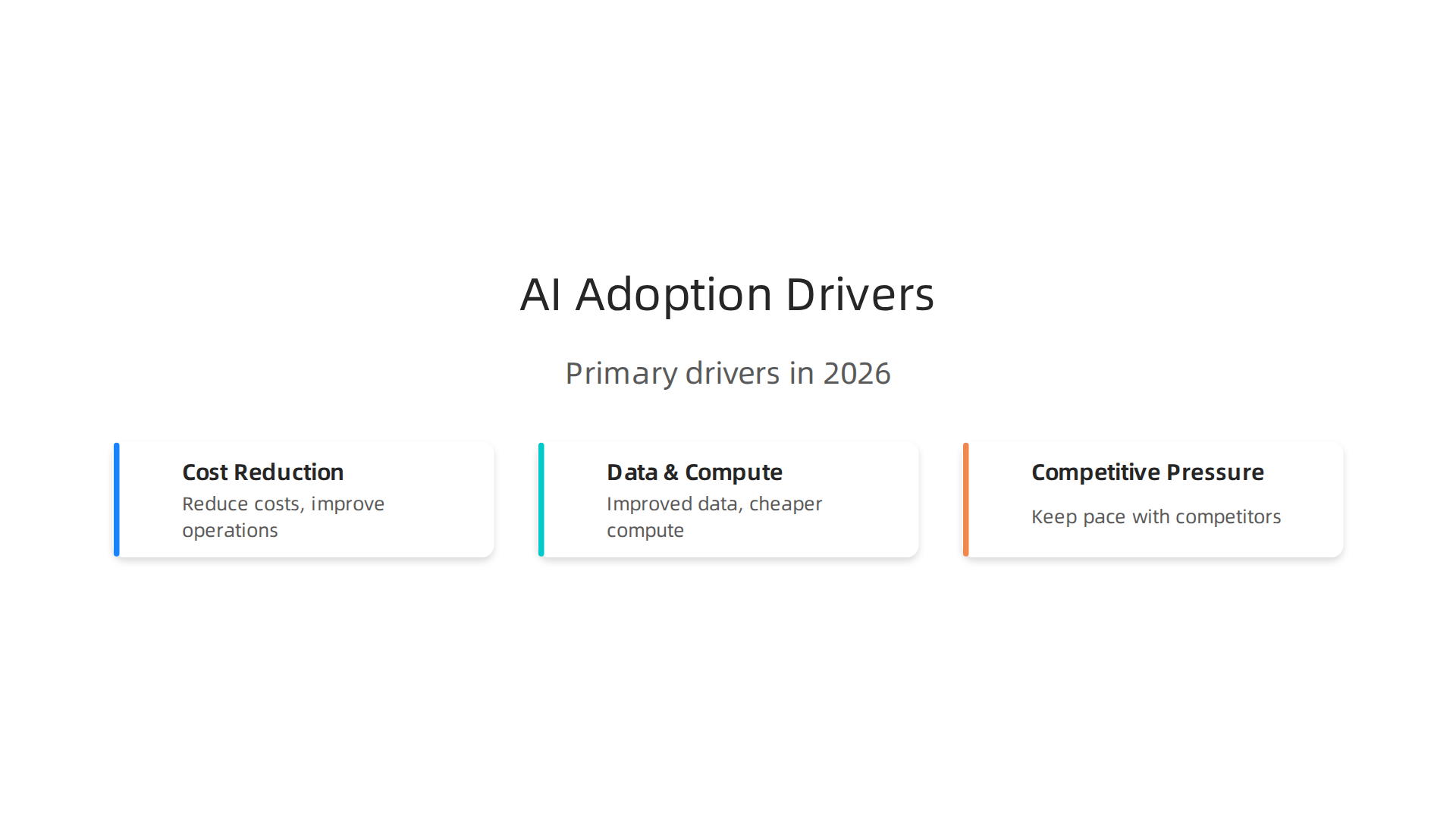
So what is really pushing companies to adopt ai-powered business solutions at such a fast pace? It is not just the cool factor. Three main forces are at work: the need to save money and run operations better, better data and computer power, and the pressure to keep up with competitors.
Cost Reduction and Operational Efficiency
Money talks. Most companies invest in AI because it helps them cut costs and work faster. According to the NVIDIA State of AI Report 2026, organizations are seeing real returns. The report notes that 48% of North American companies plan to increase their AI budgets by 10% or more this year. That kind of spending is not happening without proof.
A 2026 survey by Writer found that 29% of companies already see significant ROI from AI. That number is growing as more use cases move from pilot projects to full production. ETR panelists call 2026 the year AI shifts from pilots to production. When you can automate repetitive tasks, reduce errors, and speed up processes, the savings add up fast. Think of AI handling invoice processing, customer inquiries, or compliance checks. Each one saves hours of human work.
Better Data and Compute Power
AI is hungry for data and computing power. Both are now more available than ever. Cloud platforms make it cheap to store and process huge datasets. Tools like Cluely AI help teams analyze cloud research without needing a data science degree. Frontier labs like Anthropic AI push what models can do, and falling model costs make advanced AI affordable for more companies.
The data backs this up. Generative AI adoption doubled from 33% in 2024 to 65% in 2026, driven by falling model costs. When the price of running AI goes down, more companies can jump in. And with more data flowing from IoT devices, customer interactions, and supply chains, there is plenty of fuel for these models.
If you want to set your organization up for success, start with the basics. Check out this guide on data collection methods for enterprise AI in 2026 to make sure your data is ready.
Competitive Pressure
Here is the thing: nobody wants to be left behind. When your competitors use AI to deliver faster service, lower prices, or better products, you have to respond.

Deloitte’s January 2026 report found that 30% of enterprises are redesigning key processes around AI, and 34% are already using it in production. The pressure is real.
Industries like finance, healthcare, and manufacturing lead the charge, but traditional sectors are catching up fast. Even small and medium enterprises are getting in on the action, though at lower rates. The gap between early adopters and laggards is widening. If you are not moving now, you may find yourself scrambling later.
Staying informed is your best defense. The landscape changes weekly, not yearly. That is why a focused daily briefing can help you make smarter decisions without drowning in hype.
Get clear daily AI updates from The Deep View Newsletter.
Proven Use Cases: Where AI-Powered Solutions Deliver the Greatest ROI
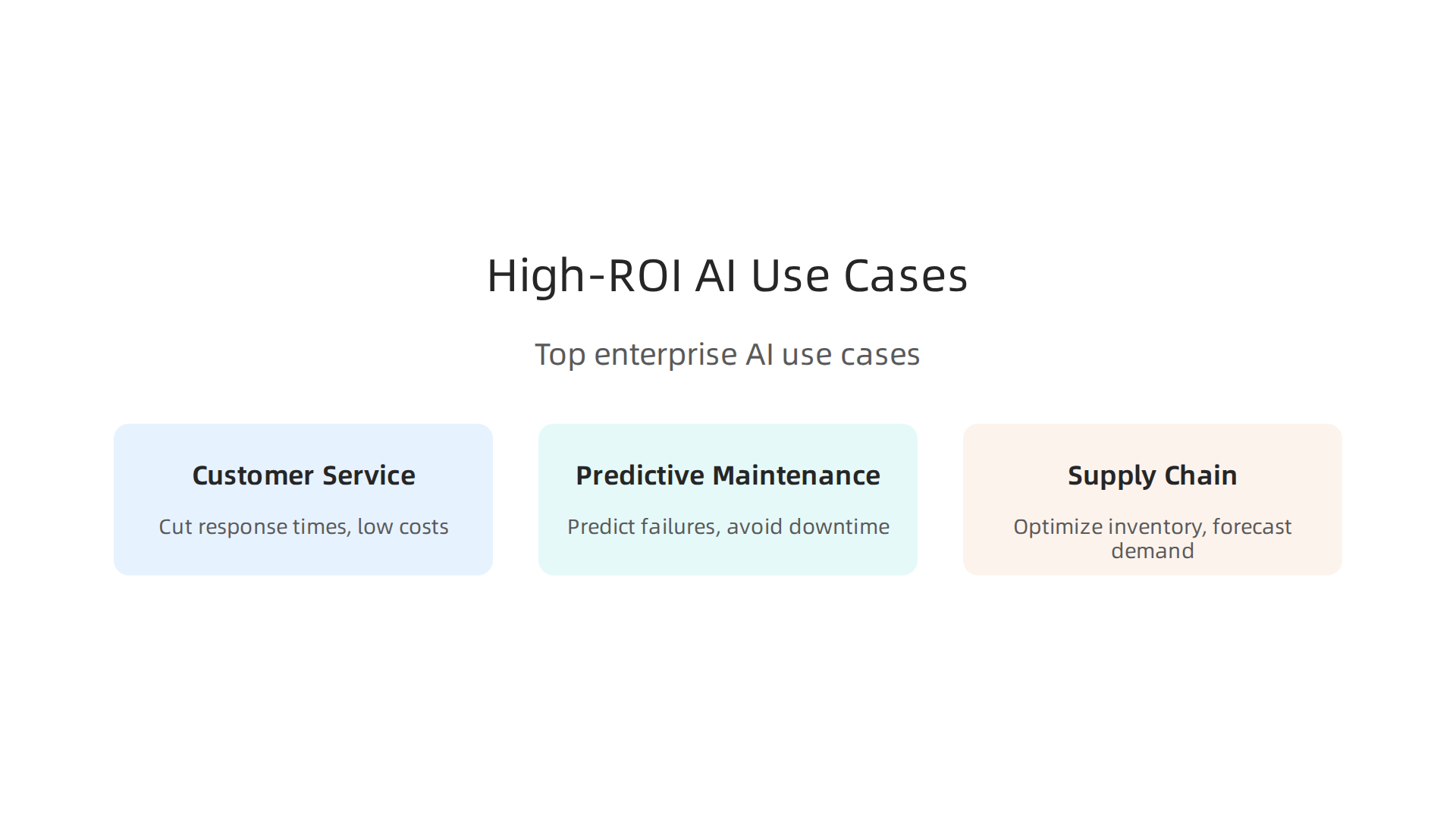
The drivers we just covered explain why companies are moving fast. But here is the real question: where does the money actually come from? Not every AI project pays off equally. The smartest organizations focus on a few high-impact areas that consistently deliver returns.
Customer Service Automation
This is the low hanging fruit. Chatbots, voice agents, and intelligent routing systems cut response times while handling massive volumes. According to the Writer 2026 AI adoption survey, 29% of companies already see significant ROI from AI, and customer service is a top use case. When a bot resolves a simple refund request in seconds instead of minutes, savings pile up fast. And the technology keeps improving. Frontier labs like Anthropic AI push models to handle more complex conversations without human handoff. The result: happier customers and lower costs at the same time.
Predictive Maintenance
For manufacturing, logistics, and energy companies, unplanned downtime is a nightmare. AI-powered solutions now analyze sensor data to predict failures before they happen. This is not science fiction. It is production today. ETR panelists confirm that 2026 is the year AI shifts from pilots to production. Predictive maintenance models learn from machine behavior and flag anomalies early, letting teams fix parts on schedule instead of during a crisis. The savings in repair costs, lost production time, and safety incidents are huge.
Supply Chain Optimization
Global supply chains are complex and fragile. AI brings clarity. Algorithms optimize inventory levels, reroute shipments around disruptions, and forecast demand with surprising accuracy. The NVIDIA State of AI Report 2026 notes that 48% of North American organizations plan to increase AI budgets by 10% or more, and supply chain is a major focus area. When you reduce overstock and prevent shortages at the same time, margins improve. Tools like Cluely AI help teams analyze cloud research data for supply chain decisions, making advanced analytics accessible without deep data science skills.
ROI Varies by Industry and Maturity
Not every use case works the same way for every company. A financial firm might get quick wins from fraud detection, while a retailer sees better returns from personalized marketing. Deloitte’s January 2026 report found that 30% of enterprises are redesigning key processes around AI, but results depend on how mature your data strategy is. Early adopters with clean data and clear goals see the strongest returns.
If you want to benchmark your own AI initiatives against industry leaders, check out this guide on enterprise technology analyst insights in 2026 for practical measurement frameworks.
The best way to stay ahead? Keep learning. The landscape changes fast, and what works today might be outdated next month. That is exactly why leaders rely on focused daily intelligence.
Get clear daily AI updates from The Deep View Newsletter.
How to Evaluate and Select the Right AI Vendor
Here is the hard truth about AI-powered business solutions today: the vendor landscape is more crowded than ever. Everyone claims to be the best. But picking the wrong partner can cost you time, money, and credibility. So how do you separate real enterprise-grade tools from clever marketing?
The first thing to understand is that evaluation is not just about the flashiest demo. You need a structured approach. A good starting point is the Enterprise AI Vendor Evaluation Criteria: The 2026 Scorecard, which breaks down capability, integration risk, and post-deployment support. That kind of framework keeps you grounded.
Let us walk through the three most important filters.
Scalability, Security, and Integration
Your vendor needs to grow with you. A tool that works for a small pilot might break under enterprise load. Check if the solution scales horizontally and handles spikes in demand. Security is non-negotiable. Look for SOC 2 compliance, data encryption, and clear policies on how your data is used for training models. Integration with your existing stack is equally critical. If the AI cannot plug into your CRM, ERP, or cloud infrastructure easily, you will face months of custom work. The Enterprise LLM Vendor Evaluation Checklist for 2026 from Traction Technology is a practical resource to ensure you do not miss these factors.
Proof of Concept Testing
Never buy based on a slide deck. Run a proof of concept in your own environment. Use real data, real workflows, and real edge cases. This is where you see if the vendor’s claims hold up. The Glean guide on 9 key questions for evaluating AI assistant vendors in 2026 recommends validating compliance requirements and security frameworks during the PoC phase. You want to know: does the model hallucinate on your domain-specific queries? How fast is inference? What happens under high load? PoC results tell the true story.
Transparent Pricing and Support
Pricing models vary wildly. Some vendors charge per user, per API call, or per token. Watch for hidden costs like data egress fees or training charges for custom models. Ask for a clear roadmap of upcoming features. If the vendor cannot articulate where they are headed in the next 12 to 18 months, that is a red flag. Strong post deployment support matters too. Do they offer dedicated account managers? Is there a community forum or knowledge base? You do not want to be stranded when something breaks.
If you are going through this evaluation process now, you might also find our guide on how to evaluate and select cloud based productivity tools helpful. The principles overlap a lot.
The bottom line: take your time. A bad vendor selection sets your AI initiatives back by quarters. But a good one accelerates everything.
Want to keep your finger on the pulse of what top vendors are actually delivering? The landscape shifts fast. Get clear daily AI updates from The Deep View Newsletter to stay ahead.
Critical Evaluation Criteria for AI Platforms
All the fancy features in the world mean nothing if your AI platform can’t meet basic standards.
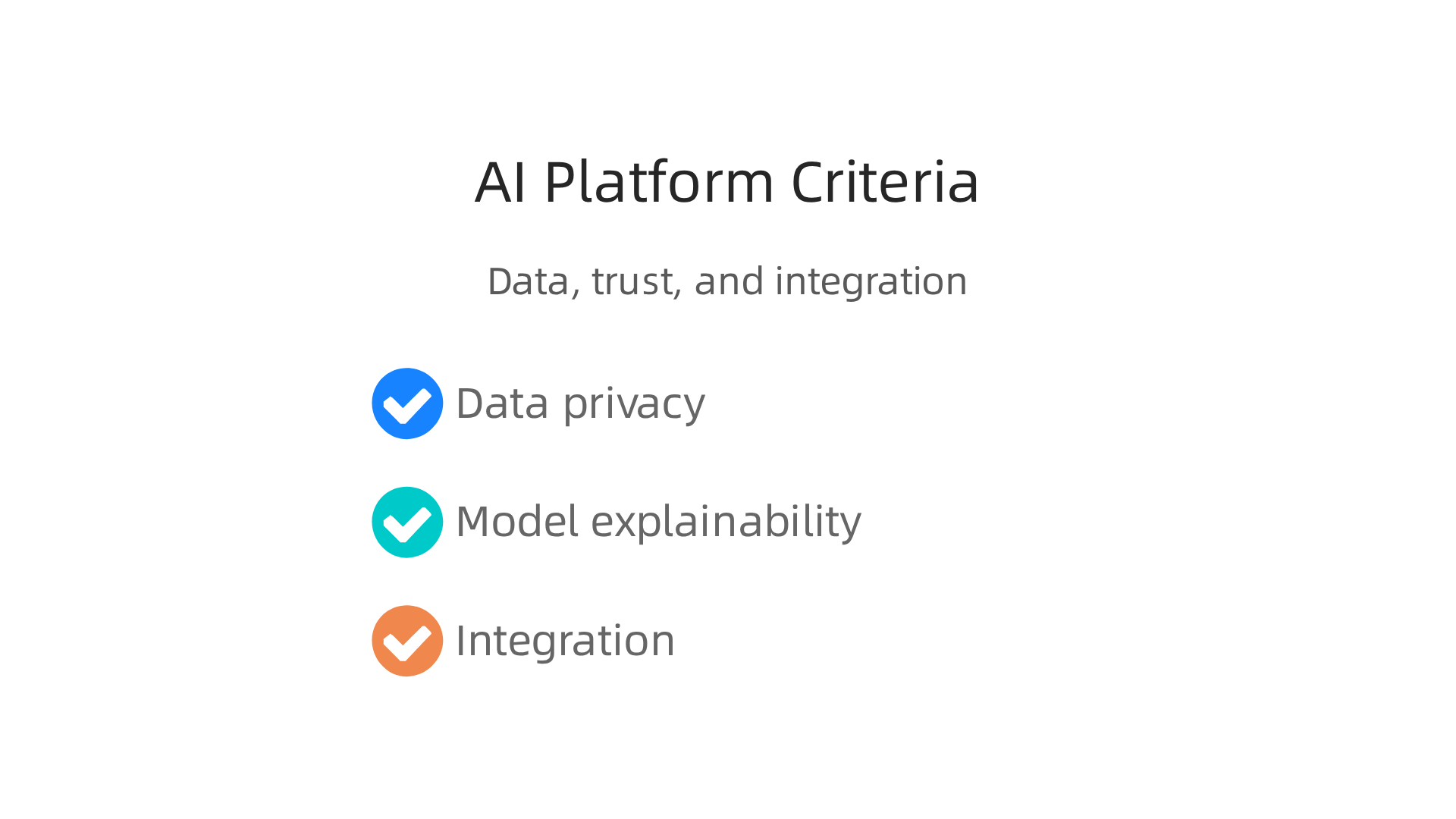
Let’s look at three non-negotiables you need to check before signing anything.
Data privacy and compliance. This is your first filter. Regulations like GDPR and CCPA put the legal burden on you, not your vendor. You need clear answers on where your data lives, how it’s encrypted, and whether the vendor uses your data to train their models. The Enterprise AI Vendor Evaluation Criteria: The 2026 Scorecard calls this the foundation of any vendor relationship. If they can’t guarantee your data stays yours, move on.
Model explainability and bias testing. Trust in AI is fragile. If your system can’t explain why it made a decision, you open your business to risk. Look for vendors who provide clear documentation on model behavior and run regular bias audits. Tools like the Conversational AI Vendor Selection Guide 2026 help you ask the right questions during evaluation. This isn’t a nice to have. It’s a must for building confidence with your teams and customers.
Integration with existing IT infrastructure. The most powerful AI is useless if it can’t talk to your ERP, CRM, or cloud platforms. You need a solution that plugs in without months of custom work. If you’re running SAP, for example, check out our guide on SAP ERP 2026 modules, benefits, and migration strategies for alignment tips. The less friction during integration, the faster you see results.
Want to stay current on what leading platforms deliver in these areas? The landscape updates daily. Get clear AI updates delivered to your inbox with The Deep View Newsletter.
Mitigating Risk in Your AI Implementation Journey
Even after you pick the right platform and check all the boxes from the previous section, your work is far from over. The truth is that 79% of organizations still face challenges when adopting AI,

according to a 2026 survey from Writer. That number actually went up from 2025. So what’s going wrong?
Three specific risks tend to trip up most teams.
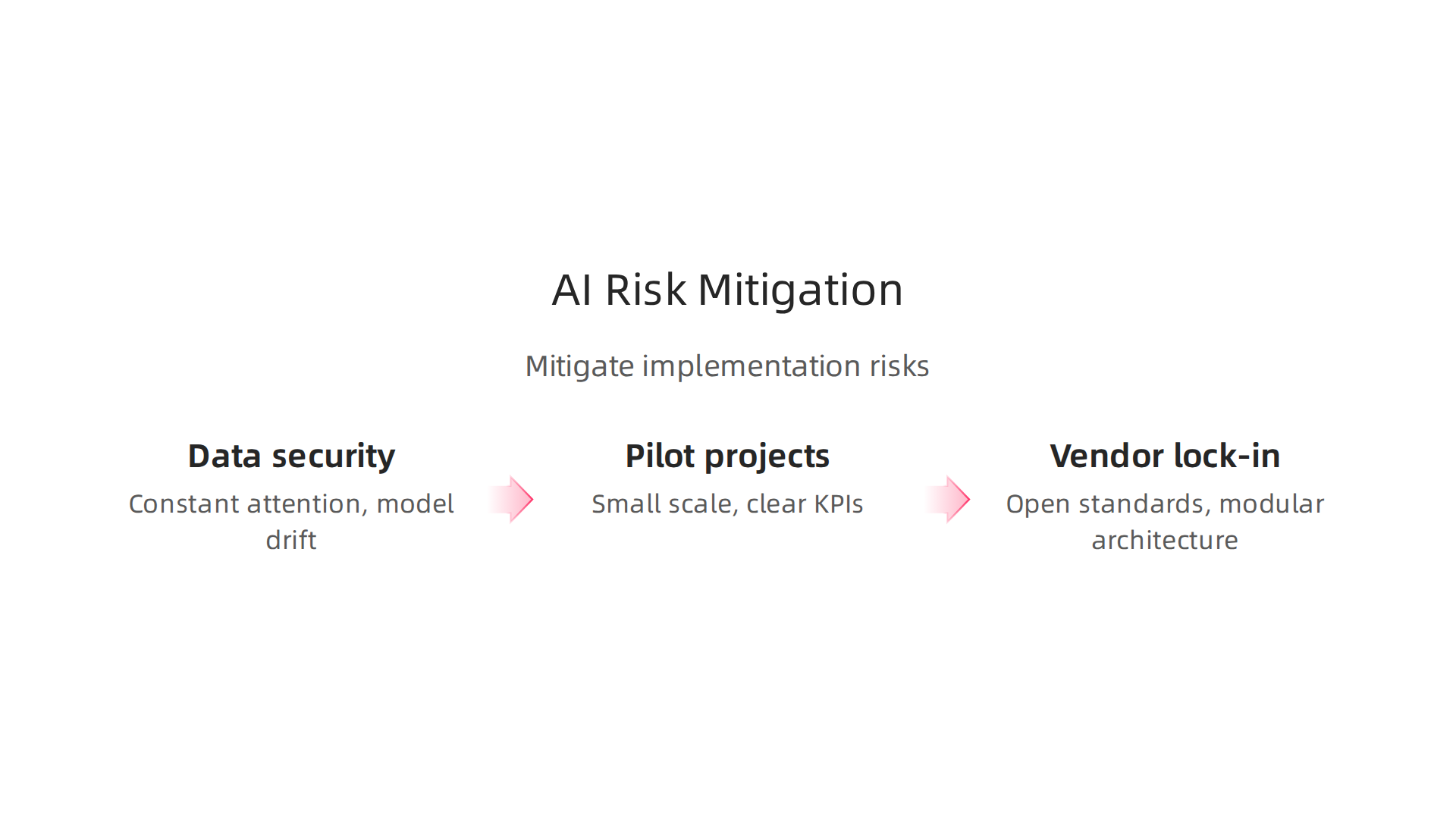
Let’s walk through each one and how you can handle it.
Data security and model drift need constant attention
Your data security setup from day one matters. But here is something many teams miss. The risk does not go away after launch. Model drift happens when your AI starts making less accurate predictions over time because the real world changes. If you are not monitoring for this, your ai-powered business solutions can slowly become unreliable.
The Stanford Digital Economy Lab’s Enterprise AI Playbook highlights that ongoing governance is a must, not a one time checkbox. You also need to watch where your data flows. If your vendor uses cloud research across multiple clients, ask hard questions about isolation. Check out our guide on data collection methods for enterprise AI in 2026 to see how leading teams structure this.
Pilot projects keep you from betting the farm
You do not need to roll out AI across your whole company on day one. That is a fast way to burn cash with nothing to show for it.
Start with a small pilot. Pick one department or one process. Set clear KPIs before you launch. How will you measure success? Is it faster response times, fewer errors, or lower costs? A strategic roadmap for deploying AI risk systems, like the one from Ethicrithm, can help you structure this step.
Running pilots also helps with another risk. The AI Implementation Strategy 2026 report notes that full scale deployment often takes 12 to 24 months. If you start small, you learn fast without exposing your entire business to failure. Tools like Cluely AI or Anthropic AI can be tested in a controlled pilot before you commit enterprise wide.
Avoid vendor lock-in by choosing open standards
Here is a fear that keeps many CIOs up at night. You build your entire workflow around one vendor’s AI, and then they change their pricing, their model behavior, or worse, they sunset the product.
You can protect yourself by asking for open standards and modular architectures from the start. Look for vendors that use common APIs and data formats. This way, if you need to switch later, you are not starting from zero. Our strategic guide on platform engineering in 2026 goes deeper into how modular setups reduce long term risk.
The key point is simple. Do not let one vendor own your entire AI future. Keep your options open.
As you build your risk-aware strategy, staying informed is your best defense. Get clear daily AI updates delivered to your inbox with The Deep View Newsletter.
Building an AI-Ready Culture and Talent Strategy
You have the tools and the risk plans in place. But none of that works without the right people. Here is the truth that many technology leaders overlook. Talent is your biggest bottleneck.
The 2026 AI Impact Survey from Grant Thornton found that 78% of business executives lack strong confidence that they could pass an independent AI governance test. That is a huge gap. And it is not just about technical skills. A Gartner report quoted by CFO Dive says it plainly. "AI adoption is a culture issue, not just a training issue."
Upskilling beats hiring every time
The talent market for AI specialists is brutal. Everyone wants the same ten people. And salaries are through the roof. But here is the smarter move. Grow your own experts.
The Deloitte State of AI in the Enterprise report shows that the top way organizations adjust their AI talent strategy is by educating the broader workforce to raise overall AI fluency. 53% of companies are doing this in 2026. That means training your existing data analysts, your product managers, and your operations teams.
Why does this work? Your current employees already understand your business processes, your data, and your culture. They just need new skills. Sending them through a structured AI upskilling program is faster and cheaper than hunting for outside hires.
Executive sponsorship makes or breaks adoption
You cannot delegate AI culture to HR or IT alone. It needs a champion in the C-suite. Someone who clears roadblocks, secures budget, and sets the tone.
Cross-functional teams also matter. Do not let AI live in a silo. The best results come when data scientists, engineers, and business leaders work together on the same project. This is where modular setups help, as covered in our strategic guide on platform engineering in 2026. When your infrastructure is flexible, these teams can experiment without breaking production systems.
A culture of experimentation changes everything
Let us be honest. Most companies say they want innovation, but they punish failure. That kills AI adoption.
You need a culture where running a small pilot and learning from it is celebrated. The Stanford Digital Economy Lab Enterprise AI Playbook emphasizes that ongoing governance is needed, but so is room to try new things. If your team is afraid to test an ai-powered business solution because they might get it wrong, you will never move fast enough.
Encourage data-driven decisions. Give your teams the tools they need, like Cluely AI for small scale experiments or Anthropic AI for safe model testing. And most importantly, reward learning, not just perfect launches.
This shift takes time. But it is the only way to build momentum that lasts. Stay on top of the latest trends and insights that shape this journey by getting clear daily AI updates delivered to your inbox with The Deep View Newsletter.
Emerging Trends in AI-Powered Business Solutions for 2027 and Beyond
You have built the culture and trained your people. Now it is time to look ahead. The next few years will bring big changes in how companies use ai-powered business solutions.

Three trends stand out.
Open source models level the playing field
Big tech companies no longer hold all the cards. Open source AI models and small language models are making powerful technology available to everyone. Instead of paying huge licensing fees, your team can download a model, fine tune it on your own data, and deploy it privately. This lowers the cost of entry and gives you more control. It also fits well with the flexible infrastructure we talked about in our guide on platform engineering in 2026, where modular systems let you swap models easily.
Edge AI brings decisions to the moment
Processing data in the cloud works, but it is not always fast enough. Edge AI runs models directly on devices, sensors, and factory floor machines. This lets you make real time decisions without waiting for a round trip to the server. In manufacturing, that means catching a defect instantly. In logistics, it means rerouting shipments on the fly. These use cases generate huge amounts of local data, which is why knowing modern data collection methods for enterprise AI becomes essential. Edge AI will turn the Internet of Things into an intelligent network.
Regulation reshapes the vendor landscape
This is the year regulation catches up. By 2027, AI related laws are expected to cover roughly half of the world’s economies, according to a forecast on agentic AI trends from IceTea Software. The EU AI Act and US executive orders are forcing vendors to bake transparency and accountability into their products. If a vendor cannot explain how their model makes decisions or prove it is fair, they will lose enterprise contracts. This is a good thing for buyers. It means you can trust the tools you bring in.
These trends are moving fast. To keep your strategy sharp, subscribe to The Deep View Newsletter for daily updates on the latest AI shifts and enterprise insights.
Summary
This article provides a practical, data-backed roadmap for evaluating, selecting, and implementing AI-powered business solutions in 2026. It explains the market context, key adoption drivers (cost savings, better data/compute, competitive pressure), and which use cases tend to deliver the highest ROI such as customer service automation, predictive maintenance, and supply chain optimization. The guide lays out a structured vendor-evaluation approach—covering scalability, security, integration, proof-of-concept testing, and transparent pricing—and highlights persistent risks like model drift, data security, and vendor lock-in. It also emphasizes the culture and talent work needed to scale AI responsibly, recommending upskilling and executive sponsorship. Finally, the piece previews emerging trends (open-source models, edge AI, and increasing regulation) so leaders can plan long-term adaptability. After reading, you’ll have clear steps to assess readiness, run pilots, choose vendors, and reduce common implementation risks.