Cloud Based CRM Software Unifies Teams and Boosts Enterprise Productivity

Imagine your sales team uses one system, marketing uses another, and customer service runs on a third. Data gets stuck in different places. Nothing talks to each other. It is a frustrating reality for many enterprises. Fragmented tools and data silos slow down work and hurt results.
Cloud-based CRM software solves this by bringing everything into one smart hub.

It unifies sales, marketing, and service so every team sees the same customer picture. In fact, 91% of companies with more than 11 employees now use a CRM system, according to the latest CRM statistics that matter in 2026. And 87% of those CRMs are cloud-based, showing a clear shift away from old on-premise tools.
In 2026, cloud-based CRM has grown far beyond a simple address book. Artificial intelligence, workflow automation, and deep integrations have turned it into a productivity amplifier. It helps teams predict customer needs, automate repetitive tasks, and close deals faster. It no longer just records history; it drives smarter decisions.
If your enterprise still struggles with disconnected tools, now is the time to rethink your approach. For a deeper look at choosing the right technology, check out our guide on cloud-based productivity tools.
And as AI continues to reshape business software, staying informed is critical. Get clear daily AI updates from The AI Newsletter Worth Reading to keep your enterprise ahead of the curve.
Understanding the Modern Productivity Stack: The Role of Cloud-Based CRM
A modern enterprise runs on a stack of connected tools. Think of it like a well-orchestrated kitchen. The CRM is the head chef, coordinating every customer interaction and passing the right information to the other stations. Marketing automation, ERP systems, collaboration platforms, and analytics tools all depend on clean, real-time data from the CRM.
This is why cloud-based CRM software sits at the center of the modern productivity stack. It does not just store contacts. It syncs with your ERP to track orders, feeds data to marketing campaigns, and gives your service team full context about every customer. When everything connects, work flows better.
Modern stacks now treat the CRM as a strategic nerve center.

63% of marketers already use the same CRM system as their sales and service departments, according to 2026 data on CRM adoption and integration trends. That shared system eliminates the handoffs that create delays and errors.
The move from on-premise to cloud has made all of this possible. With cloud-based CRM, you skip the cost of servers and the headache of manual upgrades. The vendor handles security patches and feature releases for you. Updates roll out automatically, so your team always has the latest tools without waiting for an IT project.
Cloud CRM already accounts for 58.2% of all CRM deployments, and that number keeps climbing. The shift is clear: enterprises want a system that scales fast and integrates easily with the rest of their stack.
If you are building or refining your own technology stack, understanding how these pieces fit together matters. For a deeper look at how enterprises structure internal platforms that support integrated systems, check out our guide on platform engineering in 2026. It covers the architecture that makes a connected stack possible.
Key Benefits of Cloud-Based CRM for Enterprise Productivity
When your sales team works from one spreadsheet and your support team uses another, confusion is guaranteed. Customer data gets lost, leads fall through the cracks, and nobody trusts the numbers. That is the old way.
A cloud-based CRM software solves this by giving everyone a single source of truth.
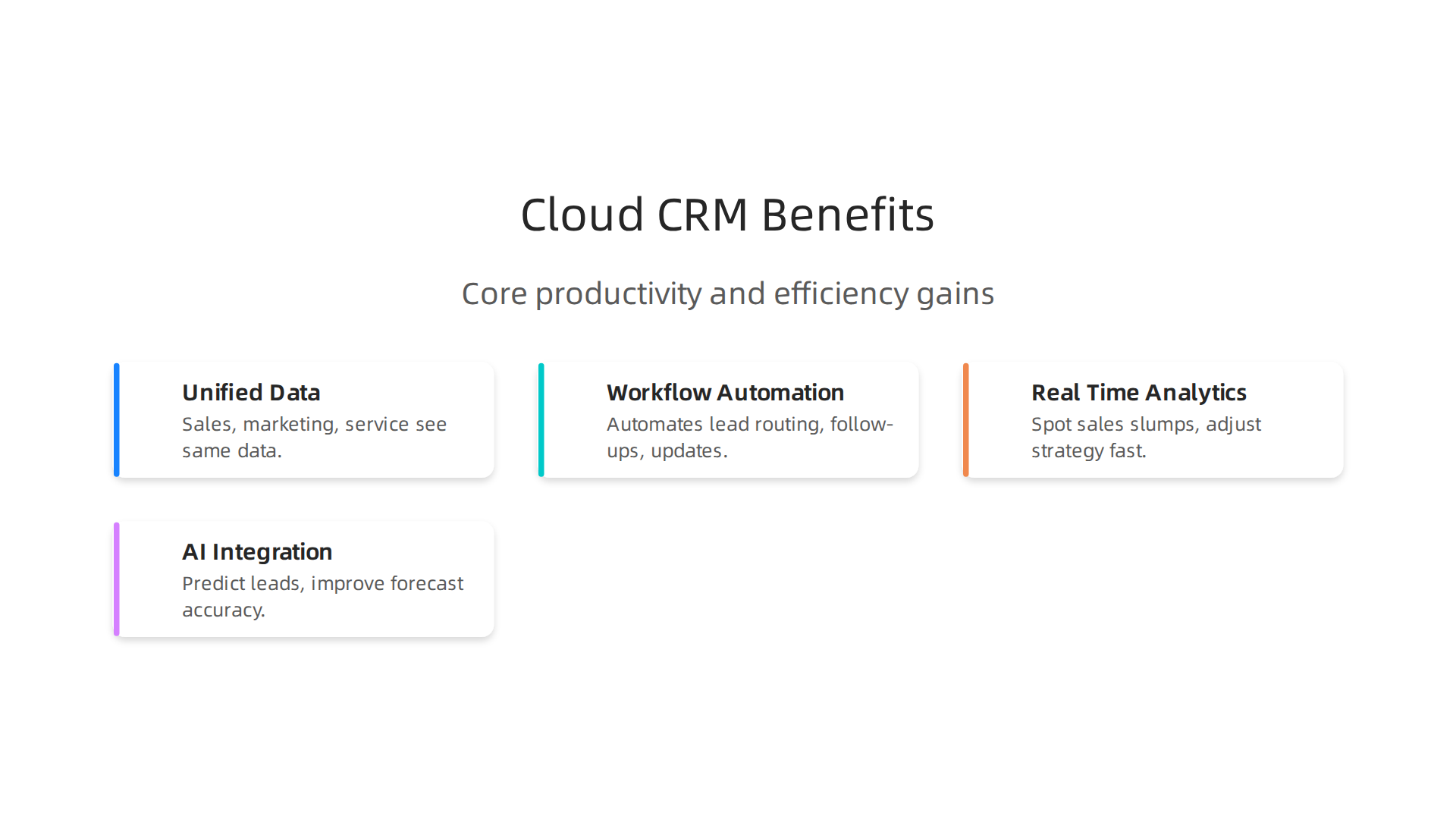
Sales, marketing, and service all see the same contact history, deal stage, and past conversations. No more asking "did you update the record?" because the system updates in real time. This centralized approach improves team collaboration and cuts down on duplicate work. In fact, businesses that use CRM earn an average of $8.71 for every dollar they spend, according to 2026 CRM statistics showing the strong return on investment from breaking down data silos.
Workflow automation takes the next big leap. Instead of manually assigning leads, sending follow-up emails, or updating deal stages, your CRM does it automatically. A lead fills out a form and instantly gets routed to the right rep. A deal stays idle too long, and the system sends a reminder. This frees up your team to focus on selling instead of clicking.

For a deeper look at how to pick the right automation tools for your stack, check out this cloud-based productivity tools evaluation guide.
Real-time analytics is the third major benefit. With a cloud-based CRM, you see pipeline health and revenue forecasts update as deals move. You can spot a sales slump before it hits and adjust your strategy fast. Leading platforms now use AI to predict which leads are most likely to close, improving forecast accuracy. For a detailed overview of platforms that offer these capabilities, read this CRM software options for 2026 feature breakdown.
AI is weaving deeper into CRM every quarter. If you want to keep up with how artificial intelligence is reshaping enterprise productivity every day, subscribe to The Deep View Newsletter. It delivers clear, daily updates on the tools and trends that matter most.
Evaluating Top Cloud-Based CRM Solutions in 2026
Choosing the right cloud-based CRM software for your enterprise can feel overwhelming. In 2026, the market is packed with options, each claiming to transform your sales process. But the truth is, leading platforms differ a lot in AI maturity, ecosystem strength, and pricing models. A smart evaluation starts with knowing what matters most to your team.
According to top ranked CRM platforms for 2026, the clear market leaders are Salesforce, HubSpot, Monday CRM, Pipedrive, and Zoho CRM. Salesforce holds the top spot for deep customization and its powerful AI layer called Agentforce. HubSpot shines for marketing-led teams with its free tier and easy-to-use interface. Microsoft Dynamics 365 is a strong pick if your company already runs on Microsoft tools like Teams and Outlook.
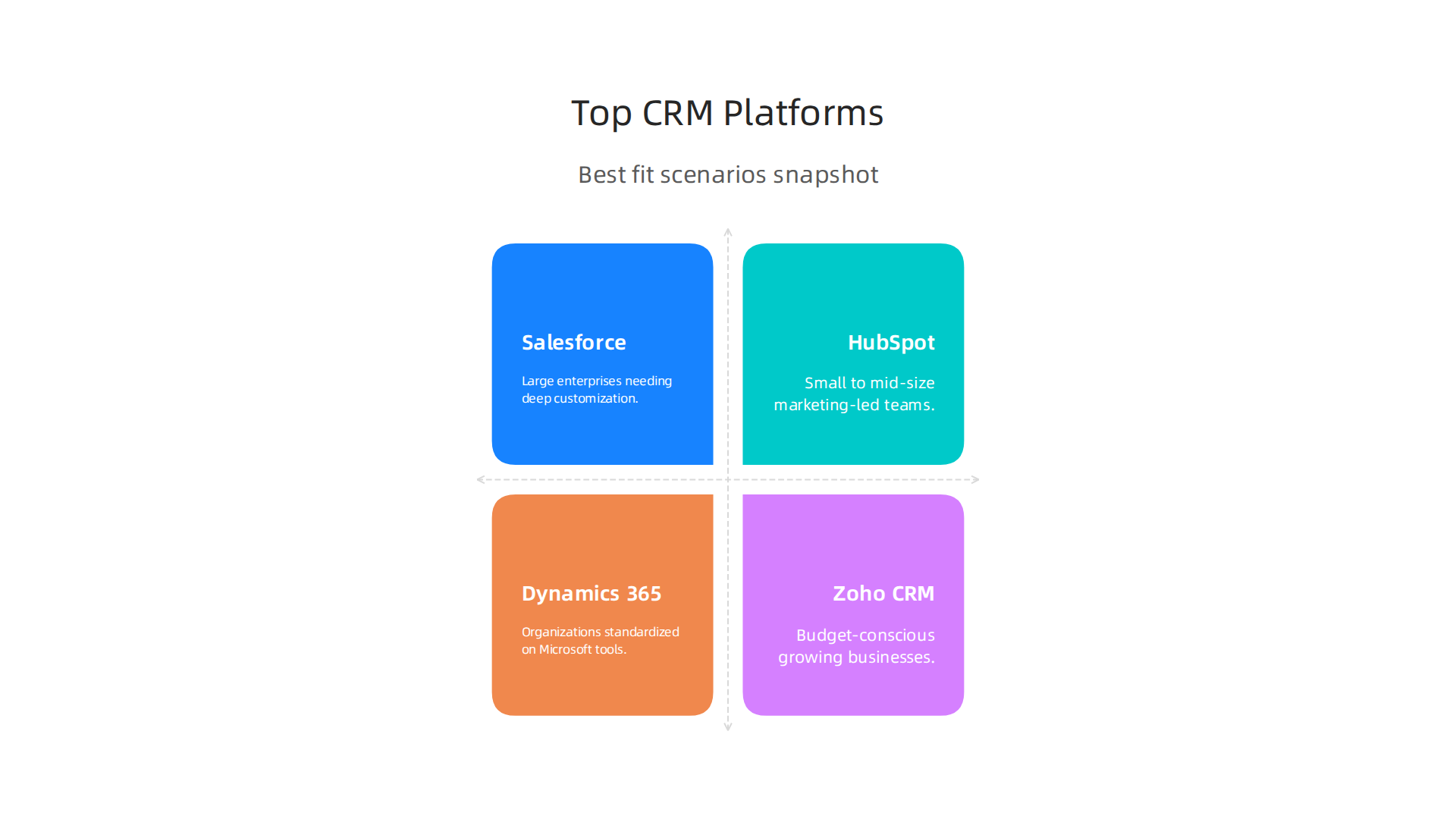
But the best fit depends on your specific needs. Here is a quick snapshot of key players:
| Platform | Best For | Starting Price (per user/month) | Standout AI Feature |
|---|---|---|---|
| Salesforce | Large enterprises needing deep customization | $25 (Starter tier) | Agentforce for lead scoring and revenue forecasting |
| HubSpot | Small to mid-size marketing-led teams | Free (paid from $15) | Smart email sequences and chatbot automation |
| Microsoft Dynamics 365 | Organizations standardized on Microsoft | $65 | Microsoft Copilot integration across Office apps |
| Zoho CRM | Budget-conscious growing businesses | Free (paid from $14) | Zia AI assistant for predictions and anomalies |
The cloud-based CRM market stats for 2026 reveal that 87% of CRM systems are now cloud-based, and businesses using AI within their CRM are 83% more likely to exceed sales goals. That is a huge advantage if you pick a platform with strong built-in artificial intelligence.
Beyond the big names, a new wave of composable and industry-specific vendors is emerging. Platforms like Attio and Salesflare offer flexible, data-rich solutions that minimize manual data entry. These are worth a look if your processes do not fit into a one-size-fits-all mold. For a deeper dive on comparing tools across your tech stack, check out this guide to evaluating cloud-based productivity tools.
The key is to match platform strengths to your enterprise needs. Do you need deep customization and a massive partner ecosystem? Go with Salesforce. Are you looking for tight integration with existing Microsoft tools? Dynamics 365 is your match. Is budget your main concern? Zoho delivers enterprise features at a fraction of the price.
AI changes fast. To make sure you stay ahead of how artificial intelligence is reshaping CRM and enterprise productivity, subscribe to The AI Newsletter Worth Reading. It delivers clear daily updates on the tools and trends that matter most.
Integration and Ecosystem: Making CRM the Hub of Productivity
After you pick the right cloud-based CRM software, the real work begins. The best platform in the world still fails if it sits alone while your marketing tools, billing systems, and customer support software all hold separate copies of customer data. That is where integration becomes the game changer.
A well-connected CRM acts as the central nervous system for your entire business. When your ERP, marketing automation, and service desk all talk to the same CRM, you eliminate data fragmentation. No more manually copying information between systems. No more wondering if the sales team has the latest support ticket.
Native connectors built into platforms like Salesforce and HubSpot handle many common links out of the box. But for complex setups, iPaaS (Integration Platform as a Service) tools simplify the job. According to this overview of the best CRM integrations in 2026, email sync, scheduling, and marketing automation are the top connections that deliver immediate value. Choosing the right integration approach, whether point-to-point or middleware, depends on your scale and technical comfort.
The real payoff comes when AI gets involved. When your CRM is the single source of truth for customer interactions, AI models can analyze patterns across sales, support, and marketing data. That leads to smarter lead scores, more accurate revenue forecasts, and proactive customer outreach. For a deeper look at how integration fuels smarter decision making, check out this roadmap for enterprise AI integration.
Building an integrated ecosystem takes planning, but it turns your CRM from a contact list into a productivity powerhouse. The effort pays back in less busywork and better business intelligence.
Implementation Best Practices for Maximum ROI
Picking the right cloud-based CRM software is only half the battle. Many teams invest big money only to watch their new system collect dust. Why? Because no one uses it. User adoption is the single biggest factor that decides whether your CRM investment pays off or flops.
So how do you avoid that trap? Start with a phased rollout.
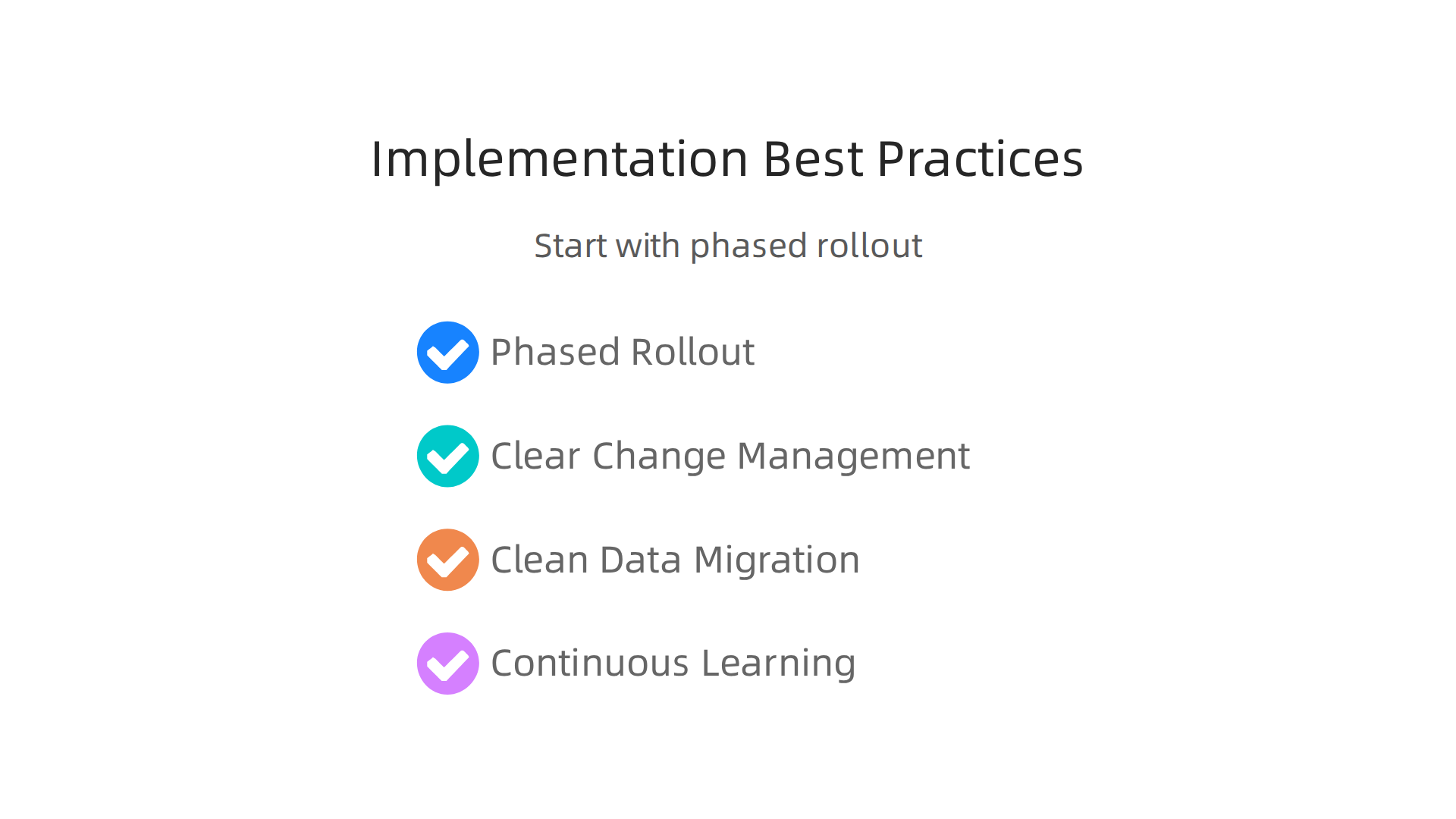
Instead of flipping a switch for the whole company at once, launch the CRM with one small team first. Let them learn the system, find the bugs, and get comfortable. Then expand to the next group. This slow approach builds confidence and cuts down resistance. According to this list of 9 CRM Best Practices to Unlock Sales Success, phasing your implementation rather than launching everything at once significantly improves adoption rates.
Clear change management also matters. Tell your team why the new system matters. Show them how it saves time. Train them on real tasks they do every day, not just generic walkthroughs. When people understand the "why," they stop fighting the change.
Now let’s talk data. Garbage in, garbage out. If you migrate old, messy data into your shiny new CRM, you get the same old problems. Before you move anything, clean your data. Remove duplicates. Fix spelling errors. Standardize formats like phone numbers and dates. Set up mandatory fields so new entries stay clean from the start. Poor data quality kills productivity fast.
To learn more about picking the right cloud tools and avoiding common mistakes, check out this guide on cloud-based productivity tool evaluation.
Finally, keep learning. The best CRM setups get better over time as you tweak workflows and add integrations. Staying up to date with technology trends helps you spot new opportunities. That is why many leaders rely on a trusted source for daily insights. If you want to stay ahead, sign up for The AI Newsletter Worth Reading and get clear AI updates straight to your inbox.
AI and Automation: The Next Frontier in CRM Productivity
Once your cloud-based CRM software is running with clean data and a team that actually uses it, the next step is unlocking real power through AI and automation. These tools are no longer futuristic extras. In 2026, they are becoming standard features in the best platforms.
Think about lead scoring. Instead of your sales team guessing which prospects to call first, AI analyzes past deals, email opens, website visits, and company fit to rank leads automatically. The system tells you exactly who is most likely to buy. This alone saves hours of manual work every week. According to this guide on CRM software with AI features, AI tools automate repetitive tasks like data entry and scheduling so teams can focus on building relationships.
Sentiment analysis is another game changer. AI scans customer emails, chat transcripts, and call notes to detect frustration, excitement, or confusion. Your support team gets a heads up before a small issue turns into a big problem. Chatbots powered by AI handle the simple questions instantly, leaving your people free for complex issues.
The biggest shift in 2026 is generative AI. Modern CRMs can now draft personalized emails, summarize long customer histories, and even generate follow-up messages based on recent interactions. Your reps spend less time typing and more time selling. Some platforms even offer autonomous AI agents that can schedule meetings, update records, and respond to basic support cases without human help.
To learn how AI is reshaping business software across the board, check out this enterprise AI strategy roadmap. It covers how to plan and adopt AI tools the right way.
Here is the thing. Automation is not just about saving time. It is about consistency. When you automate follow-ups and data updates, every customer gets the same timely attention. No more dropped leads or forgotten tasks. Your cloud-based CRM software becomes a proactive assistant that makes your whole team more effective.
Data Security and Compliance in Cloud-Based CRM
But all that power comes with a big responsibility: protecting your customer data. As your team uses a cloud-based CRM software more, it collects names, email addresses, purchase history, and even payment details. If that data leaks, you could face lawsuits, fines, and lost trust.
That is why security and compliance are not just nice to have. They are essential.

Laws like GDPR in Europe and CCPA in California set strict rules about how you collect, store, and use customer information. Breaking these rules can cost you millions of dollars. So you need a platform that takes this seriously.
How do you know if a CRM is secure? Start by looking at vendor certifications. SOC 2 and ISO 27001 are the most trusted standards. They mean the vendor follows strict security practices and gets checked regularly. Also ask about data residency. Some laws require customer data to stay in the country where it was collected. A good cloud-based CRM should let you choose where your data lives.
Even the AI features we talked about in the last section need protection. When your CRM uses AI to analyze customer conversations, that data must stay encrypted and private. Many platforms now include built-in tools to manage data rules. For example, the latest Salesforce updates include expanded data governance features like database encryption to protect data at scale, according to the Salesforce 2026 security and compliance updates.
For a deeper look at how AI platforms handle security, check out this enterprise AI platform security review.
Staying on top of these changes helps you make better choices. Get clear daily AI updates with The AI Newsletter Worth Reading. It keeps you informed about the latest security trends and best practices.
Future Trends Shaping Cloud-Based CRM and Enterprise Productivity
The world of cloud-based CRM software is moving fast. The tools you use today will look very different in a few years. Let’s look at three big trends that will change how your team works.
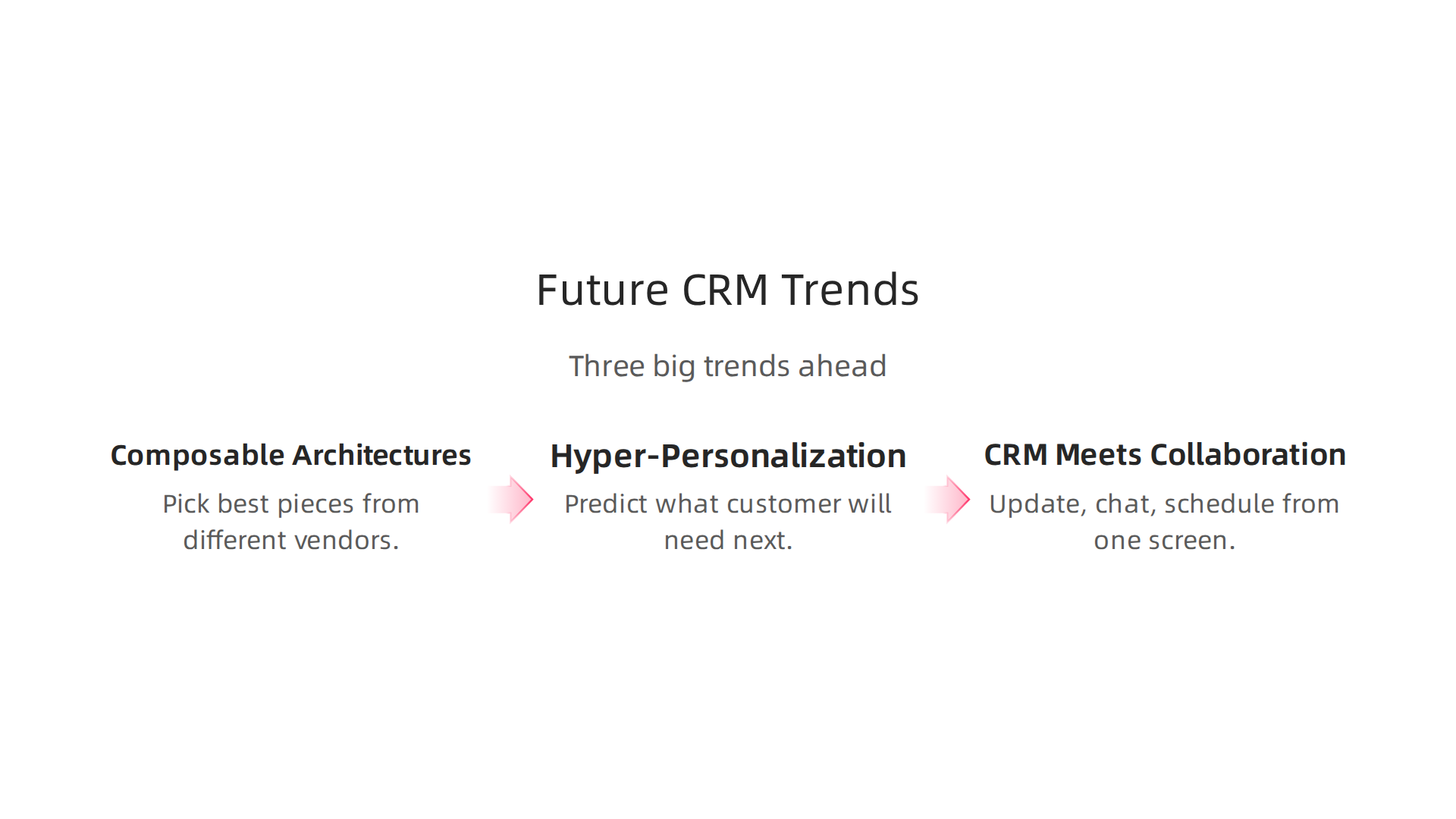
Composable CRM architectures. This sounds fancy, but it’s simple. Instead of buying one giant system that does everything, you can pick the best pieces from different vendors. You build your own stack. Want great email tracking from one tool and top-notch reporting from another? Go for it. This gives you freedom to choose what fits your needs best. It also helps you avoid getting locked into one company. For a deeper look at how to pick the right tools, check out this cloud-based productivity tools evaluation guide.
Hyper-personalization and predictive analytics. Customers expect you to know what they want before they ask. AI makes this possible. Your CRM can now study past behavior, spot patterns, and predict what a customer will need next. For example, if a client always buys more in the spring, your system can send them a special offer in late winter. This is not guesswork. It is data-driven. According to a recent 2026 CRM trends report, agentic AI systems are already handling routine tasks and will soon take on more complex roles. This frees up your team to focus on building real relationships.
CRM meets collaboration tools. Your CRM is no longer just a database. It is becoming the hub where sales, marketing, and customer service teams work together. Look for deeper integration with platforms like Slack, Microsoft Teams, and project management apps. Soon, you will be able to update a deal, chat with a coworker, and schedule a follow-up all from one screen. This convergence makes your whole workflow smoother. It also cuts down on the time you waste switching between apps.
These changes are not distant. They are happening right now. If you want to stay ahead, start thinking about how your cloud-based CRM software can adapt. The tools you choose today should support these future trends.
Summary
This article explains why cloud-based CRM software is the central hub of modern enterprise productivity and how it fixes fragmented tools and data silos. It covers the key benefits—single source of truth, workflow automation, real-time analytics, and AI-driven forecasting—and shows how these features boost collaboration and revenue. The guide walks through evaluating top CRM vendors in 2026, matching platform strengths to business needs, and practical integration options like native connectors and iPaaS. It also explains implementation best practices to drive user adoption, the importance of cleaning data, and the security and compliance measures you must check. Finally, the article outlines how generative AI and composable architectures are changing CRM capabilities and what to plan for next. After reading, you’ll know how to choose, integrate, secure, and scale a cloud CRM to improve team productivity and decision-making.