
The Enterprise AI Engineer Roadmap for 2026

Introduction: The New Mandate for Enterprise AI Engineering
You have probably heard someone call themselves an AI engineer. It is one of the fastest-growing job titles in tech right now. But here is the thing: not all AI engineers do the same work. There is a big difference between a general AI engineer who builds cool prototypes and an enterprise AI engineer who delivers reliable, secure, and scalable systems inside a large organization.
In 2026, that difference matters more than ever. Companies are moving fast to put AI into their core operations. Gartner predicts that 40% of enterprise applications will have task-specific AI agents by the end of this year. That shift is creating huge demand for engineers who understand the unique needs of big businesses. Job openings for AI engineers have grown by 143% year-over-year since early 2026, according to the latest AI engineering career data. The market for AI engineering services was worth $26.5 billion in 2026 and is expected to keep climbing fast.
So what makes an enterprise AI engineer different? It is not just about knowing how to train a model. It is about understanding how to fit AI into existing systems, manage data pipelines, handle compliance, and build trust with stakeholders. An enterprise AI engineer thinks about reliability, security, and long-term maintenance. A general AI engineer might focus on experimentation and quick wins.

This article is your roadmap for 2026. We will cover the skills you need, the tools that matter, and how to structure your team for success. Whether you are a leader hiring for these roles or an engineer looking to level up, the information here will help you navigate the new mandate for enterprise AI engineering.
If you want to stay ahead of these fast-moving trends, consider getting daily updates from the leading source for clear AI insights. Subscribe to The AI Newsletter Worth Reading and keep your finger on the pulse of enterprise AI.

For a deeper look at how businesses are adopting AI this year, check out our guide on enterprise AI adoption in 2026.
The Evolving Role of the Enterprise AI Engineer
So what does this shift from experimentation to production actually look like for the person doing the work? Let us break it down.
A few years ago, most machine learning engineers spent their time training models, tuning parameters, and reading research papers. Their job was to prove something could work. Today, an enterprise AI engineer has a totally different focus. The main job is getting AI systems into production and keeping them running reliably at scale. One major reason for this change is that the whole industry has shifted from AI research to AI deployment. That shift is reshaping which skills companies actually need.
Here is what an enterprise AI engineer does day to day.
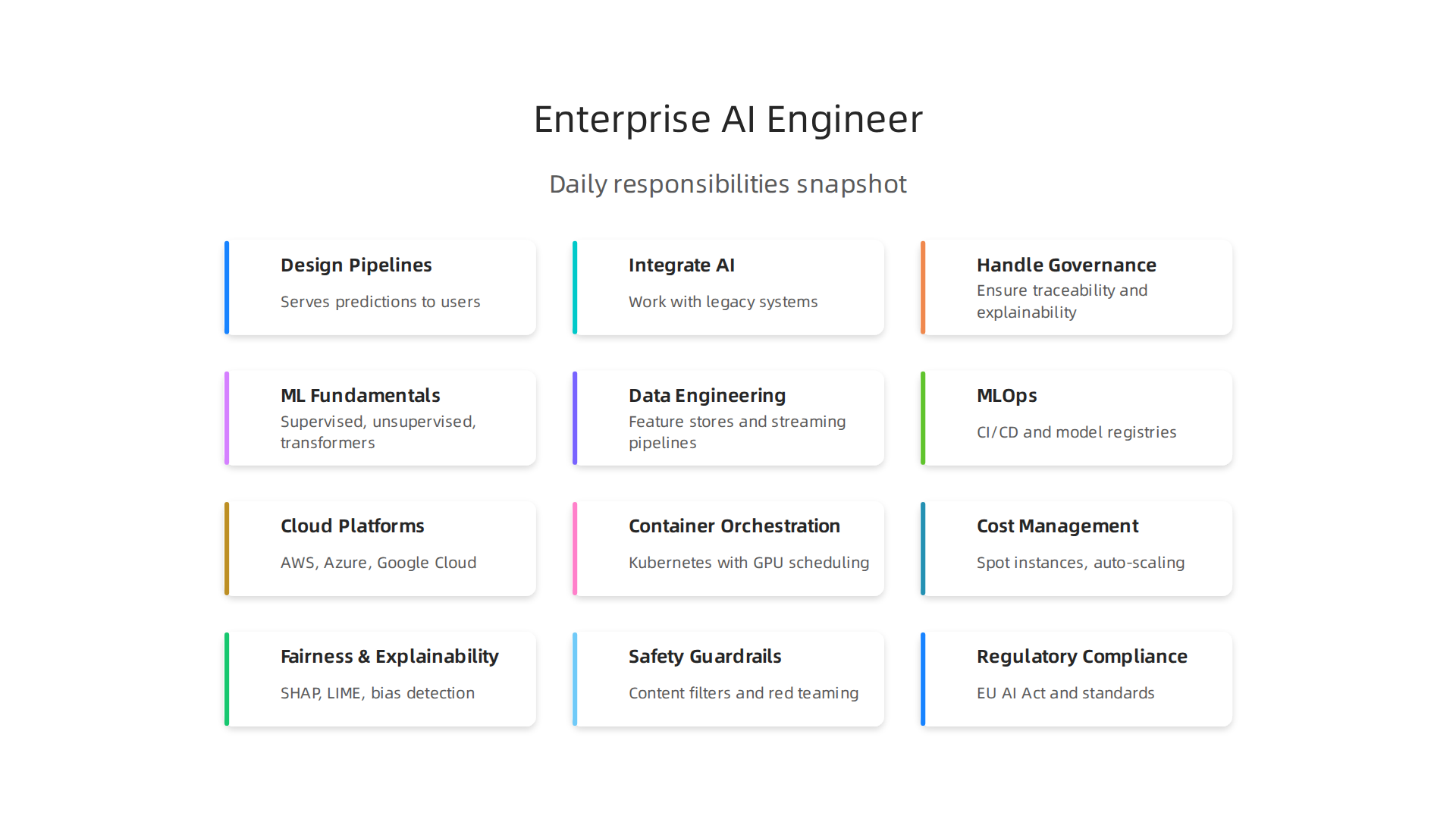
First, they design scalable inference pipelines. That means building the infrastructure that takes a trained model and serves predictions to real users, often thousands or millions of requests per second. Second, they integrate AI into legacy systems. Most big companies run on old databases, custom APIs, and complex ERP software. Making AI work with those systems is a hard engineering problem. Third, they handle governance and compliance. An enterprise AI engineer must ensure every model decision is traceable, explainable, and auditable for regulators.
How is this different from a data scientist? A data scientist explores data and builds models to find patterns or answer business questions. An enterprise AI engineer takes those models and makes them production-ready. And compared to a software engineer? A software engineer builds applications that follow deterministic rules. An AI engineer builds systems that deal with probabilistic outputs, which introduces new challenges around testing, monitoring, and behavior validation.
There is also a lot of overlap with MLOps. If your team is building these systems, you will want to understand the full lifecycle. For a deeper look at how these roles are evolving in 2026, check out our guide on the 2026 AI jobs landscape.
Core Technical Skills: Machine Learning, Data Engineering, and MLOps
To build production AI systems that actually work at scale, you need more than just knowing how to train a model. That is a starting point, but the real skill set for an ai engineer in 2026 is much broader. Let us look at the three main areas you need to master.
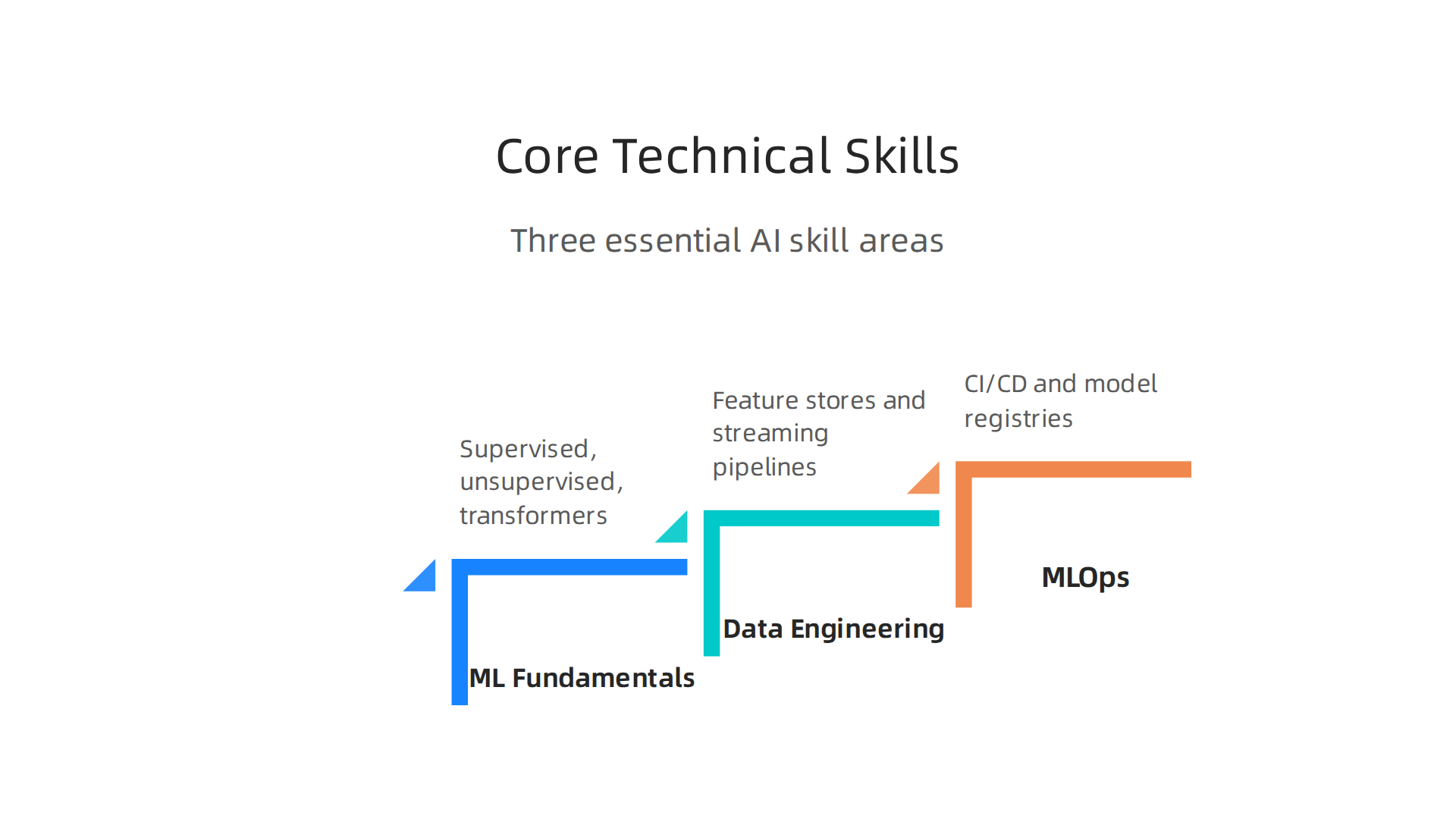
Machine learning fundamentals still matter. You need a solid grasp of supervised and unsupervised learning, plus modern transformer architectures. Fine tuning large language models is now a baseline expectation. Many teams rely on tools like Microsoft GitHub Copilot to speed up coding, but understanding what happens under the hood separates a capable a i engineer from someone who just pastes prompts. If you want to dig deeper into how prompt strategies connect to your ML work, read about context engineering vs prompt engineering for enterprise teams.
Data engineering is where most projects live or die. You cannot serve good predictions without clean, reliable data. That means knowing how to build feature stores, design data pipelines that handle streaming data, and ensure data quality at every step. Platforms like Upstage AI (a data platform) can help automate parts of this, but you still need to understand the architecture. A production ai engineer spends a lot of time making sure data flows from legacy databases into real time inference systems without breaking. According to Deloitte’s 2026 enterprise AI adoption trends, organizations with strong data foundations see much higher success rates when moving AI projects to production.
MLOps and DevOps glue everything together. This is the operational side of being an ai engineer. You need to set up CI/CD pipelines that work for machine learning, manage model registries to track every version, and use deployment tools like Kubeflow or MLflow to orchestrate serving. Without MLOps, a model that works on your laptop will fail in production. Teams that skip this step end up with models that drift, break, or become impossible to audit.
If you are building these skills or hiring for them, staying current on AI developments is critical. The field moves fast. That is why we recommend The AI Newsletter Worth Reading — it delivers clear daily updates so you never fall behind on the tools and trends that matter for enterprise AI.
The Enterprise Infrastructure Stack: Cloud, Orchestration, and GPU Management
You have the models ready and the pipelines built. But where do you actually run everything at scale? That is where the enterprise infrastructure stack comes in.
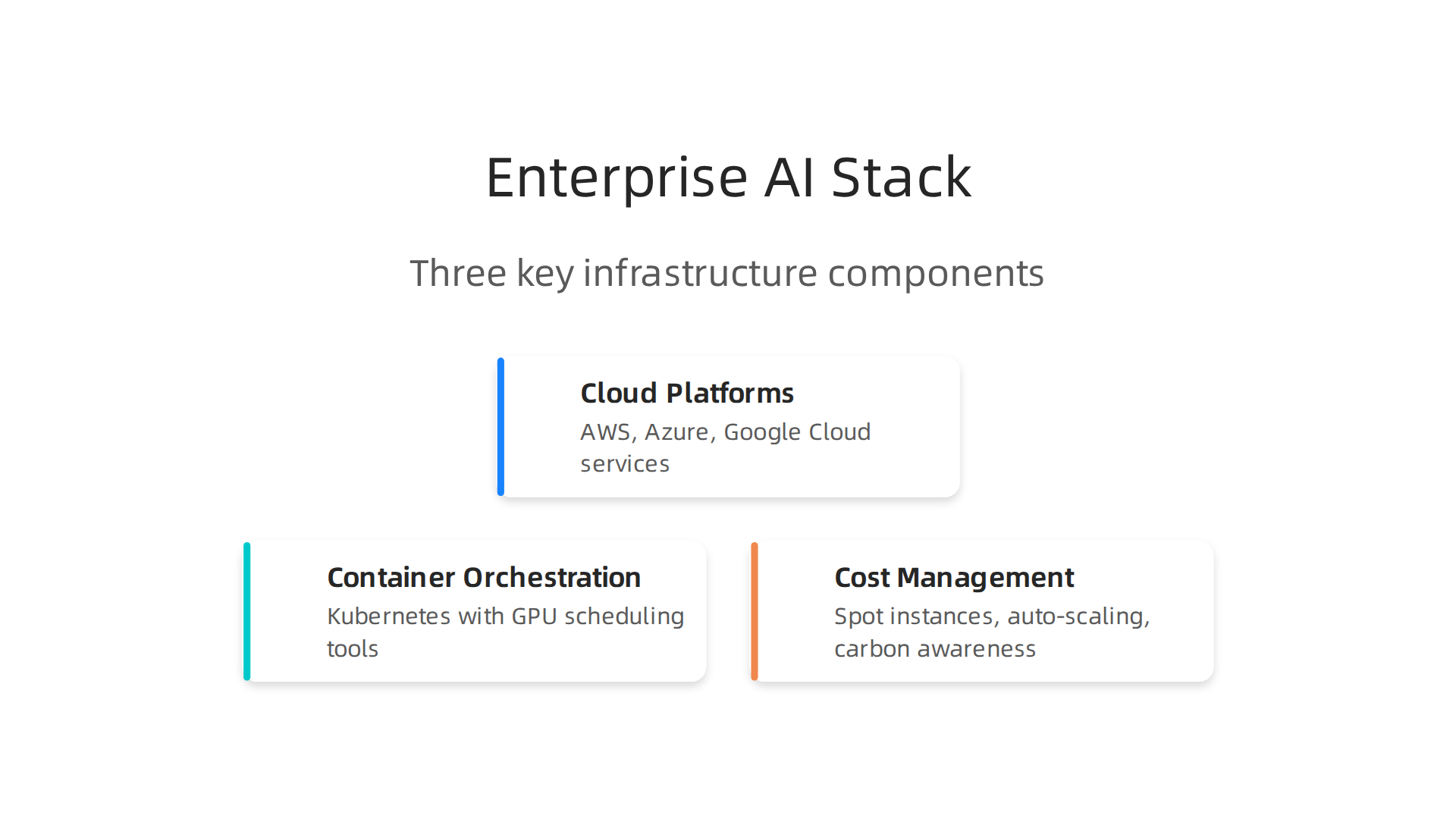
An ai engineer in 2026 needs to know how to pick the right cloud platforms and manage expensive GPU resources without wasting money.
Cloud platforms are the starting point. The big three — AWS, Azure, and Google Cloud — each have AI-specific services. AWS offers SageMaker for end-to-end machine learning. Google Cloud has Vertex AI. Azure has Azure Machine Learning. But just picking a cloud is not enough. You also need to understand how to deploy across regions, manage networking, and handle data gravity. For a broader look at the technology domains every leader should know, check out enterprise technology domains every leader must understand in 2026.
Container orchestration is where the real work happens. Most production AI systems run on Kubernetes. But standard Kubernetes was not built for GPUs. That is where GPU scheduling tools come in. You need Kubernetes device plugins to make GPUs visible to your pods. Tools like the NVIDIA GPU Operator or the Volcano scheduler help you manage GPU resources efficiently. The goal is to keep your GPUs busy without wasting capacity. The article on GPU infrastructure automation and strategy walks through how to design a scalable GPU cluster architecture that works for modern AI workloads.

Cost management is a huge part of the job. GPU instances can cost ten times more than regular compute. That means every ai engineer needs to be smart about spending. Spot instances can cut costs by a lot, but they come with the risk of being interrupted. Auto-scaling helps you spin resources up and down based on demand. And a growing area is carbon awareness — some teams now choose regions with cleaner energy to reduce their environmental footprint. A practical guide on AI cost optimization strategies for 2026 covers team-level spend limits and app-level budgets that help you stay in control.
When you get the infrastructure stack right, your models run faster, your team spends less time firefighting, and your budget stays healthy. It is one of those skills that separates a good ai engineer from a great one.
Essential AI Frameworks and Libraries for 2026
Once your infrastructure stack is running smoothly, the next step is picking the right frameworks and libraries. An ai engineer in 2026 needs to know which tools do what and when to use them. This part of the job never stops changing. Getting comfortable with the key libraries makes you faster and more flexible.
Deep learning frameworks are the foundation of everything. PyTorch is the most popular choice for both research and production. It powers most of the models you see in the news. TensorFlow still has a strong presence, especially in large enterprise deployments where existing codebases run on it. And JAX is gaining ground fast because it offers speed and automatic differentiation that work well for large-scale training. If you want to be a versatile ai engineer, being comfortable with all three is a smart move.
NLP and LLM tooling is a must-know area. Hugging Face Transformers gives you access to thousands of pretrained models with just a few lines of code. It is the standard starting point for most language tasks. LangChain lets you chain together calls to different models, tools, and data sources. This is the library you need for building AI agents and multi-step workflows. In fact, many organizations are now building AI agents in 2026 using LangChain and similar tools. If you work with prompts and chains, you will want to study the 2026 prompt engineering guide as well. LlamaIndex helps you connect large language models to your own private data, making retrieval-augmented generation practical. These three libraries are a must for any ai engineer working with language.
Computer vision and multimodal libraries are equally important. OpenCV remains the go-to tool for image and video processing. It is reliable, fast, and works across platforms. Detectron2 from Facebook AI handles object detection and segmentation with ease. And OpenAI’s CLIP connects images and text, enabling applications that understand both at once. Tools like Microsoft GitHub Copilot can speed up your coding in these libraries, and upscale AI tools help with image enhancement and generation.
Keeping up with these frameworks is a big part of the job. The landscape shifts quickly, and a smart ai engineer learns how to evaluate new libraries as they appear. That is where staying informed matters most. For daily insights on the tools and trends shaping AI, you can get clear daily AI updates from The Deep View Newsletter.
Building and Deploying Responsible AI Systems
Knowing the right frameworks is only half the battle. The other half is making sure your AI systems are built responsibly. An ai engineer in 2026 must design models that are fair, transparent, and safe.
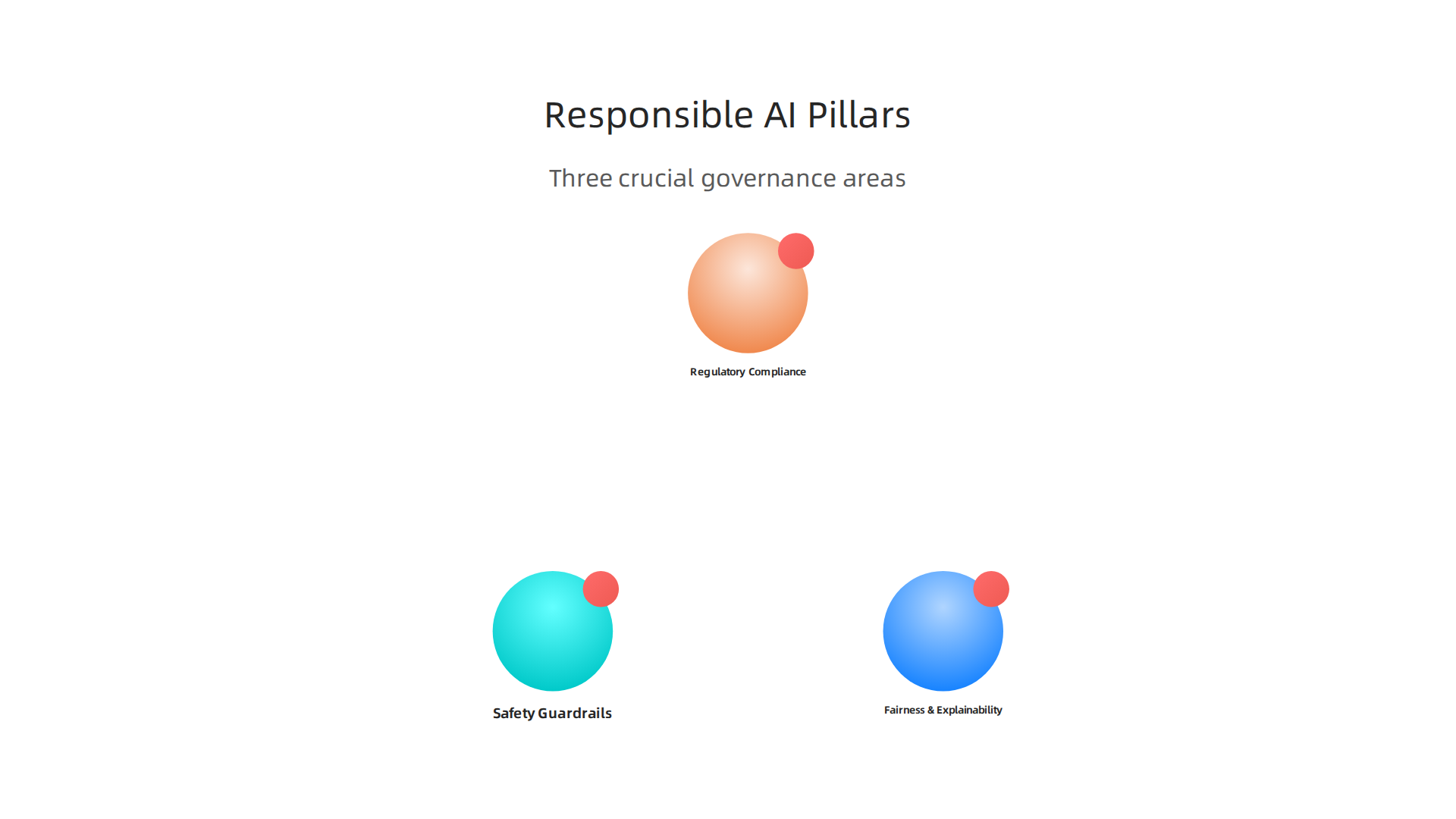
This is not just a nice to have. It is becoming a legal requirement in many places.
Fairness and explainability start with tools that help you see inside your model. Libraries like SHAP, LIME, and Captum let you understand why a model made a certain decision. This is crucial when your system affects hiring, lending, or healthcare. Without these tools, you are flying blind. You can also use bias detection methods to spot problems in your training data before they cause harm.
Safety guardrails protect users from harmful outputs. This includes content filters, adversarial testing, and red teaming. Red teaming means having people try to break your model on purpose. The goal is to find weaknesses before real users do. Many enterprises now run red teaming exercises as standard practice. For more on building these safeguards, read about enterprise AI trust and guardrails.
Regulatory compliance is a major driver of responsible AI today. The EU AI Act has a key deadline: August 2, 2026. After that date, high risk AI systems must follow strict rules on risk management, data governance, and human oversight. The EU AI Act August 2026 compliance countdown explains what companies must do before the deadline. The high level summary of the AI Act gives a clear overview of all requirements. In the US, the Executive Order on AI pushes similar standards for safety and transparency.
As an ai engineer, you should get comfortable with auditing frameworks that check your systems against these rules. Many companies now hire for dedicated responsible AI roles. Knowing how to audit a model for compliance gives you a major career advantage. It also helps your team avoid costly fines and reputation damage.
Building responsible AI is not a one time task. It is a continuous practice that should be part of every stage in the development cycle. The earlier you bake in fairness and safety, the easier it is to maintain them later.
Monitoring, Observability, and Continuous Improvement
Deploying a model is not the finish line. After your AI system goes live, it faces a whole new set of challenges. Data can shift. User behavior changes. And model performance can slowly drop without anyone noticing. That is why every ai engineer needs solid monitoring and observability practices.

Model monitoring means keeping an eye on three main things: drift, data quality, and performance. Drift happens when the real world data your model sees starts to differ from the training data. Data quality issues like missing values or corrupted inputs can quietly ruin predictions. Performance degradation might show up as slower response times or dropping accuracy. You need alerts that catch these problems early, before they affect real users.
Observability platforms make this work easier. Tools like WhyLabs, Arize AI, and Evidently AI give you dashboards that show what your model is doing in real time. You can spot trends, compare new data against old data, and get clear signals when something goes wrong. These platforms also help you explain model behavior to stakeholders. That matters a lot when you need to prove your system is safe and fair.
Monitoring also covers your infrastructure. If your model runs on GPUs, you need to watch utilization and costs. An ai engineer in 2026 should be familiar with best practices for managing AI workloads and resource efficiency to avoid wasting compute power.
Feedback loops close the improvement cycle. Human in the loop systems let people review tricky predictions and correct them. Active learning uses those corrections to retrain the model on the most useful examples. And model retraining pipelines automate the process of updating your model with fresh data. This keeps your system accurate over time.
Continuous improvement is not optional. It is the difference between a model that stays useful and one that becomes a liability. As you build these practices, staying informed on AI developments helps you make better decisions. You can stay ahead with help from The AI Newsletter Worth Reading, which delivers daily updates on AI trends and tools.
For more on evaluating your AI systems at a deeper level, check out this guide on the ai engine evaluation framework.
The ‘Soft’ Skills That Differentiate Senior AI Engineers
You can build a killer model. But if you cannot explain what it does or why it matters, your work may never leave the lab. The best AI engineers in 2026 know this well. Technical skills get you in the door. Soft skills keep you at the table.
Talking to non-technical stakeholders is a big one. A senior AI engineer translates complex outputs into business value.

You need to tell a product manager how a model improves user retention. You need to show a CFO the ROI of a new recommendation engine. This skill is what separates a junior coder from a trusted advisor. When you can speak the language of business, your projects get budget and support.
Cross-functional collaboration matters just as much. You do not work alone. You partner with product teams who define what to build. You work with IT to get the infrastructure right. You coordinate with compliance to make sure everything stays within regulation. And you lean on data engineers to keep the pipelines clean. A senior AI engineer acts as a bridge between these groups. Without that bridge, projects stall. According to recent market data, the 2026 AI engineer shortage is creating a gap between demand and qualified candidates. That makes engineers who can collaborate across teams even more valuable.
Continuous learning and adaptability round out the list. AI tools change fast. Google prompt engineering techniques that worked last year get updated. Microsoft GitHub Copilot adds new features every quarter. Tools like Upscale AI keep improving how teams handle image generation and data processing. A senior engineer does not wait for a training course. They stay curious, read new research, and test new tools early. This habit keeps their skills fresh and their teams ahead.
If you want to grow your career beyond coding, start practicing these soft skills today. They are what turn a good AI engineer into a great one. For more on how to build a strong foundation for enterprise AI work, read this guide on enterprise AI adoption in 2026.
Talent Acquisition and Team Structure: Hiring and Upskilling for AI
The soft skills we just covered make a senior AI engineer stand out. But here is the hard truth for 2026: there simply are not enough of them to go around. The numbers are stark. According to recent market data, the 2026 AI engineer shortage shows demand outpacing supply by a ratio of more than three to one.
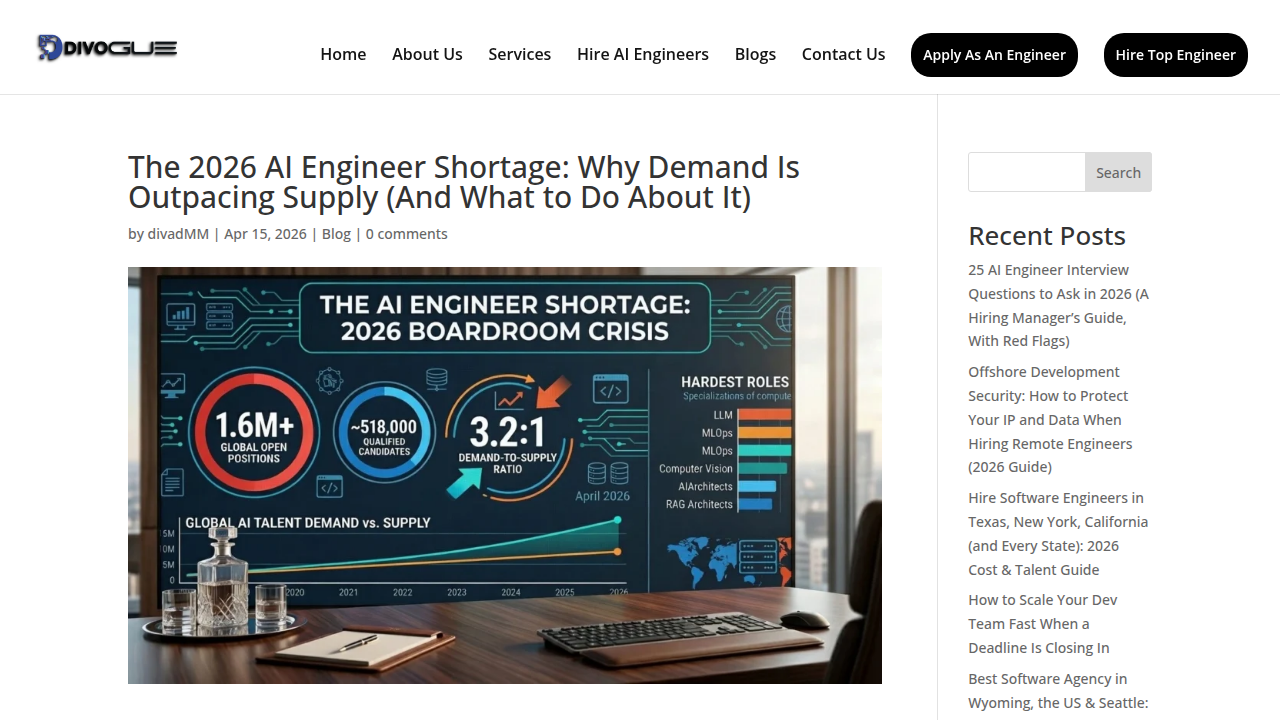
Over 1.6 million AI roles are open, yet only about half a million qualified candidates exist. That gap puts pressure on every enterprise leader.
So how do you fill the pipeline? You have two paths: hire externally or grow your own talent.
External hiring is the obvious move, but it is expensive and slow. Top AI engineers command high salaries and often get snatched up fast. Many companies now compete for the same small pool of people.
Internal upskilling offers a smarter long-term solution. Instead of fighting for scarce talent, you invest in your existing workforce. Certifications, bootcamps, and hands-on projects turn strong engineers into AI engineers. Programs focused on tools like Google prompt engineering or Microsoft GitHub Copilot can quickly bring your team up to speed. If you want a deeper look at how to build your workforce from within, this guide on building your engineering workforce from within covers the key strategies.
Building an effective AI team is not just about titles. You need the right mix of roles. A typical enterprise AI squad includes:
- ML engineers who build and tune models.
- Data engineers who keep the pipelines clean and fast.
- MLOps engineers who handle deployment, monitoring, and reliability.
- Product managers who connect technical work to business value.
These people need to work as one unit, not separate silos. The organizational model matters. A centralized AI center of excellence works well for setting standards. A decentralized model with embedded AI specialists speeds up adoption in specific departments. Many large enterprises use a hybrid approach.
Whichever path you choose, the key is to start now. The talent gap is not going away. But with smart hiring, strong upskilling, and the right team structure, you can build an AI function that delivers. Stay ahead by keeping your finger on the pulse of AI trends. The AI Newsletter Worth Reading delivers clear daily updates to help you and your team stay informed.
Summary
This article defines the evolving role of the enterprise AI engineer in 2026 and explains how that role differs from data scientists and general AI hobbyists by focusing on production-grade, secure, and maintainable AI systems. It walks through the technical foundations you must master—machine learning fundamentals, robust data engineering, and MLOps—then explains how to choose and run infrastructure like cloud services, Kubernetes, and GPU schedulers while keeping costs under control. The piece surveys the essential frameworks and libraries for language, vision, and multimodal work, and shows how to bake in responsible-AI practices such as explainability, red teaming, and regulatory compliance. It also covers monitoring, observability, and continuous improvement to prevent model drift, plus the soft skills and team structures that make enterprise projects succeed. Readers will finish with a clear picture of the skills to learn, tools to adopt, and hiring/upskilling strategies to build reliable AI at scale.