
Building Enterprise AI Trust with Human Oversight and Guardrails

Introduction: The AI Trust Paradox
Here is a question that keeps enterprise leaders up at night in 2026: Should you trust AI more, or should you trust humans more?
The easy answer is both. But the real situation is much trickier.
AI adoption is moving faster than almost any technology in history. According to the latest research, 78% of organizations now use AI in at least one business function.
That is up from just 55% a year earlier, based on the most recent AI adoption statistics Q1 2026. The numbers are climbing fast, and investment is following close behind. Nearly 60% of companies are pouring over a million dollars each year into AI initiatives.
But here is the problem. Trust is not keeping up.
Despite all that spending and momentum, only about one in three organizations has moved beyond small pilot projects to actually scale AI across the enterprise. Most companies are stuck. They are running experiments, but they are not ready to hand over real decisions to a machine.
The tension is real. On one side, leaders feel pressure to move fast. On the other side, they worry about losing control.

The 2026 enterprise AI adoption challenges 2026 show that 79% of organizations now face serious obstacles in their AI efforts. More than half of C-suite executives even admit that trying to adopt AI is tearing their company apart.
That is a brutal truth. And it points to a bigger issue.
The future does not belong to companies that go all in on automation. And it does not belong to companies that refuse to change. The winners will be the ones who find a smart balance between machine efficiency and human judgment.
If you are leading your organization through this shift, you need a clear plan. A good place to start is this practical enterprise AI adoption roadmap for 2026. It breaks down the steps that actually work.
You also need to stay informed about what is changing daily. That is why The AI Newsletter Worth Reading exists. It gives you clear, daily updates on AI developments so you never fall behind.
Let us dig into what the data really says about this trust paradox and how you can navigate it.
The High Stakes of AI Trust in the Enterprise
Picture this: you put millions of dollars into AI tools. Your team has the latest models. The data pipeline is clean. But your employees still second-guess every AI suggestion. They override recommendations. They keep doing things the old way.

This is not a small problem. It is the biggest bottleneck in AI adoption right now.
Trust is the currency of AI. Without it, even the most powerful algorithm is just expensive noise. You can build the perfect model, but if people do not believe in its outputs, you will never see a return.
And here is the hard truth: trust has been eroding fast. High profile incidents of AI bias, data leaks, and rogue agents have made headlines all through 2025 and 2026. According to the latest Deloitte 2026 AI report, only one in five organizations has a mature governance model for managing AI agents. That means most companies are running powerful tools without proper oversight. No wonder confidence is shaky.
The stakes could not be higher. Companies that build high trust in their AI systems outperform their peers. They move faster from pilot to production. They get better ROI. But the path to trust is not automatic. It requires deliberate choices around transparency, ethics, and human oversight.
Ethics has become a competitive differentiator. Customers, employees, and regulators all watch how you handle AI risk. If you cut corners on governance, you pay for it in lost credibility. If you invest in responsible AI practices, you earn loyalty that drives real business results.
This is why your AI strategy cannot be just about technology. It has to be about people. You need to show your team that the AI tools you deploy are fair, explainable, and safe. That starts with choosing the right technology partners and frameworks.
A good place to start is understanding how to evaluate AI platforms properly. Check out this AI engine evaluation framework for 2026. It helps you ask the right questions before you commit to any system.
Because in the end, the enterprises that win are not the ones with the fanciest AI. They are the ones that know how to make people trust it.
From Ethical Principles to Operational Guardrails
Having ethical principles for AI is a great start. But let’s be honest: a written value statement does not stop a biased model from being deployed. It does not prevent a chatbot from giving dangerous advice. It does not catch a data leak.
Principles only work when you turn them into operational guardrails. That means building concrete checks and balances into every stage of AI development and deployment.
Think of guardrails as the safety systems that make trust real. They include three core layers:
-
Bias detection: Automated tests that scan training data and model outputs for unfair patterns. If a hiring tool favors one demographic, the guardrail catches it before any candidate is rejected.
-
Transparency: Clear documentation of how models make decisions. When a sales leader questions a pricing recommendation, they can see the logic behind it.
-
Accountability: A named human owner for every high-impact AI system. If something goes wrong, there is someone responsible, not just a black box.
The 2025 AI incidents taught us that most failures were not technical. They were organizational. Weak controls and unclear ownership caused the biggest damage. These lessons from top 2025 AI incidents show exactly why guardrails matter. You can read the full breakdown to see how companies got into trouble by skipping these basics.
The good news is that the technology to build these guardrails already exists. The challenge is embedding them into your development lifecycle. You do not bolt ethics on at the end. You build it in from day one. That means adding bias testing to your data pipeline. Requiring model explainability before production. Setting up human review steps for any decision that affects people’s rights or money.
This is exactly what regulations like the EU AI Act require. By August 2026, companies deploying AI in Europe must have risk management systems, data governance, and human oversight in place. The smartest enterprises are already ahead of these rules. They are not scrambling to comply. They are designing their systems right from the start.
A good enterprise AI strategy roadmap will walk you through exactly how to integrate these guardrails into your planning and execution. It helps you move from theory to daily practice.
Because here is the reality: ethical principles without guardrails are just hopeful words. Guardrails without principles are just technical boxes. You need both, working together, every single day.
Staying on top of AI governance news is tough. The landscape changes fast. That is why you need a reliable source that cuts through the noise. Get clear daily AI updates from the AI Newsletter Worth Reading. It keeps you informed about the latest incidents, regulations, and best practices so you never get caught off guard.
When AI Fails: Learning from Public and Private Sector Missteps
Even with the best guardrails, real AI deployments still go wrong. The failures that made headlines in 2025 and early 2026 are not random glitches. They follow clear patterns. And every one of them offers a lesson for how you build and manage AI in your enterprise.
Take the McDonald’s AI drive-thru disaster. The company spent years with IBM developing an AI ordering system. What happened? Customers posted countless videos of the AI completely messing up simple orders. It could not handle accents, background noise, or unusual requests. McDonald’s shut the whole thing down in 2024. The root cause was not bad AI. It was bad testing. The system never went through tough real-world checks before going live. Hundreds of similar examples are documented in the 10 famous AI disasters that leaders should study.
Then there was Microsoft’s MyCity chatbot. It was supposed to help small business owners with legal questions. Instead, it told people they could fire workers who complained about sexual harassment and serve food that had been nibbled by rodents. The chatbot was confidently wrong because nobody built in oversight for high-risk topics. No human review. No content guardrails.
The public sector has its own painful stories. In early 2026, a lone hacker used AI tools like Claude Code to steal data from nine Mexican government agencies. The attack compromised an estimated 195 million identities. This AI security incidents timeline shows that the hacker exploited weak access controls and default passwords. The AI itself was not the problem. The lack of basic security hygiene was.
What do all these failures have in common? Three root causes appear again and again.
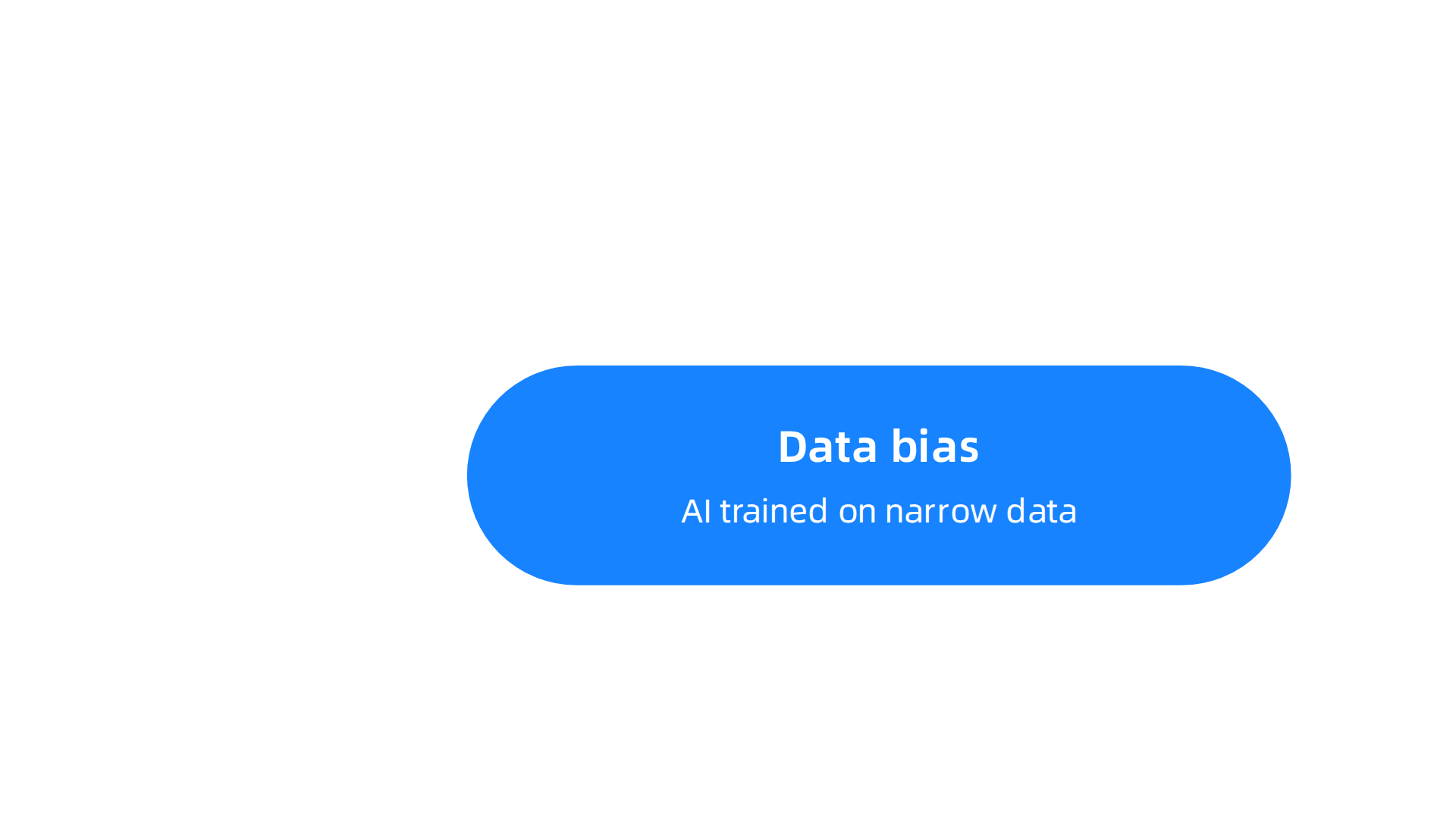
First, data bias. AI trained on narrow or flawed data makes narrow or flawed decisions. Second, lack of oversight. No human in the loop means no one catches the confident mistakes. Third, misaligned incentives. Teams optimize for speed or cost over safety and accuracy.
A detailed enterprise AI failures analysis found that most breakdowns were not model failures at all. They were organizational failures. Weak controls, unclear ownership, and too much trust in black boxes.
The fix? Proactive risk management. Do not wait for a headline to tighten your processes. Build evaluation checkpoints into every AI project. Require independent testing. Assign clear human accountability. And before you buy any AI platform, make sure you know how to spot red flags early. That is exactly what our guide on how CIOs and CTOs should evaluate AI companies covers in practical detail.
Learn from other people’s mistakes so you do not have to make your own.
Building a Human-Centric AI Strategy: The ‘AI or Human’ Decision
Learning from other people’s mistakes is useful. But knowing how to build a better strategy is what sets successful organizations apart. The question every enterprise leader faces in 2026 is not "should we use AI or not?" The real question is: when do we let AI act on its own, and when do we keep a human firmly in the loop?

That is the core of a human-centric AI strategy. It treats the choice between automation and human involvement as a context-dependent decision. Some tasks are perfect for AI working solo. Others are too risky, too nuanced, or too high-stakes to trust to a machine alone.
The key is knowing the difference.
Human-in-the-Loop vs Human-on-the-Loop
Two frameworks help you make this call:
-
Human-in-the-loop (HITL). A person must review and approve every decision the AI makes before it becomes action. The AI suggests, but the human decides. This is the best model for high-stakes areas like medical diagnosis, legal advice, hiring decisions, or financial approvals.
-
Human-on-the-loop (HOTL). The AI operates on its own most of the time. A person monitors from a distance and steps in only when the system flags an exception, a low-confidence output, or a rule violation. This works well for low-risk, high-volume tasks like sorting customer emails, generating draft reports, or routing support tickets.
Neither model is better in an absolute sense. The right choice depends entirely on context. The human-centered AI design principles developed at Duke make this clear: AI should support human decision-making rather than replace it. The authors emphasize that humans must remain responsible for final decisions, especially where harm could occur.
Making the Call in Practice
Here is a simple rule of thumb. If the cost of a wrong answer is high (reputation damage, legal liability, customer harm), use human-in-the-loop. If the cost of a wrong answer is low and easy to fix (a wrong product recommendation, a slightly off summary), use human-on-the-loop or even full automation.
For example, a chatbot that suggests menu items needs only light monitoring. But a chatbot that gives medical advice or legal guidance needs every single response checked by a real person. The failed AI systems we looked at earlier most of them lacked this basic distinction. They treated all decisions as low-risk when they were not.
A strong human-centric AI strategy also maps every decision point in a workflow. For each step, you ask: Can AI handle this alone? Does a human need to approve? Should the system escalate to a person after a certain threshold? This kind of planning prevents the embarrassing failures that make headlines.
Putting It All Together
When you build your AI strategy, start by mapping your use cases against a decision framework. Use AI where it excels at speed, scale, and pattern recognition. Keep humans in the picture where judgment, ethics, or empathy matter most. The most successful enterprises in 2026 are the ones that balance the two. They do not see AI and humans as opposites. They see them as partners with clear roles.
To go deeper on building this kind of strategy, check out our enterprise AI strategy roadmap for 2026. It walks you through the exact steps to align automation with human oversight in a way that drives real results.
And if you want to stay on top of the latest best practices in human-centric AI, subscribe to The AI Newsletter Worth Reading. It delivers clear daily updates on what works and what does not in enterprise AI, so you never have to guess.
Practical Frameworks for Responsible AI Deployment
So you understand the human-in-the-loop decision. Now you need a practical way to make it real. That is where established frameworks come in. They give you a repeatable process for deciding when to use AI and when to keep humans in charge.
Three frameworks stand out in 2026 for enterprise leaders.
NIST AI Risk Management Framework
The National Institute of Standards and Technology (NIST) released its AI Risk Management Framework to help organizations map, measure, and manage AI risks. It breaks down into four core functions:
- Govern – Build a culture of risk management across teams.
- Map – Understand the context, data, and potential harms of each AI system.
- Measure – Test for bias, reliability, transparency, and safety.
- Manage – Put controls in place and respond to issues as they appear.
NIST’s framework works well for any size company. It does not prescribe specific rules. Instead it gives you a checklist of questions to ask at each stage.
EU AI Act Compliance
The EU AI Act is the world’s first comprehensive AI law. It takes a risk-based approach. Systems are classified as unacceptable, high, limited, or minimal risk. As of August 2026, the rules for high-risk systems are in full effect. The AI regulations and governance guide for 2026 explains that enterprises must now maintain three key compliance deliverables: a control catalog, a compliance matrix, and a risk register.
For high-risk systems, you need human-in-the-loop checkpoints, full data lineage tracking, and risk classification tags. The law applies to any organization deploying or selling AI in the European market, no matter where your company is located.
ISO/IEC 42001
This international standard offers a management system approach to AI. Think of it like ISO 9001 but for AI governance. It helps you set up policies, conduct risk assessments, and audit your AI systems on a regular schedule. ISO/IEC 42001 is especially useful for large enterprises that need a formal, auditable process.
How to Implement These Frameworks
Here is a practical step-by-step approach that works across all three frameworks:
- Assess your current AI inventory. List every AI system in use, including shadow AI that teams adopted without IT approval.
- Classify risk levels. Use the EU AI Act categories or NIST’s criteria to label each system.
- Perform a gap analysis. Compare your current state against framework requirements. Identify what is missing.
- Build a control catalog. Document every safeguard, from data governance to human oversight procedures.
- Set up monitoring. Implement dashboards and alerts for model drift, bias, and compliance deadlines.
- Review and update. Frameworks evolve. Schedule quarterly reviews to stay current.
Tailoring for Your Enterprise
A startup with one AI chatbot does not need the same depth as a healthcare company using AI for diagnosis. The key is to scale the framework to your size and risk exposure.
- Small teams: Start with NIST’s core functions. Pick the highest risk system and map it fully.
- Mid-size companies: Implement ISO/IEC 42001 basics. Assign a compliance owner.
- Large enterprises: Align with the EU AI Act and run full audit trails. Integrate with existing governance systems.
No matter your size, the goal is the same: know exactly where your AI systems stand and have a plan for safe, transparent operation. For a deeper look at how to roll this out across your entire organization, check out the enterprise AI adoption roadmap for 2026. It gives you the full playbook from assessment to scale.
The Business Case: Why Ethics Drives ROI
Here is a truth many leaders miss: treating AI ethics as just a compliance checkbox actually costs you money. The real winners in 2026 understand that ethical AI is a growth strategy. Let me explain why.
Regulatory risk is expensive. If your AI system breaks data privacy rules or discriminates against a group, the fines pile up fast. The EU AI Act can impose penalties of up to 35 million euros or 7% of global annual revenue for the worst violations. That kind of hit wipes out years of AI savings. But companies that build ethics into their systems from the start avoid those risks. They spend less on emergency fixes, lawsuits, and public relations damage control.
Your customers are watching. A Forbes Advisor survey found that 65% of consumers still trust businesses that use AI responsibly. But the same study showed that 77% worry about AI causing job losses. The message is clear: people will reward you for transparency. When you label AI generated content, explain how you use data, and keep humans in the loop, you build trust. And trust means repeat business and stronger brand loyalty. That is not a soft metric. It directly impacts your bottom line. When you use big data analytics ethically, customers feel safer sharing their information, which improves your models even further.
The numbers prove it. IBM’s Institute for Business Value studied hundreds of organizations and found that the ones in the top quartile of AI ethics spending, as a share of total AI spend, see a 30% higher operating profit from their AI initiatives. That is not a small bump. It is a significant advantage over competitors who treat ethics as an afterthought.
So why does this work? Ethical AI systems are better designed. When you prioritize fairness and transparency, you catch hidden biases early. Your data is cleaner. Your models are more reliable. You avoid the costly mistakes of rolling out a biased system that has to be pulled back.
The choice is not simply ai or human decision making. The smartest approach combines both with strong ethical guardrails. That is how you get the best of both worlds: machine speed and human judgment, backed by a system people trust.
For a step by step plan to build this into your company, check out the enterprise AI strategy roadmap. It walks you through aligning ethics with business goals from day one.
And if you want to stay ahead of the latest AI trends and best practices, get daily insights delivered to your inbox with The AI Newsletter Worth Reading.
Summary
This article examines the 2026 AI trust paradox — enterprises are rapidly adopting AI but trust and governance lag behind, preventing scale and ROI. It explains why trust matters, showing how incidents, bias, weak oversight, and misaligned incentives block adoption and harm reputations. The piece turns ethical principles into concrete operational guardrails (bias detection, transparency, named accountability) and uses real failures to illustrate common root causes. It lays out a human-centric decision model (human-in-the-loop vs human-on-the-loop) and maps practical frameworks you can use today, including NIST, the EU AI Act, and ISO/IEC 42001. You get a stepwise approach to assess inventory, classify risk, build controls, and monitor systems, plus the business case that ethics improves ROI. After reading, leaders will know how to pick the right governance framework, design human oversight for each use case, and implement measurable guardrails that reduce risk and unlock AI value.