
IT Talent 2026 Building Your Engineering Workforce from Within

The State of IT Talent in 2026: Building Tomorrow’s Engineering Workforce
If you are an enterprise leader trying to fill an open role right now, you already know the struggle. In 2026, finding skilled IT talent feels harder than ever. According to the ManpowerGroup 2026 Global Talent Shortage Survey, a staggering 72% of employers worldwide report difficulty filling open positions. That is not a small problem. It is a crisis that directly affects how fast your company can innovate, how secure your systems stay, and how resilient your operations become.
The numbers back up the tension. Tech employment is still growing, with net tech roles projected to reach about 9.8 million workers this year, up 1.9% from 2025, according to CompTIA. But demand is outpacing supply. Technical assessment activity has jumped 48% compared to 2023, and US technical hiring activity is up by 90% over the same period, as reported by HeroHunt.ai. Companies are scrambling, and many end up in a cycle of bidding wars for the same small pool of experienced professionals.
Here is the thing: throwing more money at the problem through aggressive hiring is not enough anymore. The smartest enterprise leaders are shifting their focus. Instead of just trying to poach talent, they are building it from within.

That means investing in upskilling programs, certifications like the AWS Solutions Architect Associate or the Google Data Analytics Professional Certificate, and creating clear career paths for roles such as IT infrastructure engineer, junior system engineer, and beyond.
This article will walk you through actionable strategies to develop your engineering workforce, not just hire your way out of the talent gap. For deeper insights on how platform and cloud roles are evolving in 2026, check out our guide on cloud engineer career and hiring trends. And to stay ahead of all these rapid shifts in enterprise tech, get daily, no-fluff AI and technology updates by subscribing to The Deep View Newsletter. Let us dive into what actually works this year.
Why the IT Talent Gap Is Wider Than Ever in 2026
You already know it is hard to fill an open it job in 2026. But the numbers really show how big the problem is. According to data from HeroHunt.ai, technical hiring activity in the US has jumped 90% compared to mid-2023, while technical assessments are up 48%. Companies are interviewing more than ever, yet many positions still sit unfilled. At the same time, net tech employment is expected to grow to about 9.8 million workers this year, according to CompTIA. That sounds good, but it is not keeping up with demand.
So why is the gap getting bigger? Three main reasons stand out.
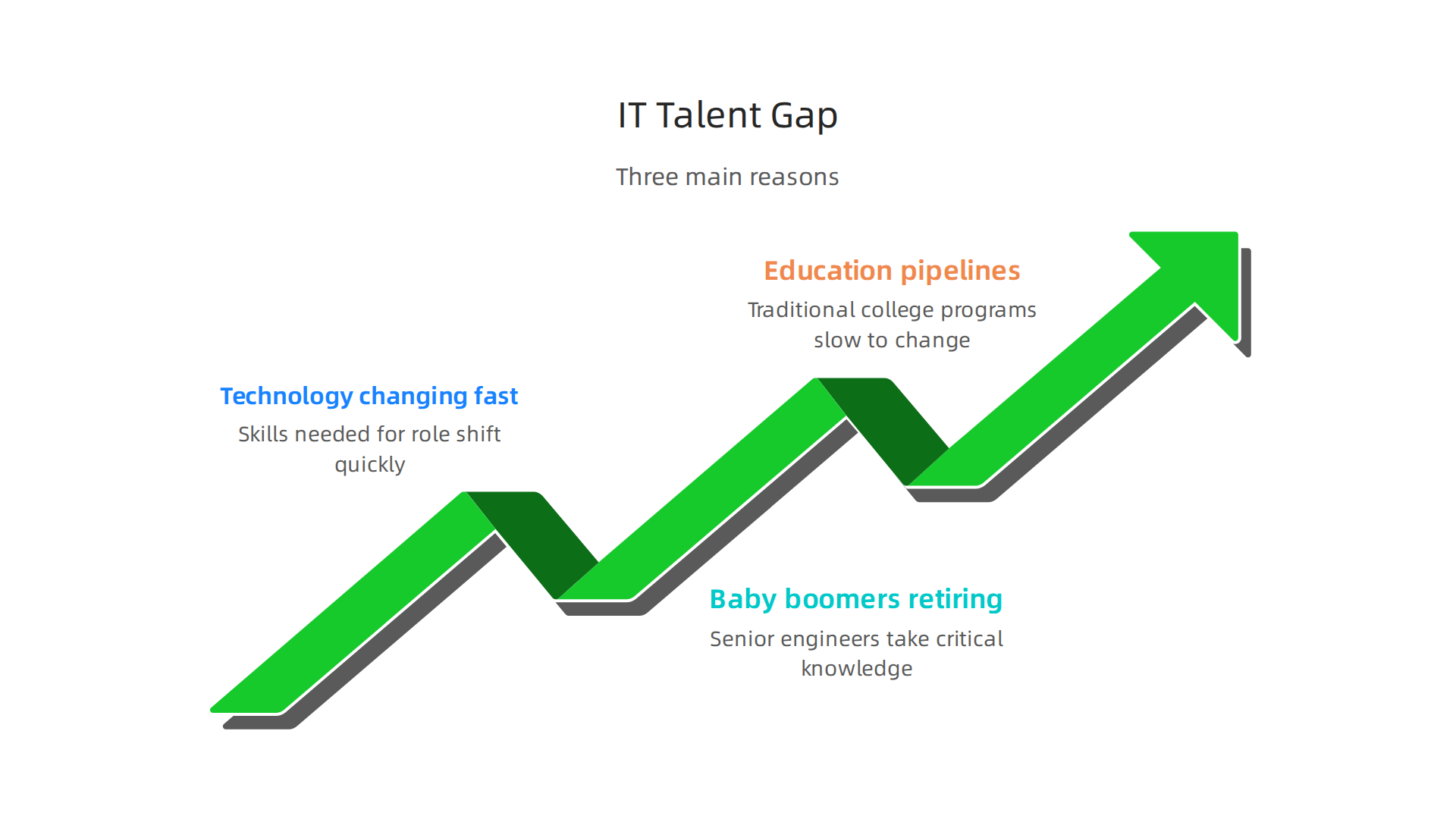
First, technology is changing fast. New tools in cloud computing, AI, and automation appear every month. The skills needed for a role like it infrastructure engineer or junior system engineer shift quickly. Many experienced workers do not have the latest knowledge, and entry-level candidates are not trained fast enough.
Second, a big wave of baby boomers is retiring. These are senior engineers and IT leaders who have decades of experience. When they leave, they take critical knowledge with them. Younger workers cannot always step in right away.
Third, our education pipelines are not keeping up. Traditional college programs are slow to change. Meanwhile, 85% of employers now use skills-based hiring, as reported by Scholaro. That means they care more about what you can do than what degree you have. Certifications like the AWS Solutions Architect Associate and the Google Data Analytics Professional Certificate are becoming essential for getting hired.
The impact on enterprises is real. Delayed digital transformation is one result. You want to move to the cloud, but you cannot find the people to do it. Many companies rely more on expensive contractors, which hurts budgets. Security risks also grow when you have understaffed teams or too many temporary workers.
To stay ahead of these changes, you need clear, daily insights on enterprise tech. That is why we recommend subscribing to The Deep View Newsletter. It delivers the latest AI and technology updates straight to your inbox, no fluff. For more on how platform roles are evolving, check out our guide on platform engineering in 2026.
Top In-Demand Skills for IT and Engineering Jobs in 2026
So what skills do you actually need to land a great it job this year? Employers are looking for a mix of hard technical abilities and soft human strengths. Here are the top ones, based on the latest hiring data.
Artificial Intelligence and Machine Learning lead the pack. Companies everywhere want people who can build, train, and deploy AI models. According to Salt Recruitment, AI and machine learning are the most in-demand tech skills of 2026. This makes sense, since a BCG report found that over half of US jobs will be reshaped by AI in the next few years. Roles like it infrastructure engineer now often require some AI knowledge too.
Cloud architecture comes next. Expertise in AWS, Azure, and Google Cloud is a must. The Pluralsight list of top tech skills puts cloud computing at number one. Getting certified as an AWS Solutions Architect Associate can make you stand out fast. For more on building a cloud career, check out our cloud engineer career and hiring guide for 2026.
Cybersecurity is another massive area. Threats are growing, and demand for security pros keeps outpacing supply, as DestCert reports. Whether you protect systems or respond to breaches, this skill set is golden.
DevOps and data engineering round out the top five. Companies need people who can automate deployments and manage pipelines. The LSE list of in-demand tech careers highlights DevOps and data engineering roles. A Google Data Analytics Professional Certificate can help you break into the data side.
But technical skills alone are not enough. Soft skills are equally critical. Adaptability is huge, because tools change fast. Cross-functional collaboration matters, since you will work with non-tech teams. And continuous learning is a must. The PwC AI Jobs Barometer shows that workers who keep learning stay valuable, even as AI automates parts of their job.
Finally, regional variation matters. In North America, cloud and cybersecurity are hottest. In Europe, data engineering and AI see the most demand. In APAC, cloud adoption and DevOps are surging, especially in markets like India and Singapore.
The bottom line? Focus on a strong technical core, stay flexible, and never stop learning.

For daily insights on which skills and tools are trending, subscribe to The Deep View Newsletter. It delivers clear, no-fluff updates straight to your inbox.
Inside the Enterprise Talent Development Playbook
Hiring from the outside is expensive. And with the skills gap growing, many companies are looking inward instead. They are building their own talent through structured programs. This is called enterprise talent development, and it is a huge trend in 2026. According to Training Orchestra, high quality corporate training experiences are on the rise. So what does a modern talent development playbook look like? Let’s break it down.
The Three Core Pillars
Leading companies focus on three main areas:
-
Internal mobility – This means helping current employees move into new roles. Instead of hiring an outside it infrastructure engineer, a firm might train a junior system engineer for the job. It saves money and keeps experience inside the company.
-
Structured upskilling programs – These are formal training paths. For example, a company might pay for employees to earn an AWS Solutions Architect Associate certification or a Google Data Analytics Professional Certificate. The goal is to close specific skill gaps. As one guide on corporate training in 2026 explains, these programs focus on areas like technical training and soft skills to meet organizational needs.
-
Mentorship pipelines – Pairing junior talent with senior leaders speeds up learning. It also builds loyalty. The best employee learning programs are scalable, sustainable, and ever improving, notes Intellum.
Case Studies: AT&T and Amazon
AT&T is a classic example. Years ago, they launched a massive upskilling program. They spent hundreds of millions to retrain workers for cloud and AI roles. The result? They filled critical positions internally and cut hiring costs.
Amazon goes even further. Their Career Choice program pre-pays tuition for employees in high demand fields like cloud computing and data analytics. This includes certifications like the AWS Solutions Architect Associate. It is a smart move, because it creates a steady pipeline of skilled workers who already know the company culture. The trend toward skills based organizations is accelerating in 2026, as noted by TechClass.
Measuring the ROI
But does this actually pay off? Yes. Companies that invest in talent development see three big returns:
- Reduced hiring costs – Internal moves cost far less than external recruiting.
- Increased retention – Employees stay longer when they see a future.
- Faster time to productivity – Existing workers already understand the business.
A data driven approach to upskilling helps companies track these metrics, according to Absorb LMS. And when you connect training to business goals, the results speak for themselves.
For leaders looking to build similar programs, staying current on tools and trends is essential. That is where daily insights matter. Subscribe to The Deep View Newsletter to get clear updates on AI, cloud, and enterprise talent strategies. It helps you stay ahead without the noise.
Degrees, Certifications, and Alternative Pathways – What Works?
So you want an it job in 2026. What is the best way to get one? The old path was simple: get a four year computer science degree. But the rules have changed. Today, there are three main routes, and each one has its own strengths.
Traditional Computer Science Degrees
A CS degree from a university still opens doors. Many employers see it as proof of strong fundamentals. But here is the thing: a degree alone is no longer enough. According to the Scholaro report, 85% of employers now use skills based hiring. They care more about what you can actually do than where you studied. Still, a degree can help with bigger companies and roles like it infrastructure engineer where deep theory matters.
Coding Bootcamps
Bootcamps are intensive programs that teach practical skills in months, not years. They work well for career changers. But employer perception is mixed. Some companies love bootcamp grads for their hands on experience. Others prefer candidates with a more traditional foundation. The key is to pair a bootcamp with real projects or a certification to prove your skills.
Vendor Certifications – The Fast Track
Certifications are booming in 2026. The Pearson VUE report found that certified IT employees deliver nearly $18,000 in extra annual value for their employers. That is a big number. Two of the hottest certs right now are the AWS Solutions Architect Associate and the Google Data Analytics Professional Certificate. These credentials tell employers you know specific tools and platforms. For roles like junior system engineer or cloud engineer, a cert can be more valuable than a degree.
Hybrid Models – The Best of Both
The smartest path in 2026 is a hybrid. Start with a degree for the foundation, then add a certification to prove hands on skills. For example, a CS grad who earns the Google Data Analytics Professional Certificate becomes a strong candidate for data focused IT jobs. This combo shows both theory and practice. A similar approach works for someone aiming to be an it infrastructure engineer: a degree plus an AWS Solutions Architect Associate certification is a powerful combination.
What Employers Actually Want
So which carries more weight? It depends on the role. A CCC Careers analysis shows that for technical IT jobs, certifications often beat degrees when it comes to hiring speed. But for leadership tracks, degrees still matter. The best strategy is to stack credentials: degree + cert + experience.
Staying current on these trends is essential for anyone planning their career. That is where daily insights help. Subscribe to The Deep View Newsletter for clear, daily updates on IT hiring, cloud credentials, and enterprise tech. It helps you make smart choices without the noise.
Engineering Career Ladders: Mapping Roles from Entry to Executive
So you have your credentials sorted. Now what? The next big question is how your it job career will grow. In 2026, the path from entry level to executive is clearer than ever.

But you need to choose your direction wisely.
The Typical IT Career Ladder
Most people start in a hands on role like a junior system engineer or associate developer. From there, you move to mid level, then senior. After senior, two big doors open: staff or principal engineer, and architect or CTO. The staff path means you go deep technically. The architect path means you design big systems. The LSE analysis of in-demand tech careers shows that cloud engineering and AI roles are growing fast at every level. That means there is room to move up if you keep learning.
Specialist vs. Generalist: Which Pays More?
Here is the thing. You can become a deep expert in one area, like cloud security or data engineering. Or you can stay broad and learn many tools. In 2026, specialists often earn more early on. Companies pay top dollar for someone who can solve a hard problem in cloud infrastructure. But generalists have more job options. A generalist it infrastructure engineer can work in many industries. A specialist might get stuck if their niche cools off. The Pluralsight list of top tech skills for 2026 highlights cloud computing (AWS and Azure) as a must have for both tracks. So whichever path you pick, cloud skills help.
How Advanced Degrees and Certs Fit In
You do not need a master’s degree to become a principal engineer. But it can help for leadership tracks. Many CTOs have a CS degree plus years of experience. Certifications, though, are the fast lift. Earning an AWS Solutions Architect Associate certification can push a senior engineer into a cloud architect role faster. Similarly, the Google Data Analytics Professional Certificate helps a data engineer move into analytics leadership. The key is to add certs at each career stage, not just at the start. For a detailed look at how cloud skills accelerate your climb, check out our cloud engineer career and hiring guide for 2026.
Staying on Top of the Ladder
The career ladder in tech is not a straight line. You might jump roles, switch companies, or pivot to a new specialty. The best way to navigate is to stay informed. That is where daily, curated insights help. Subscribe to The Deep View Newsletter for clear updates on IT hiring trends and enterprise tech. It helps you know which skills to learn next and where the market is heading.
How AI and Automation Are Redefining IT Job Roles
So you know the career ladder exists. But here is the question that keeps a lot of people up at night. Is AI going to take your job? Actually, the truth is more interesting than that. In 2026, AI and automation are not replacing most IT roles. They are reshaping them. And that means your it job is going to look different in a few years. The key is to understand how.
AI Is Augmenting, Not Replacing
Think of AI as a really smart assistant that handles boring tasks. It does not replace the IT professional. It adds new layers to the role. A BCG report from 2026 found that 50% to 55% of jobs in the US will be reshaped by AI over the next two to three years. That means most people keep their jobs, but the work changes.
For IT pros, this shift brings new responsibilities. You might need to learn prompt engineering to get the best output from AI tools. You might work in AI ops, making sure AI systems run smoothly in production. And you will need ethical oversight skills to check whether AI decisions are fair and secure.
These new duties are becoming part of many IT job descriptions. A junior system engineer today might spend time tuning automated monitoring tools. A senior cloud engineer might oversee AI-powered security systems. The Salt Recruitment analysis of 2026 tech skills highlights AI and machine learning as top areas to learn. So if you want to keep your it job relevant, start adding AI skills now.
Automation Shifts Focus to Strategic Work
Here is the thing. Automation removes the grunt work. That is a good thing. If you spend hours copying data or running manual checks, those tasks will get automated. That frees you up to do the hard stuff, like planning system architecture or solving complex problems.
But there is a catch. You need to reskill. A Goldman Sachs analysis from 2026 estimates that about 300 million jobs globally are exposed to some degree of AI automation. That number sounds scary. But the Nexford report on AI and jobs 2026-2030 points out that two-thirds of jobs will only be partially automated. The people who thrive are the ones who lean into the strategic work.
For example, an it infrastructure engineer who once spent half the day checking server logs now uses AI tools to detect issues automatically. That engineer can now focus on designing more resilient networks. To make that jump, you need to understand how to work with AI systems. That is where certifications like the AWS Solutions Architect Associate or the Google Data Analytics Professional Certificate come in. They teach you to build and manage the systems that AI runs on.
Forecast: Which IT Job Families Will Grow, Shrink, or Transform by 2028
Let’s look ahead a couple years. The World Economic Forum predicts 69 million new jobs will be created worldwide by 2028 due to AI and automation.
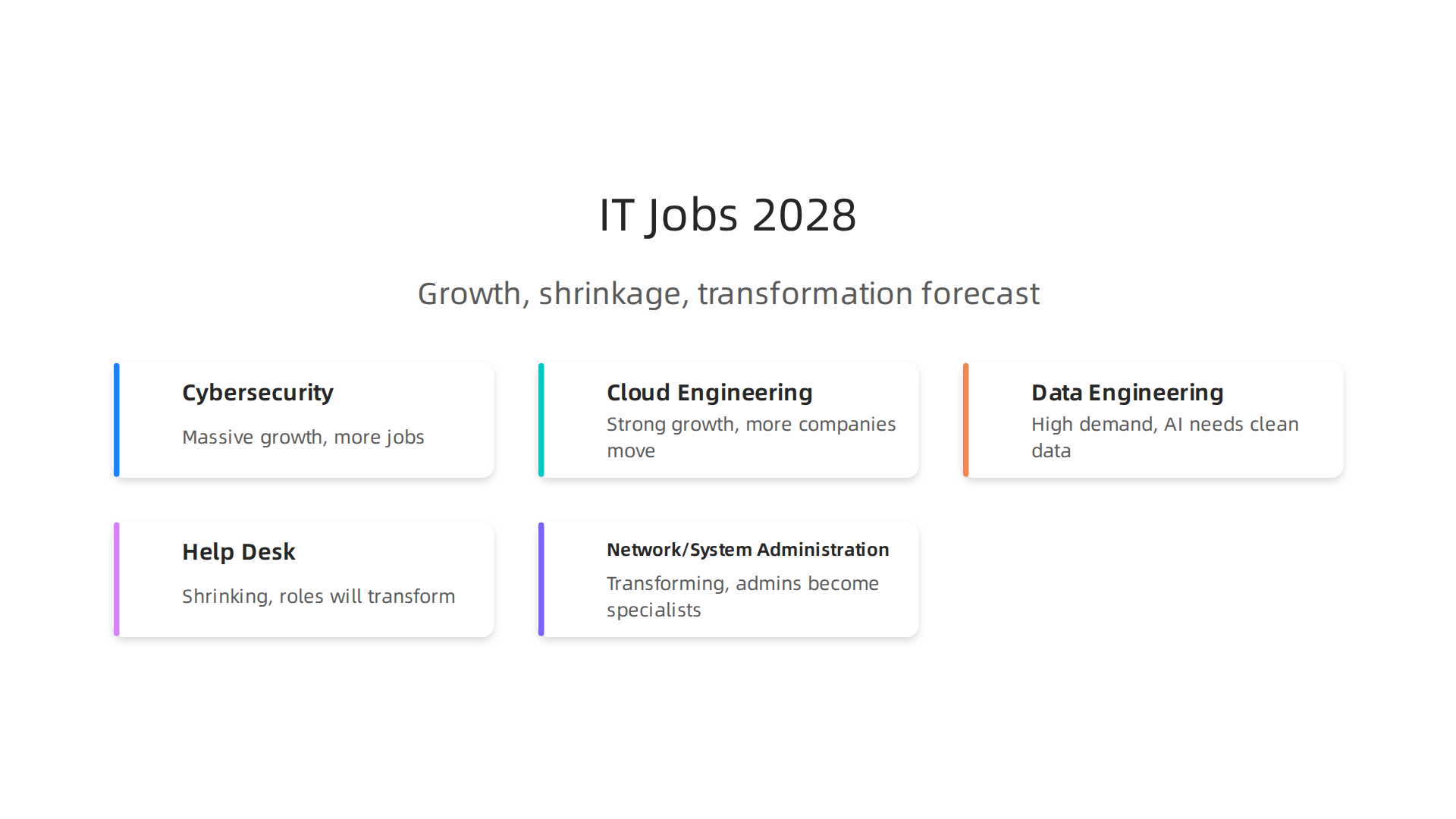
At the same time, some roles will shrink. Here is a simple breakdown.
| Job Family | Forecast by 2028 |
|---|---|
| Cybersecurity | Massive growth. AI creates new attack surfaces. More threats mean more jobs. The DestCert analysis shows demand still outpaces supply in 2026. |
| Cloud Engineering | Strong growth. More companies move to the cloud. AI tools need cloud infrastructure. |
| Data Engineering and Science | High demand. AI needs clean data. Companies pay well for people who can build and manage data pipelines. |
| Help Desk and Entry-Level IT | Shrinking. AI chatbots and automated ticketing handle Level 1 support. Entry level roles will transform into system oversight jobs. |
| Network and System Administration | Transforming. Routine maintenance gets automated. Admins become automation specialists or platform engineers. |
The PwC Global AI Jobs Barometer confirms that AI makes workers more valuable, even in jobs that are highly automatable. The key is to invest in the skills that are growing. For a deeper look at how to build these skills and plan your next move, read our guide on enterprise AI adoption in 2026. It covers the tools and strategies you need to stay ahead.
The market is moving fast. Keeping up with daily changes can feel like a full-time job. That is where clear, curated updates help. Subscribe to The Deep View Newsletter for practical AI and tech insights every day. It helps you know which skills to learn next and where the hiring trends are headed.
Summary
The article analyzes the 2026 IT talent crisis and gives enterprise leaders a practical playbook for closing skills gaps without overpaying for external hires. It opens with data showing hiring activity and assessment volume rising while supply lags, then explains why rapid technology change, retirements, and slow educational pipelines make the problem worse. The piece highlights which technical and soft skills are most in demand — from AI and cloud architecture to cybersecurity and adaptability — and argues that certifications and hybrid learning paths now often outpace degrees for many roles. It lays out a three‑pillar talent development strategy (internal mobility, structured upskilling, mentorship), profiles corporate case studies, and shows how to measure ROI. The article also maps modern career ladders, contrasts specialist and generalist tracks, and explains how AI and automation will transform rather than eliminate IT work. Readers finish with actionable steps to design training programs, pick certifications, and plan hires to future‑proof their engineering workforce.