Producer AI: The Enterprise Leader’s Strategic Guide for 2026

Why ‘Producer AI’ Matters for Enterprise Product Leaders in 2026
In 2026, it feels like artificial intelligence (AI) is everywhere. From simple tools that help you write emails to complex systems managing factory floors, AI is changing how we work and live. But for big companies and product leaders, there’s a special kind of AI that truly matters: producer AI. This isn’t just about using any AI; it’s about building and using AI that works for your specific business needs.
So, what exactly is producer AI? Think of it as AI that your company creates, controls, and puts into action. An "AI Producer" is the team or company that makes and sets up these AI models and systems. They design, train, test, and deploy AI tools that are used inside their business or by their customers AI Partner, AI Provider or AI Producer?.
This is very different from simply using consumer-facing AI. Consumer AI, like public chatbots or simple image generators, is made for everyone and often doesn’t have the special safety features or rules that a business needs. It’s often what some call "unfiltered AI." Producer AI, on the other hand, is built with your company’s rules, data, and security in mind. It’s also different from just using basic developer tools. While large language models (LLMs) and other generative AI tools are powerful building blocks, producer AI means taking these pieces and turning them into full, ready-to-use solutions. These solutions support specific generative AI use cases that really help your business.
For CIOs, CTOs, product leaders, and SaaS founders, understanding producer AI is super important. It’s about making smart choices for where to put your money and effort in AI.

Many AI test projects, called pilots, never actually get used widely in a company Enterprise AI Implementation: Pilot to Production Guide. This is why focusing on producer AI helps you move past small tests to build AI that is secure, managed well, and trusted across your whole business. It helps you pick the right AI companies to work with and ensure your investments lead to real results. You can also explore how to master generative AI tools for enterprise productivity.
This article will give you clear steps and ideas to help you succeed with producer AI. We will share a practical way to think about AI, talk about what risks to watch out for, and provide a helpful list to check off as you bring AI into your company. We’ve come a long way since the early days of artificial intelligence in 1956. Now, it’s about smart, careful planning for enterprise AI adoption.
Ready to stay updated on the latest AI trends for businesses? Get clear daily AI updates.
The AI Newsletter Worth Reading
For product teams, understanding producer AI is like knowing how all the parts of a big machine work together to make something amazing. It’s not just about what the AI can do, but how your company builds and manages it from start to finish. This involves different teams working hand-in-hand to bring AI to life for your business.

Let’s break down what producer AI means for key teams:
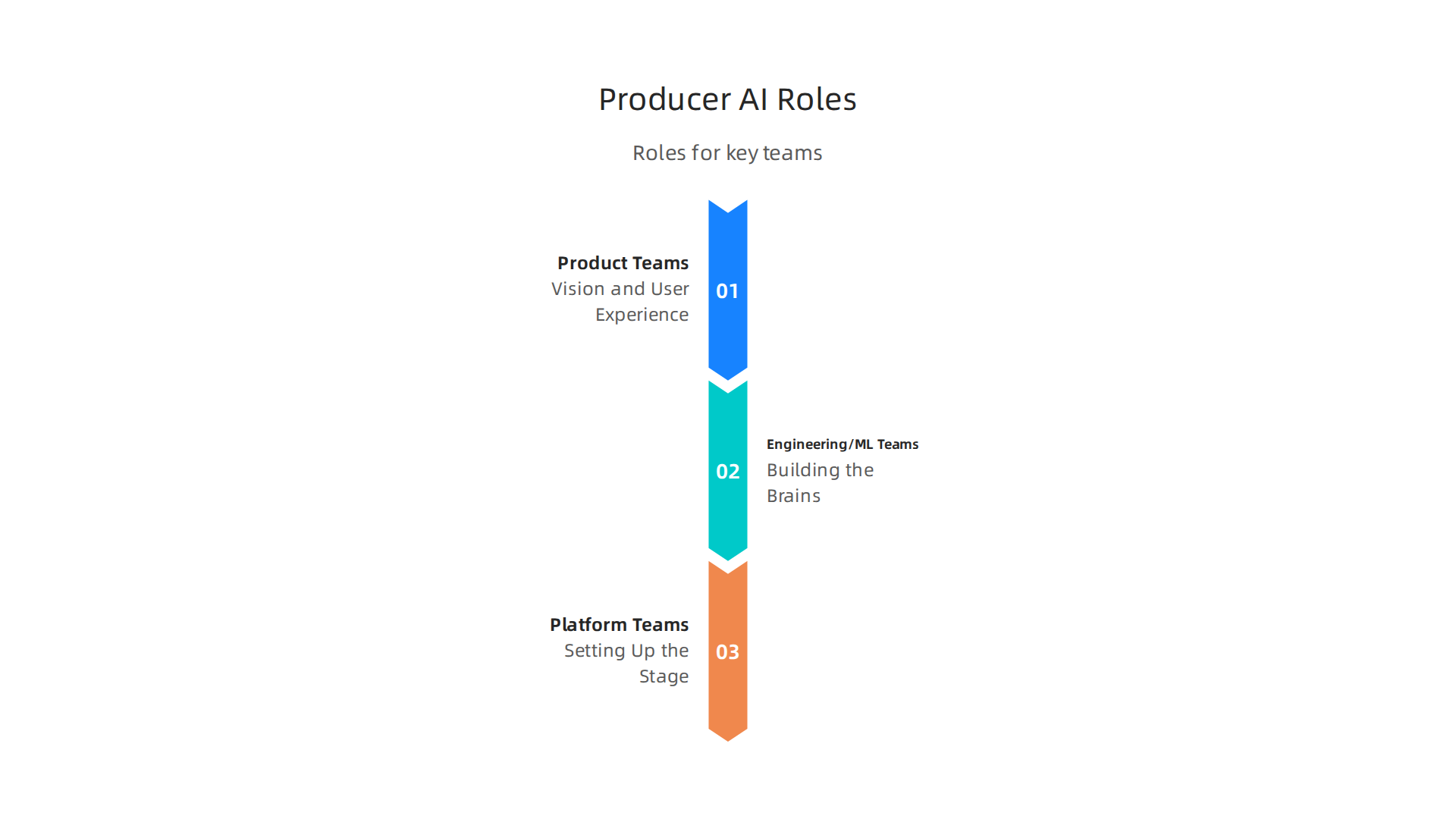
Product Teams: Vision and User Experience
Product teams are at the start and end of the producer AI journey. They figure out what problem the AI needs to solve for customers or for the company itself. They define how the AI should work and what it should feel like for the people using it. This means thinking about the user experience, making sure the AI is fair, and planning for any ethical questions that might come up. They guide the entire process, from idea to launch, making sure the AI truly helps and makes a difference.
Engineering and Machine Learning (ML) Teams: Building the Brains
These are the builders. ML engineering teams take the ideas from the product team and turn them into actual working AI. This involves training the AI models with the right data, making sure they learn correctly, and then getting them ready to be used. Think of it like teaching a smart student for a very specific job. They also handle MLOps, which is like the set of rules and tools that help manage the AI models reliably throughout their life MLOps System Design: Reference Architecture for 2026. This includes things like testing, updating, and making sure the AI keeps working well in the real world. For engineers looking to grow in this area, exploring a roadmap for enterprise AI engineers can be very helpful.
Platform Teams: Setting Up the Stage
Platform teams create the foundation where AI models live and run. They manage the technical setup, like servers, storage, and all the tools needed to keep the AI working smoothly and safely. This often means setting up "self-hosted models," which are AI models that your company runs on its own computer systems, rather than relying fully on outside providers What Is Self-Hosted Model? Definition & Examples. This gives your company more control over data and security. They also build "observability" tools. These tools help everyone see how the AI is performing, if there are any errors, and how people are interacting with it, much like watching all the gauges in a car’s dashboard What is Enterprise Observability? Components & Benefits. Knowing how to build robust platform engineering solutions is key here.
Producer AI vs. Foundation Models and General ML Engineering
It’s important to see the difference. Foundation models, like big generative AI models or large language models (LLMs), are powerful starting points. They are like a general-purpose engine. Producer AI is about taking that engine and building a custom car around it for your specific business needs. It moves beyond just general llm vs generative ai discussions. It’s about creating unique generative ai use cases that give your company an advantage. While general ML engineering might focus on any type of machine learning, producer AI is specifically about bringing those models into a controlled, safe, and business-focused environment. This means managing everything from the data used for training to how the AI is deployed and watched over.
Real-World Generative AI Use Cases Driven by Producer AI
Producer AI helps businesses create real value. Here are some examples of what it can do:
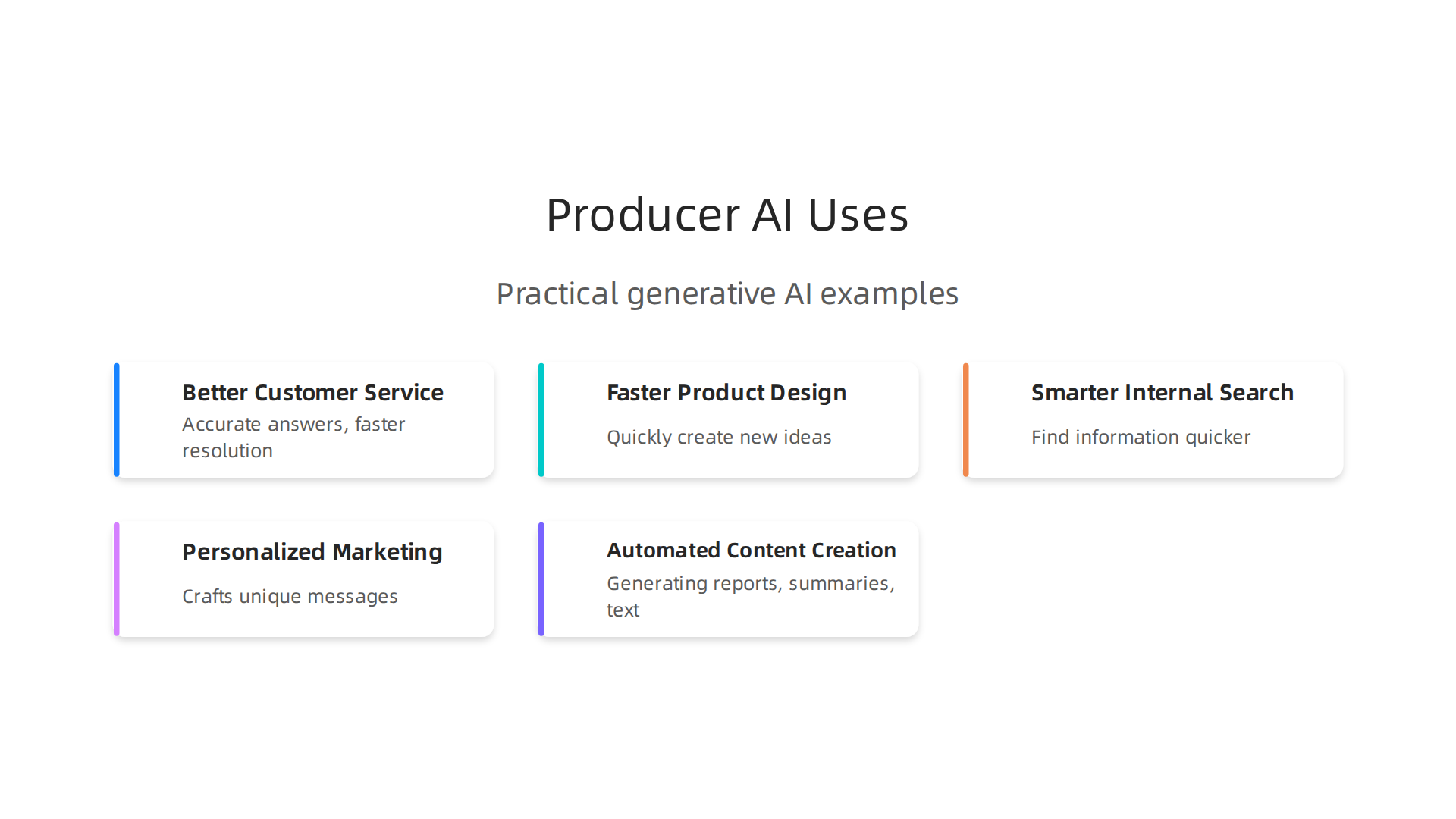
- Better Customer Service: AI chatbots that understand specific company products and rules, giving accurate answers and solving problems faster.
- Faster Product Design: AI tools that help designers quickly create many new ideas for products based on what customers like.
- Smarter Internal Search: AI that helps employees find specific information within huge company documents much quicker than before.
- Personalized Marketing: AI that crafts unique messages for each customer, leading to better engagement and sales.
- Automated Content Creation: Generating reports, summaries, or even basic marketing text that follows company style and facts.
By taking control and being the "producer" of AI, companies in 2026 can make sure these tools are not just fancy, but truly powerful, secure, and valuable for their everyday work.
Bringing producer AI to life means building a strong technical backbone. It’s about how companies handle the data, manage the AI models themselves, and set up the computer systems where these smart tools run every day. This takes careful planning and the right tools to make sure the AI is reliable and truly helpful for the business.
Data Engineering: The Fuel for Your AI
Imagine your AI models as smart engines. They need good fuel to work well. For producer AI, this fuel is data. Data engineering is all about collecting, cleaning, and preparing the right information so your AI can learn properly. This often means working with very specific company data, not just general information found on the internet.
Think about a custom AI chatbot that answers questions about your company’s unique products. It needs to be trained on your product manuals, customer support chats, and sales data. This data must be accurate and well-organized. If the data is messy or incomplete, the AI won’t give good answers. Setting up strong data pipeline 2026 blueprint for building real-time reliable infrastructure helps make sure this data flows smoothly to your AI models. It also involves making sure the data used is fair and doesn’t lead to unfair or biased AI decisions.
Model Lifecycle and MLOps: Keeping AI Running Smoothly
Once you have good data, you train your AI models. The model lifecycle is like a complete journey for an AI model, from being built to being used and updated. MLOps, or Machine Learning Operations, helps manage this journey. It’s a set of practices for making sure AI models are built, tested, and put into use reliably.
For producer AI, MLOps is extra important because these models are often critical for daily business tasks. This means having clear steps for:
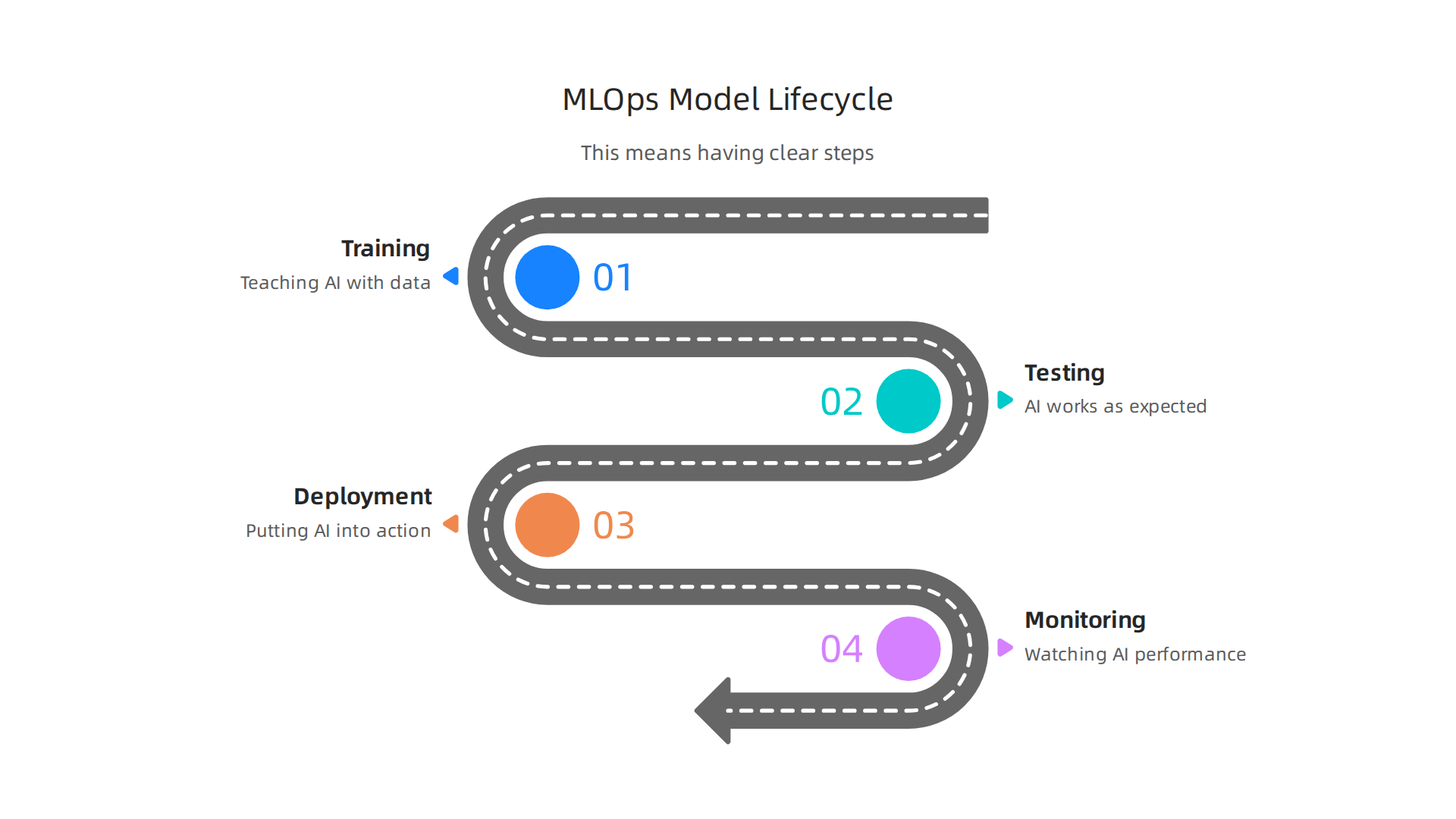
- Training: Teaching the AI with your prepared data.
- Testing: Making sure the AI works as expected before anyone uses it.
- Deployment: Putting the AI model into action so people can use it.
- Monitoring: Watching how the AI performs in the real world to catch any problems.
This full process ensures that the AI models are not just one-off projects but robust tools that grow and improve over time. An MLOps Architecture: End-to-End Design for Production provides a guide for this. When planning your enterprise LLM adoption in 2026, understanding this lifecycle is key to getting real value.
Production Infrastructure: The Home for Your AI
The systems and servers where your AI models live are called the production infrastructure. This is where the models run and deliver their smart features. Companies have a choice here: either run the models on their own systems (self-hosting) or use services from big cloud providers.
In-house Model Operations (Self-Hosted Models)
Running AI models on your own servers or private cloud gives you full control. This is important for sensitive data and unique business needs. Many companies choose to deploy self-hosted LLM deployment for enterprises to keep their data secure and meet strict company rules. This approach means your teams manage everything, including setting up the servers and keeping them running.
Managed Services
Alternatively, you can use managed services from cloud providers. They handle much of the technical work for you, like maintaining servers and ensuring uptime. This can be faster to set up, but you might have less control over the fine details.
Reliability and Observability
No matter which path you choose, two things are vital:
- Reliability: The AI system must work consistently without breaking down. For producer AI, this means setting up systems that can handle many users and recover quickly from any issues.
- Observability: This is about being able to see inside your AI system to understand how it’s working. Tools for observability help you track performance, find errors, and understand why certain decisions are made. This is like having a super-powered dashboard for your AI, going beyond simple monitoring to truly understand what’s happening, as discussed in What Is Observability Architecture.
Building these technical foundations correctly is what makes producer AI a powerful advantage, allowing companies to build AI for business impact in 2026.
Want to stay informed about the latest AI advancements and how they impact enterprises?
The AI Newsletter Worth Reading delivers clear daily updates from The Deep View Newsletter.
After building the strong technical foundation for your producer AI, the next big step is making sure people can actually use it well. This is where product and user experience (UX) design come in. It’s about making complex artificial intelligence simple and helpful for everyone in the company.
Product & UX Design for AI Producers: From Prompting to Continuous Improvement
Designing for producer AI means thinking about how people will talk to the AI, how the AI will show its work, and how it will keep getting better over time. It’s not just about cool tech; it’s about creating tools that truly make work easier and smarter for users.
Making AI Actions Clear and Easy to Use
Your AI models do smart things, but users need to understand what they are doing and how to guide them. Product and UX design translate the AI’s "brain" into features that people can interact with. For example, if your producer AI writes marketing emails, the design shows you how to give it instructions (often called "prompting") and how to review the drafts it creates.
In 2026, designers are focused on making these AI interactions feel natural. This involves figuring out what buttons, menus, and messages best help people work with generative AI use cases. It’s about designing how the AI behaves and how users control it, so the AI feels like a helpful teammate rather than a confusing machine.
Improving AI with Human Feedback
Producer AI isn’t perfect from day one. It needs to learn and get better. This is where "feedback loops" come in. These are ways for users to tell the AI what worked well and what didn’t. Think of it like teaching a new employee.
One key idea is "human-in-the-loop." This means that humans are actively involved in reviewing and approving the AI’s work, especially for important tasks.

For example, an AI might suggest a sales report, but a person needs to check it for accuracy before it’s sent out. Tools can track how the AI is used (this is called instrumentation), and then human experts can use that information to help the AI learn. This way, the AI gets smarter over time, with humans guiding its progress. As experts share, human judgment remains important in how AI processes are designed, especially for business uses in 2026, helping to build Human-in-the-Loop AI: Enterprise Oversight Design Patterns.
Building Trust with Safety Features and Controls
When companies use producer AI, trust and safety are very important. People need to feel confident that the AI will act responsibly. This means designing in "guardrails" or rules that stop the AI from doing something wrong or harmful. These guardrails help avoid issues when dealing with unfiltered AI outputs.
It also means making the AI more "explainable." Users should be able to understand, at least simply, why the AI made a certain decision or suggestion. This is like asking for the reasoning behind a report. User controls, such as options to adjust how the AI works or to correct its mistakes, are also key. These features help companies meet important rules and keep their data safe, all while helping to build building enterprise AI trust with human oversight and guardrails. By focusing on these design principles, businesses can make sure their producer AI is not just powerful, but also safe, reliable, and truly user-friendly.
Want to stay informed about the latest AI advancements and how they impact enterprises? The AI Newsletter Worth Reading delivers clear daily updates from The Deep View Newsletter.
When companies use producer AI, making it safe and easy to use is just the beginning. The next big step is to make sure everything follows the rules, stays secure, and meets legal standards. This is called governance, security, and compliance. It is super important, especially for businesses in regulated fields like banking or healthcare.
Finding and Fixing Risks with Producer AI
Using producer AI brings some new challenges. You need to identify what could go wrong. Think about these areas:
- Legal risks: Could the AI create content that breaks copyright laws? What if it makes decisions that are unfair or against regulations? This is a big deal, especially for AI governance policies for manufacturers in 2026 and other strict industries.
- Security risks: Is the data used by the AI safe? Can bad actors mess with the AI’s models or get sensitive information from them? Keeping AI systems secure is a must.
- Ethical risks: Will the AI act in a fair and unbiased way? Could it create outputs that are misleading or harmful, even by accident? These are the kinds of worries that come with using advanced tools.
Dealing with "unfiltered AI" outputs, which are raw and unchecked, can be especially risky. That’s why strong controls are needed to keep things safe and responsible.
Smart Ways to Control Producer AI
To handle these risks, companies need good governance. This means having clear rules and systems in place. Here are some practical steps:
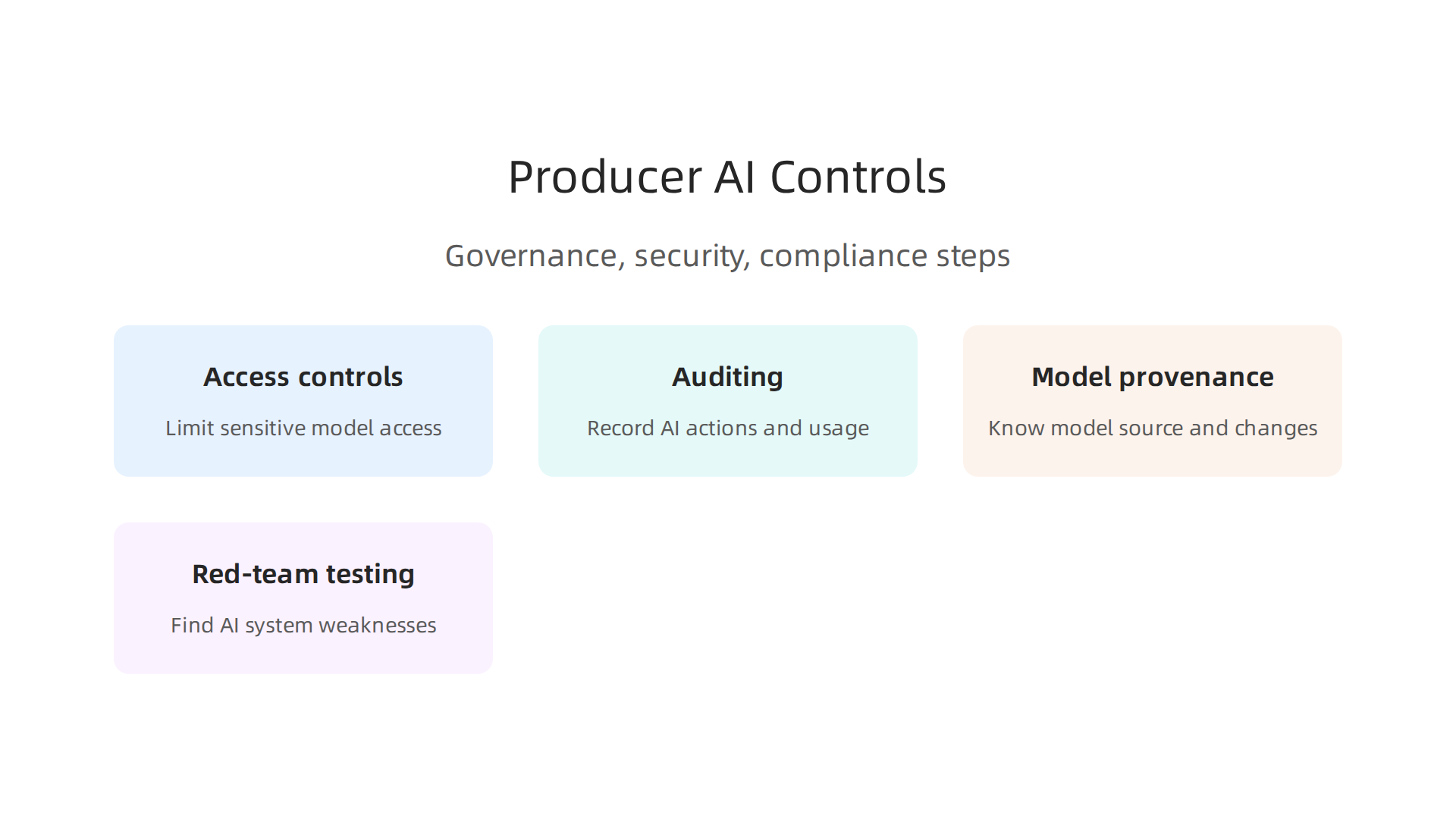
- Access controls: Only certain people should be able to train or use sensitive producer AI models. This stops unwanted changes or uses.
- Auditing: You need to keep a record of what the AI does and who uses it. This is like a logbook for the AI, helping you track its behavior and decisions.
- Model provenance: This means knowing where the AI model came from, what data it was trained on, and how it has changed over time. It is important to have a clear history for your AI, as explained in a guide to Mastering Enterprise AI Governance.
- Red-team testing: This is like hiring a group of ethical hackers to try and find weaknesses in your AI. They try to make the AI fail or do something wrong, so you can fix it before it causes real problems. This helps protect your models and data, as detailed in an AI security and governance guide.
Putting these controls in place helps make sure your producer AI is used wisely and safely.
Building Compliance from the Start
For AI systems to follow rules, compliance needs to be built into them from the very beginning. This includes how models are developed and how data moves through your systems, also known as Continuous Integration/Continuous Delivery (CI/CD) for models and data pipelines.
It means that as you build new AI tools or update existing ones, you always check for compliance. This ensures that every step of the process meets the needed legal and ethical standards. For example, making sure data is handled correctly is a big part of compliance, which you can learn more about in Data Governance Frameworks for AI Compliance. By thinking about governance, security, and compliance early on, companies can avoid big headaches later and use their producer AI with greater confidence. This is a key part of choosing the best AI for business 2026 enterprise strategy guide.
The previous section talked about making sure producer AI is safe and follows rules. Now, let’s talk about how to know if your producer AI is actually helping your business. You need to see if it’s worth the money and effort. This means looking at how well it works and if it helps reach your business goals.
Measuring Value: Metrics, ROI, and Business KPIs for Producer AI
To truly understand the value of your producer AI, you need to track how it is doing.

We can look at two main types of measures:
-
Leading Metrics: These are early signs of success. They tell you if people are using the AI and how they feel about it. For example:
- How many times do people use the AI tool?
- How fast does the AI give an answer or create content?
- Are users happy with the AI’s suggestions?
When thinking about these, remember that even advanced AI, like those using large language models (LLM) for generative AI use cases, often still needs human oversight. This "human-in-the-loop" approach, where people check and approve AI outputs, helps make sure the AI is accurate and useful. This is especially true with outputs that might come from "unfiltered ai" systems initially. Getting human feedback is key for improving how people use AI, as discussed in ideas about Usability in the Age of AI and when building AI product experiences with humans in the loop.
-
Lagging Metrics: These are the big-picture results that show real business impact. They come later and tell you if the AI is saving money or making more money. For example:
- Did the AI help reduce costs in a certain area?
- Did it make sales go up?
- Did it free up employees to do more important work?
These numbers directly show the return on investment (ROI).
Proving ROI to Stakeholders
Showing how your producer AI brings money back to the company is super important. You need clear ways to explain this to the people who make big decisions. Think of it like building a strong case:
- Start with the goal: What problem was the AI supposed to solve?
- Show the change: How did the numbers improve after using the AI?
- Connect to money: How did that improvement turn into saved costs or new income?
This helps everyone see the real value, like in guides for enterprise LLM adoption in 2026 how to deploy fine tune and measure ROI.
Common Pitfalls When Attributing Business Outcomes to AI
It can be tricky to figure out exactly how much of a business change came only from the AI. Sometimes, many things are happening at once in a company.
- Too many changes: If you change a lot of things at once, it is hard to know which change made the difference.
- Short-term vs. long-term: AI might show small wins early, but the big money savings might take longer to appear.
- Hidden costs: Do not forget the costs of keeping the AI running and updated.
To avoid these, try to test your producer AI in small, controlled ways first. That way, you can see its impact more clearly. It is all about making smart choices for your business. For more daily insights into the world of AI, you can sign up for The AI Newsletter Worth Reading.
After you know how well your producer AI is working and if it is worth the money, the next step is to make sure your company has the right people and systems in place to make it grow. This means looking at your team, how they work together, and how you bring new AI tools into your business.
Team, Talent & Operating Models: Scaling Producer AI in the Organization
Bringing producer AI into your company needs more than just good software. It needs the right people and a smart plan for how everyone works with AI. This helps you use AI for many different things, like complex generative AI use cases that need careful handling.
Building the Right Team and Skills
To truly grow your producer AI efforts, you will need special kinds of people.
- ML Engineers: These folks build and maintain the actual AI models. They make sure the artificial intelligence works as it should.
- Data Product Managers: They help figure out what problems the AI should solve and make sure the AI tools meet business needs. Think of them as the bridge between what the business wants and what the AI can do. You can learn more about finding these key roles in guides like Mastering remote hiring for technical product manager jobs in 2026.
- Platform Engineers: These engineers create and manage the systems that let AI models run smoothly and safely across the company. Their work is key for scaling any AI project. To dive deeper into this role, check out Platform engineering in 2026: a strategic guide for CIOs and CTOs.
You can hire new people for these roles, or you can help your current employees learn these new skills. This is called upskilling, and it is a great way to build your team from the inside. Knowing the 2026 AI jobs landscape can help you plan.
Choosing How Your AI Teams Work
When you scale producer AI, you also need to decide how your teams will be set up. There are two main ways:
- Centralized AI Platform: This means one main team builds and manages all the AI tools and services for the whole company. Other teams then use these shared tools. This can be good for keeping things standard and easy to manage.
- Embedded AI Squads: Here, smaller AI teams work directly within different business units. For example, a marketing team might have its own AI experts. This helps the AI tools be very specific to each team’s needs.
Both ways have pros and cons, and the best choice depends on how your company likes to work.
Managing Change and Picking the Best Vendors
Bringing producer AI into a company also means people might need to change how they work. It is important to help everyone understand why these changes are good and how to use the new tools. This is called change management.
Sometimes, you might need to buy AI tools or services from outside companies. This is called vendor selection. It is important to pick the right partners. When you are looking for AI vendors, make sure you:
- Define Your Needs: Know exactly what you want the AI to do for your business.
- Check Their Tech: Make sure their AI solutions are good, secure, and can explain how they work. Guides like the AI Vendor Evaluation Checklist can help you ask the right questions.
- Look at Governance and Compliance: Ensure the vendor’s tools follow all the rules and privacy laws, especially for important data. A complete guide to Mastering Enterprise AI Governance can offer insights here. Also, consider the AI Vendor Contract Requirements: A 2026 Checklist to protect your company.
- Consider Future Growth: Can their tools grow with your business?
Choosing the right producer AI vendors and managing how your company adopts these new tools are big steps towards making AI a true success.
Summary
Producer AI is the practice of building, controlling and deploying AI systems tailored to a company’s specific data, rules and business goals rather than relying on generic consumer models. This article explains what producer AI means for enterprise product leaders and technical teams, contrasts it with foundation models and public AI, and walks through the practical elements needed to succeed: product vision, ML engineering, platform and infrastructure choices, data pipelines, MLOps, observability, UX design with human-in-the-loop patterns, and governance and compliance. It covers real generative-AI use cases—customer service, internal search, personalized marketing—and describes how to measure impact with leading and lagging metrics to prove ROI. The piece also outlines team structures, talent needs, vendor selection and common risks to watch for, giving leaders a checklist-style roadmap to move projects from pilots into trusted, scalable production systems. Read it to learn the technical and organizational steps that turn AI experiments into secure, measurable business capabilities.