Mastering Software Development Agile for Enterprise Leaders in 2026

Creating software for big businesses in 2026 is a tricky job. These projects are huge, need to move very fast, and come with big risks. When companies try to build large computer systems, they often find it hard to keep everyone on the same page. Making sure new tools work well with old ones can be a big headache, too.

In fact, more than half of teams say figuring out how to connect new tools is their biggest problem when trying new ideas like AI in their work, according to a 2026 report on AI and agile practices [https://www.scrum.org/resources/blog/ai4agile-practitioners-report-2026].
Many companies struggle with how to get their large teams to work together smoothly. They need to deliver new features quickly to stay ahead, but the old ways of working can slow them down. This is where the idea of software development agile comes in. Agile is a way of working that helps teams break down big projects into smaller, easier steps. It allows them to quickly adapt to changes and get things done faster.
However, using the agile software development methodology in a big company can be tough. Leaders often see challenges like people not wanting to change how they work, or not enough support from management. Studies show that a large number of leaders still face these kinds of issues when trying to use agile ways of working [https://staragile.com/blog/state-of-agile]. It’s a common problem for enterprises to have their culture clash with agile values, making it hard to make big changes [https://www.eg.bucknell.edu/~cs479/common-files/resources/versionone-state-of-agile/versionone-12th-annual-state-of-agile-report.pdf].
This guide is here to help you understand why your enterprise team still needs software development agile and how to make it really work for a large company. We will give you proven ideas, smart ways to work, and simple checklists. These will help leaders like you guide your teams to build amazing universal software solutions and manage your business management software systems better. It’s all about making sure your company can build fast, adapt quickly, and lower risks.
Want to stay informed about how AI is changing technology every day?
Get clear daily AI updates from The Deep View Newsletter
Why Agile Matters for Enterprise Software (business outcomes)
Even with challenges, using software development agile methods in big companies is super important for staying competitive in 2026.
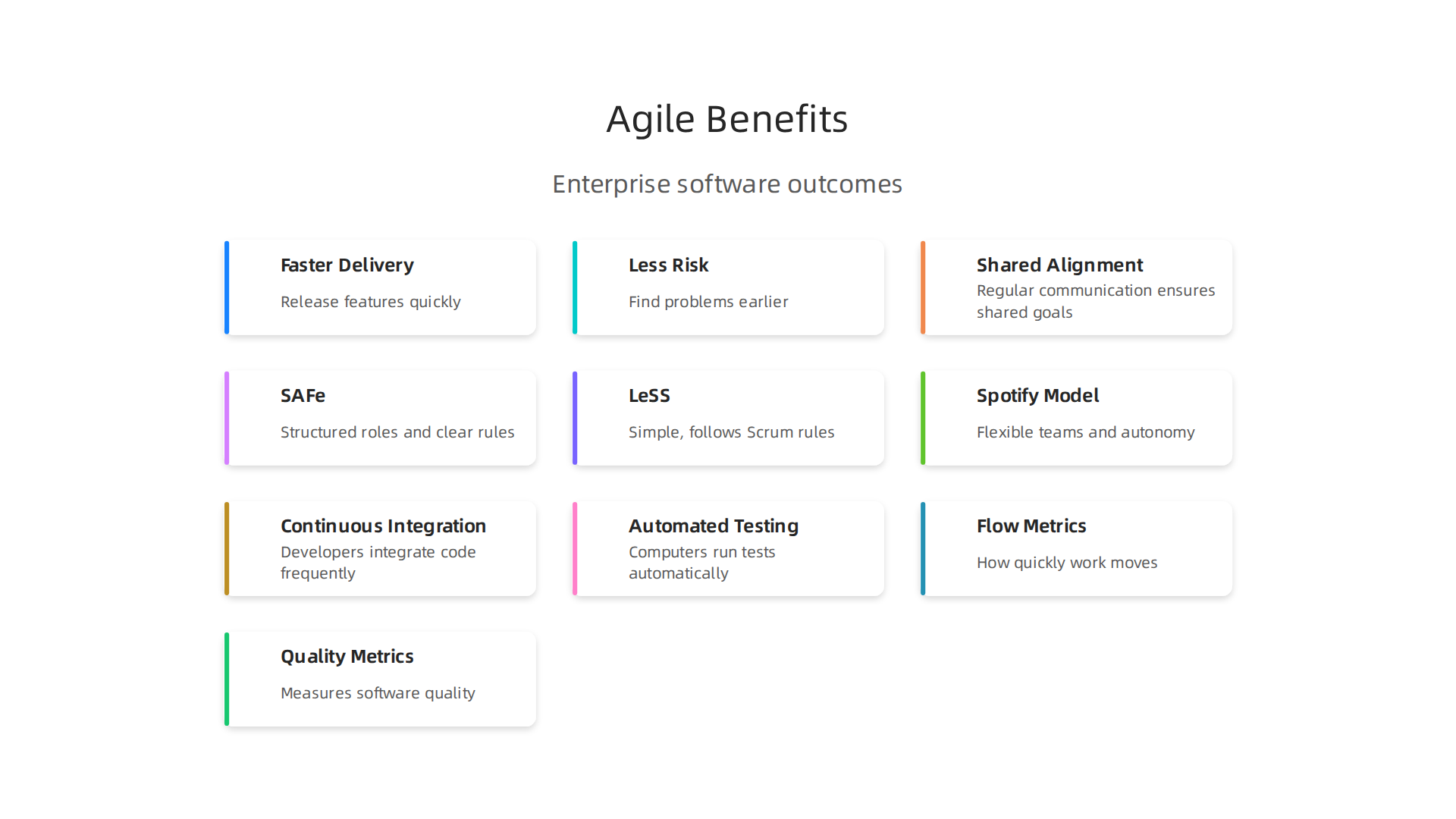
It’s not just a fancy way to work; it brings real benefits to how your business runs and how well your software works.
Here are some big reasons why agile matters for your enterprise:
Faster Time-to-Market
One of the best things about the agile software development methodology is that it helps you get new products and features out much faster. Instead of waiting a long time to build everything at once, agile teams work in short bursts, called sprints. They release small parts of the software regularly. This means your customers get to use new things sooner, and your company can react quickly to what the market needs. Reports show that agile helps with faster delivery and better team work, according to the VersionOne 11th Annual State of Agile Report. To dive deeper into this, you can learn how to accelerate enterprise software delivery with agile SDLC.
Less Risk, More Control
Building big universal software solutions for a company can be risky. What if you spend a lot of time and money, and the final product isn’t what people wanted? Agile helps lower these risks. Because teams build and show small parts often, they can find problems and make changes early. This means less money is wasted on things that don’t work, and it’s easier to fix mistakes before they become big issues. It makes creating business management software systems much safer.
Everyone is on the Same Page
Agile means constantly talking with everyone involved, from the people building the software to the business leaders and even the customers. This regular communication helps make sure everyone understands what’s being built and why. When everyone has a clear and shared goal, it’s easier to make decisions and keep the project moving forward smoothly. This leads to better software that truly meets the needs of your business and its users.

It’s important to remember that simply doing "agile practices" is different from doing "agile at scale." Just using some agile tools or meetings won’t give you all these benefits in a large company. For big enterprises, agile needs to fit into your whole organization. The way your company is set up and how it works together will change how well agile can deliver these amazing outcomes. It’s about how your entire organization embraces this way of working, not just a few teams.
When a big company wants to use software development agile methods, it’s a bit like getting many small boats to move as one giant ship. This idea is called "scaling agile." It means taking the great ideas of agile and making them work for a whole big business, not just one team.
However, scaling agile is not always easy. Many big companies face challenges like making sure all teams work well together and use the same good practices. In 2026, reports still show that a company’s culture and its natural dislike of change are big problems when trying to scale agile. For example, about 46% of organizations find general resistance to change to be a hurdle, and over half report their organizational culture clashes with agile values, according to the 12th Annual State of Agile Report.
Scaling Frameworks and Their Trade-offs
To help big businesses become more agile, special frameworks have been created.
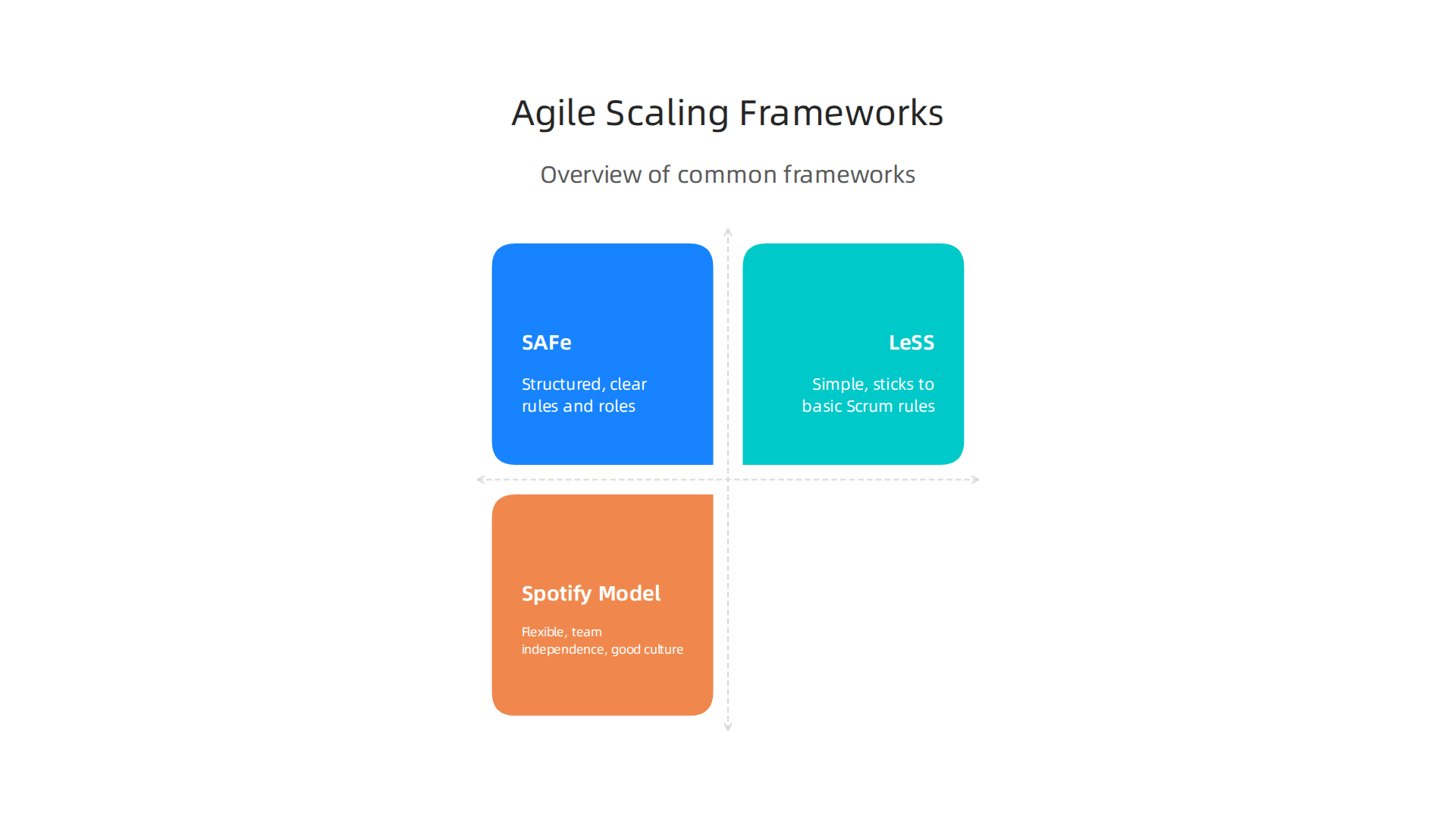
These frameworks are like helpful guides for how a large company can use the agile software development methodology across many different groups. Some well-known ones include:
- SAFe (Scaled Agile Framework): This framework is very structured. It has clear rules and roles, which can be good for very large companies or those in strict industries. SAFe helps many teams work together on big projects, making it easier to reach company goals and produce good software quickly, by scaling Scrum to the enterprise level. You can learn more about choosing the right framework to scale agile by comparing different models in detail, such as in this guide on Choosing the Right Agile Framework.
- LeSS (Large-Scale Scrum): This framework tries to keep things simple and sticks closely to the basic Scrum rules, even when many teams are involved. It gives teams more freedom to decide how they work best.
- Spotify Model: This is more like a set of ideas about how Spotify organized its teams, focusing on team independence and good culture. It’s often seen as a very flexible way to work.
Choosing between these frameworks means thinking about what you need most. Do you want lots of control and clear steps (heavy governance)? Or do you want more freedom for teams to figure things out themselves (lightweight coordination)? Many companies find that a mix works best for their business management software systems. A study from 2022 looked at how different large-scale agile methods, like SAFe and the Spotify model, compare in their practices and principles, showing there are many ways to make agile work for big companies. For a deeper look at these options, you can read more in Comparing Methods for Large-Scale Agile Software Development.
Structural Options for Large-Scale Agile
No matter which framework is chosen, getting the whole company on board is crucial. This means setting up how teams work together at different levels:
- Program-level coordination: This is when groups of agile teams work together on a larger goal, like building a specific universal software solution or a big new feature.
- Value streams: This way of working focuses on delivering value directly to customers. All the teams involved in creating a specific product or service work together to make sure that value flows smoothly and quickly to the end-user.
- Portfolio alignment: This makes sure that all the projects and software being built help the company reach its most important business goals. It connects the big plans of the business to the daily work of agile teams, ensuring everyone is pulling in the same direction.
Finding the right balance for your organization takes careful thought. It’s about how your entire organization truly lives and breathes this way of working. For leaders navigating complex technology landscapes, staying updated is key.
Stay informed about the fast-changing world of enterprise technology, especially as AI continues to shape how businesses operate. Get insights directly to your inbox with The AI Newsletter Worth Reading.
To truly live and breathe agile ways of working, especially in complex technology landscapes, big companies need a strong plan for their software architecture. This plan helps them balance working fast with making sure everything stays stable.

It’s about how your business management software systems are built to be flexible enough for quick changes but also reliable and secure. Achieving this balance is a core part of succeeding with an agile software development methodology in 2026.
Architectural Patterns for Speed and Stability
When using software development agile methods, companies want to build things quickly. But they also need their software to work well all the time. Here are some smart ways to build software that helps with both:
- Modularity: This means breaking down a large software system into many small, independent parts. Think of it like a big LEGO castle made of smaller, separate sections. Each team can work on their small section quickly without messing up the other parts. This makes it easier to change just one part without affecting the whole system.
- APIs (Application Programming Interfaces): These are like clear instruction books that tell the different small software parts how to talk to each other. They set rules for how information should be shared. This way, teams can build their parts knowing exactly how they will connect with other parts, creating smooth interactions across all your universal software solutions.
- Platform Teams: These are special teams that build and take care of shared tools and services that all other software development teams use. Imagine them as the builders who create the strong foundations and common parts for all the LEGO castles. This helps other teams work faster because they do not have to build everything from scratch. For more on this, you can look into a strategic guide on platform engineering in 2026.
Guardrails for Reducing Risk
Even with these patterns, large companies need ways to make sure everything works together without problems. These are called "guardrails":
- Standards: These are agreed-upon rules for how software should be built and what quality it needs to have. Everyone follows the same set of guidelines for important parts. This helps make sure new software fits well with what’s already there and works predictably.
- Contracts: These are clear promises between different parts of the software (and the teams building them) about how they will behave. For example, one part might promise to send data in a certain way, and another part will expect to receive it exactly like that. This reduces surprises and makes sure parts integrate correctly.
- Automated Verification: This means using computer programs to automatically check if the software works as it should and follows all the rules. It’s like having a robot constantly checking for mistakes. This helps find and fix problems early, which reduces "integration risk" when many parts come together. Implementing an agile approach successfully at scale requires careful thought about both flexibility and control, as highlighted by resources on Agile at scale.
DevOps, CI/CD and Tooling for Agile at Scale
Building on top of smart software design and clear rules, big companies also need powerful tools and ways to automate things. This is where DevOps and CI/CD come in. They are like the special engines that make your software development agile methods run super fast and smooth.
Essential Automation for Speed
DevOps (short for Development and Operations) is a way of working that brings software builders and the teams who run the software much closer.
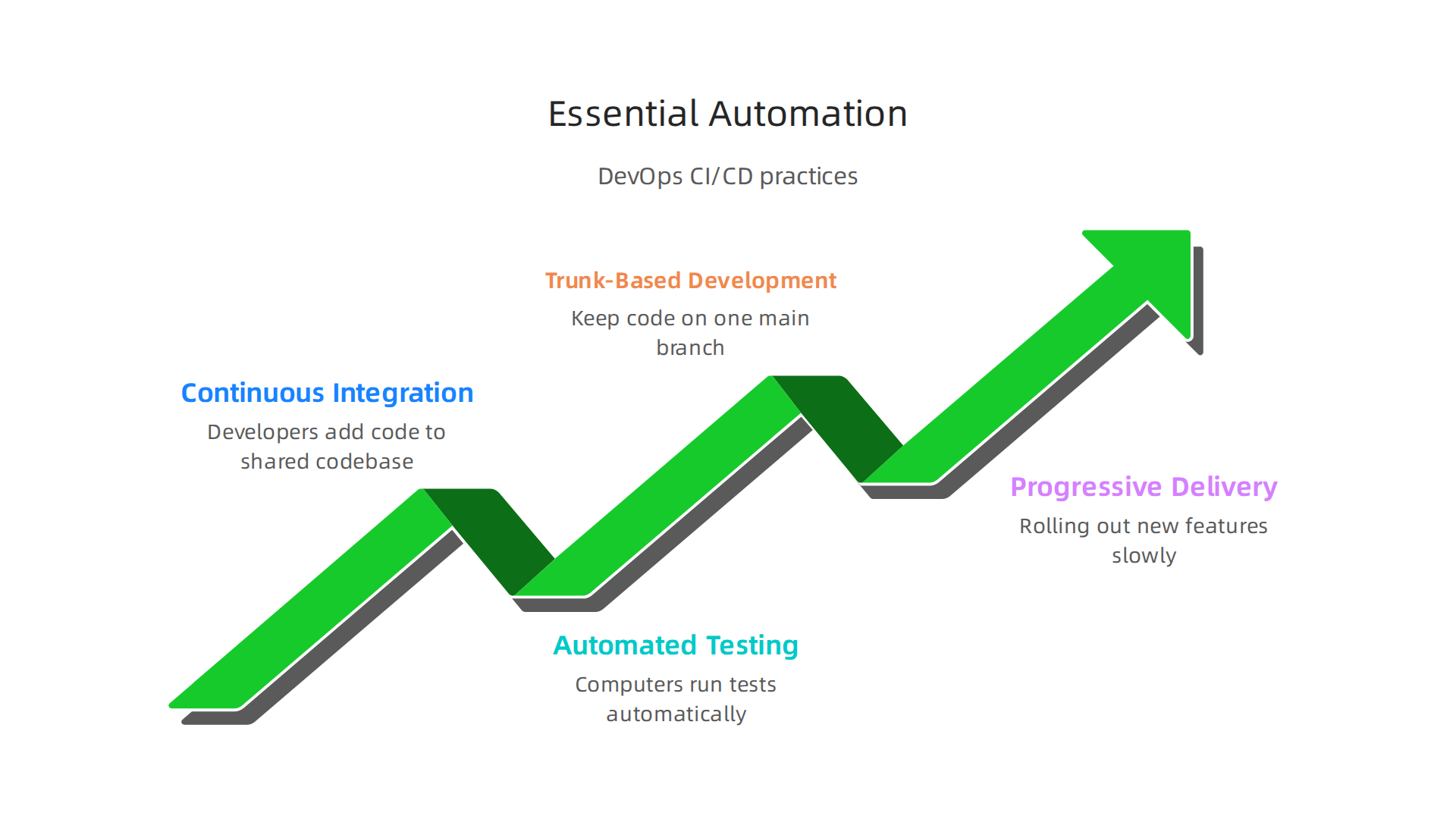
CI/CD (Continuous Integration and Continuous Delivery/Deployment) are key parts of this. They are about automating the steps to build, test, and release software.
Here is how these help:
- Continuous Integration (CI): This means that developers often add their new code changes to a main shared codebase. Each time they do, automated checks run to make sure everything still works together. This helps find problems early, instead of letting them pile up.
- Automated Testing: Computers run tests automatically to check if the new code breaks anything or if the software does what it is supposed to. This saves a lot of time and makes sure the software is reliable.
- Trunk-Based Development: This is a way of working where all developers keep their code on one main "trunk" or branch. This reduces the time spent merging different code versions and helps teams work faster.
- Progressive Delivery: This means rolling out new software features slowly and safely. For example, a new feature might only be shown to a small group of users first. If all goes well, it’s then given to everyone. This helps reduce risks when putting new features into your
business management software systems.
These practices are super important to accelerate enterprise software delivery with agile SDLC in 2026.
Smart Tools and Security Checks
To make DevOps and CI/CD work well at a large company, you need the right tools. These tools help keep things safe and easy to track for all your universal software solutions.
- Security Scanning: It’s vital to check for security problems early and often in the building process. Tools can automatically scan your code for weaknesses. This helps fix security flaws before they become big issues. You can learn more about this in a guide on automating security scans in your CI/CD pipeline.
- Observability: This means having good ways to see what your software is doing at all times, even after it’s released. It’s like having many sensors that tell you if everything is working right. This helps teams quickly find and fix problems.
- Governance Automation: This is about using tools to make sure your software follows all the company rules and quality standards automatically. It’s an automatic guardrail for your software.
Companies measure how well they are doing with DevOps using key metrics like those in the DORA framework, which looks at things like how often software is deployed and how quickly problems are fixed. These are important for checking your DORA Metrics to Measure DevOps Performance and ensuring your agile software development methodology is truly effective.
Staying on top of these trends is key for any leader.
Get clear daily AI updates from The AI Newsletter Worth Reading.
After setting up powerful tools and ways to automate things with DevOps and CI/CD, the next big step for companies is to know if all that effort is actually working. This means carefully measuring success. It is not just about how fast you build software; it is also about building the right software, with good quality, and making sure it helps the business.
A Balanced Look at What Matters
To really understand how well your software development agile methods are performing, you need a balanced set of numbers, or metrics. Think of it like checking many different dials in a car, not just the speed.
Here are the kinds of metrics that help:
- Flow Metrics: These tell you how quickly work moves through your system. For example, how long does it take for a new idea to become a usable feature for customers? This includes things like deployment frequency (how often you release new code) and lead time for changes (how fast a change goes from code to customers). High-performing teams often deploy many times a day and have changes live in less than an hour, as noted in reports on software delivery performance metrics.
- Quality Metrics: These measure how good your software is. Are there many bugs? How often do new releases cause problems? A key metric here is the change failure rate, which tracks how often a new deployment causes a problem that needs to be fixed right away. You also look at how quickly you can fix problems when they do happen, known as time to restore service, according to the State Of Dev Ops Report.
- Business Outcome Metrics: This is where you see if your software is actually helping the company reach its goals. Are customers using the new features? Is it saving money or making more money? Are employees happier and more productive using the new
business management software systems? These show the real-world value. - Risk Indicators: These help you spot potential problems before they become big issues. Are there security flaws being found too late? Are teams getting overwhelmed? Are you relying too much on one person for a key part of the
universal software solutions?
By looking at all these different areas, you get a much clearer picture than if you just focused on one thing.
Using Metrics for Smart Governance
The trick with metrics is to use them to guide teams, not to punish them. If you only focus on speed, teams might rush and create buggy software. If you only focus on no bugs, they might become too slow.
Good leaders use these metrics to:
- Spot Trends: See if things are getting better or worse over time.
- Find Bottlenecks: Figure out where work is getting stuck or slowing down.
- Help Teams Improve: Work with teams to understand why certain numbers are what they are, and then find ways to get better. This supports a true
agile software development methodology. - Make Decisions: Use the data to decide where to invest more time or resources.
The goal is to encourage continuous improvement and learning, making sure your agile software development methodology truly helps the business grow. If you are looking to deepen your understanding of these methods, consider exploring how to further enhance your strategies for mastering agile software development for enterprise technology leaders.
The goal is to encourage continuous improvement and learning, making sure your agile software development methodology truly helps the business grow. But this growth and learning don’t happen just by tracking numbers; they also depend on people, culture, and how a company is set up. To make the most of software development agile ways, companies need to change how leaders behave, how jobs are defined, and how they find and keep skilled workers.
Organizational Change: Culture, Roles, and Closing the Talent Gap
For software development agile methods to really shine, a company’s culture must support them. This means changing old ways of thinking and working. One big part is how leaders lead. Instead of telling people exactly what to do, good agile leaders give their teams clear goals and then let them figure out the best path.

This shift is very important because traditional leadership styles often get in the way of agile success. Studies have shown that leadership disconnection and cultural resistance are core obstacles to successful agile adoption. Instead, effective agile leaders align teams, empower them, and constantly seek feedback to improve, as highlighted in insights on Is Your Leadership Your Agile Blindspot?.
As companies become more agile, new jobs show up, and old jobs change. For example, "product operations" (or product ops) roles help product teams work smoothly. "Platform teams" build common tools and services that many other teams can use. These new roles help everyone work better together across the company. Understanding these evolving jobs is part of mastering platform engineering in 2026. It’s also about making sure career paths are clear so people know how they can grow within these new structures.
Actually, finding and keeping skilled people for new jobs, especially in agile and AI, is tough in 2026. A 2026 report states that almost 70% of HR professionals struggle to hire for full-time positions. The skills needed for jobs are changing very fast, sometimes in less than four years. So, companies must focus on three key areas:
- Recruit: Actively find new people with the right skills.
- Upskill: Teach current employees new skills for
universal software solutionsand AI. However, finding good training content and having enough time for learning are big problems for training programs this year, according to a 2026 report on The State of Workplace Learning. - Retain: Keep good employees happy so they don’t leave. Building a positive company culture and focusing on how employees can quickly learn new skills, known as talent agility, are very important here.
Making these changes in culture, roles, and talent strategy helps build a strong foundation for agile software development methodology to thrive and deliver real business value. To keep up with fast changes in AI and technology, leaders need to stay informed. Get clear daily AI updates from The AI Newsletter Worth Reading.
Adopting Agile with AI and Cloud-Native Trends (2026)
Building a strong foundation for agile software development methodology means always looking at new tools and ways of working. In 2026, Artificial Intelligence (AI) and cloud-native platforms are changing how teams do software development agile work. These new technologies make processes faster and smarter, which changes how teams make choices and get things done.
AI-driven tools are now helping a lot with different parts of making software. For example, AI can write much of the new code. Reports from 2026 show that a big chunk of new code, even at large companies like Google, is now made by AI. This means the job of a developer is changing. They now spend less time writing every line of code themselves and more time guiding AI tools, setting up quality rules, and making sure everything works right automatically. This shift helps speed up the work, but it also means that old ways of checking code, security, and releasing new software might not be fast enough for AI-driven speeds.
Cloud-native platforms also make a big difference for software development agile teams. They allow teams to build and run applications in a way that is flexible and can grow easily. Using tools like containers and automated deployment pipelines, teams can put out new software much faster and more often. These ways of working together mean quicker feedback loops and a quicker response to what customers need. This helps achieve goals for better software delivery. For instance, putting security checks into these automated pipelines very early helps catch problems sooner, making the software safer overall.
However, using AI in agile software development methodology also brings new needs. We must make sure that AI tools are used safely and correctly. This means setting up clear rules for how AI experiments happen in agile cycles. It’s important to build trust in AI systems by making sure there’s human oversight and proper safeguards. One way to do this is by using a model that includes special AI controls for the software development process, along with "policy-as-code." This means rules are written directly into the code, helping to keep everything fair and compliant. Strong governance is key. By doing this, AI becomes a helpful tool that makes rules stronger, not a replacement for them. To make sure your software delivery is fast and stable, it is important to accelerate enterprise software delivery with agile SDLC practices.
Summary
This article explains why adopting an agile software development methodology remains critical for large enterprises in 2026 and shows how to make it work at scale. It reviews the core business benefits—faster time-to-market, lower risk, and clearer alignment across stakeholders—and outlines practical choices for scaling (SAFe, LeSS, Spotify-style), organizational structures (programs, value streams, portfolios), and architecture (modularity, APIs, platform teams). The guide covers the technical foundation too: DevOps, CI/CD, automated testing, security scanning, and observability that enable rapid, safe delivery. It also explains which metrics to track—flow, quality, business outcomes, and risk indicators—and how leaders should use them to guide improvement, not punish teams. Finally, the article addresses people and culture: new roles, upskilling, and hiring challenges, and shows how AI and cloud‑native trends change both tools and governance for enterprise agile.